Web development fundamentals
HTML, CSS, responsive design, page structure and the styling behind a modern website.
What this module covers
4 topics
- 01HTML structure
- 02CSS styling
- 03Responsive design
- 04Page layout
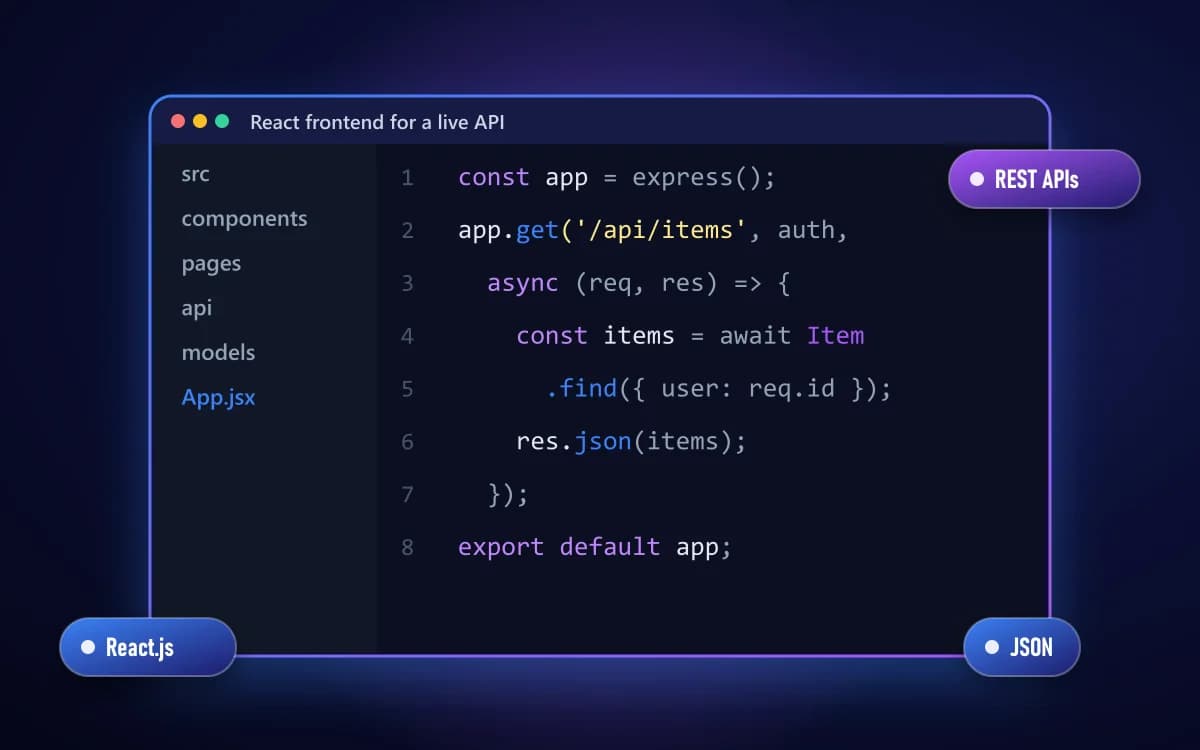
MongoDB, Express, React and Node — one language end to end, from first component to a deployed full stack application.
5 Months
Programme length
Intermediate
Difficulty level
Classroom & live online
Format
Certificate
On completion

Admissions open
Free demo class & counselling
Session slots
A 5 Months, intermediate programme taught at our Hoshiarpur centre in Model Town and live online, with live projects and placement support built in.
Start your full-stack career with structured MERN training in Hoshiarpur. You build modern web applications with MongoDB, Express.js, React.js and Node.js, alongside JavaScript, REST APIs, databases and real project work. Designed to take beginners through to industry-ready: the track starts at web fundamentals and finishes with a complete, authenticated, deployed application.
Key course facts
Core tools covered: HTML & CSS • JavaScript • React.js • Node.js • Express.js • MongoDB • Mongoose • Git & GitHub
Certificate on completion
Awarded when you finish the course
Live project work
Built into the course, for your portfolio
Placement support
Included with every course
Morning, evening & weekend batches
At the centre or live online

MERN Stack Development
5 MonthsIntermediateHoshiarpur & live online
4.9 / 5
168 reviews
Classroom & live online
Morning, evening & weekend
12 modules and 48 topics across 5 Months, in the order you learn them. Open any module to see what it covers.
HTML, CSS, responsive design, page structure and the styling behind a modern website.
What this module covers
4 topics
Variables, data types, operators, functions, arrays, objects, conditions and loops, with coding practice throughout.
What this module covers
4 topics
ES6+ features, arrow functions, destructuring, spread, promises, asynchronous programming and modules.
What this module covers
4 topics
Components, JSX, props, state, events, conditional rendering, lists and forms.
What this module covers
4 topics
Hooks, React Router, the Context API, API integration, forms and state management in an interactive application.
What this module covers
4 topics
Node.js fundamentals and backend development with Express — routing, middleware, controllers and server-side JavaScript.
What this module covers
4 topics
Collections, documents, CRUD, queries, relationships and managing data inside a web application.
What this module covers
4 topics
Building and consuming REST APIs — HTTP methods, JSON, the request-response cycle and frontend-backend communication.
What this module covers
4 topics
User registration, login, password handling, JWT authentication, authorisation and route protection.
What this module covers
4 topics
Integrating a React frontend with Node.js, Express and MongoDB into one complete database-driven application.
What this module covers
4 topics
Version control, repository management, collaborating on a project and deploying a full stack application.
What this module covers
4 topics
MERN projects, debugging, portfolio building and interview preparation.
What this module covers
4 topics
What you can do by the end of the course — each one practised in class and in the projects you build.
6
skills, start to finish
Web development and JavaScript fundamentals
React frontend development
Node.js and Express.js backend development
MongoDB and database management
REST APIs, authentication and Git
Full stack projects and deployment
Tools covered in this course: HTML & CSS, JavaScript, React.js, Node.js, Express.js, MongoDB, Mongoose, Git & GitHub, REST APIs & JSON, JWT Authentication, React Router, VS Code, NPM & Package Management, Deployment & Hosting.
Every course includes live projects. These are the ones you finish this course holding — built in class and kept for your portfolio.

Components, routing and state management, rendering data fetched asynchronously.
Skills practised Components, Hooks, API integration

Express and MongoDB behind registration, login, JWT sessions and protected routes.
Skills practised REST design, Authentication, CRUD

A complete database-driven application — React front end, Express API, MongoDB, deployed and version-controlled.
Skills practised Full stack architecture, Deployment, Git workflow
Counselling and the demo class are free. Come to the Hoshiarpur centre in Model Town or join live online, in a morning, evening or weekend batch.
Begin with web development fundamentals and progress through frontend and backend with MongoDB, Express.js, React and Node.js.
Write code, build components, create APIs, connect databases and ship full stack applications rather than working from theory.
Work hands-on with MongoDB, Express.js, React, Node.js, JavaScript, REST APIs, Git and GitHub.
Build frontend and full stack projects that show how modern applications work, and that belong in your portfolio.
Coding sessions, development sessions, worked examples, debugging and doubt solving.
Build the skills internships, interviews, freelancing and software development roles actually ask for.
12
Modules
5 Months
Course duration
Online / Offline
Mode of learning
Free
Counselling & demo class
The stack only clicks when one language carries you from a button click to a database write. The sessions are built around that path, so every concept lands attached to an application you are already running.
Go beyond theory with coding exercises, assignments, application development and projects.
Start with web development fundamentals and move gradually into frontend and backend development.
Work with React.js, Node.js, Express.js, MongoDB, Git, GitHub and APIs.
Build applications that strengthen problem solving, development experience and your portfolio.
Live demonstrations, coding, problem solving, debugging and development support.
Full stack programming and project skills for interviews, internships, freelancing and software development.
The course is built for learners arriving from different starting points.
Kick-start your web development career by learning JavaScript, React, Node.js and database concepts through coding.
Sharpen your development skills by building with MERN technologies and real projects.
Learn frontend and backend together and build complete, dynamic web applications.
Move into the IT industry with practical full-stack skills in current technologies.
Extend your JavaScript across frontend, backend, APIs and database-driven applications.
Eligibility
Not sure whether your background fits? Counselling is free — tell us your background and goal and we will suggest the right batch, with no obligation.
The stack you work with in class and in the live projects.
Finishing MERN Stack Development puts three separate documents in your file — each one for a different part of what you did.
Awarded when you complete the MERN Stack Development programme. Where the track has a recognised vendor exam, we prepare you for that as well.
For the live project you build during MERN Stack Development, naming the work and the tools you used — so the project on your CV is backed by paper, not just claimed.
Take your training as a university internship and you finish with an internship letter covering your weeks on a project team.
See internship trainingIllustration — ask to see a real certificate at the centre.
How the paper is used
The roles MERN Stack Development prepares you for, and the kinds of employers who use these skills. Outcomes depend on your own work and the market — we prepare you for interviews, we do not promise a job or a number.
Build full stack web applications with MongoDB, Express.js, React.js and Node.js.
Create interactive, responsive interfaces with React.js, JavaScript, HTML and CSS.
Build server-side applications, APIs, authentication systems and database-driven solutions.
Work across frontend, backend, APIs and databases on complete web applications.
Build modern, interactive frontend applications with React.js and its ecosystem.
Build backend services, APIs and server-side applications with Node.js.
Develop and improve software and web-based applications using full stack programming.
Placement support comes with every course — portfolio review, mock interviews and guidance on where to apply.
Talk about placementsMost MERN Stack Development courses cover a similar syllabus. What separates them is what you build while you are there, and what happens after the last session.
At techcadd: Every module ends in built work, and the course finishes with a portfolio project that goes through review.
At most places: Varies — worth asking whether you finish with work you can show.
At techcadd: A completion certificate when you finish the course.
At most places: Varies from course to course.
At techcadd: Included with the course: portfolio review, mock interviews and preparation for the roles you are targeting.
At most places: Worth checking what is included and what is extra.
At techcadd: Free career counselling and a free demo class, with no registration fee.
At most places: Not always offered before enrolment.
At techcadd: At our Model Town centre in Hoshiarpur or live online — the same material, and you can switch if your schedule changes.
At most places: Often one format only.
At techcadd: Small batches in morning, evening and weekend slots, with direct access to your trainer.
At most places: Timings and batch sizes differ.
Compare us on the same points before you enrol anywhere — sit a demo class and ask to see the project work students finish with.
Students of MERN Stack Development, on what made the difference for them.
4.9
168 ratings
The capstone was the closest thing to a real job I had done. Architecture decisions, review comments, the lot.
Being pushed to write tests early changed how I work. It came up in every interview I sat.
Still unsure? A ten-minute call with a counsellor usually settles it faster than any brochure.
Ask us directly
What the call covers
Counselling and the demo class are both free.
Anyone comfortable with basic programming. If you have never written JavaScript, start with Full Stack Web Development instead — it covers the fundamentals first.
Basic programming logic and some HTML/CSS exposure. The first modules cover web fundamentals and the JavaScript you need.
Both. Batches run at the Hoshiarpur campus and online, covering identical material, so you can switch format if your schedule changes.
Yes. Scheduled doubt sessions run alongside the batch, and mentor hours continue after you finish the programme.
Yes. You receive a techcadd completion certificate once you finish the course and its final assessment.
Yes. Every module ends in work you complete yourself, and the course finishes with a portfolio project your trainer reviews with you.
Send your question and a counsellor will call you back — batch timings, fees, placement support, certification. No obligation to enrol.
We use your number only to answer this enquiry.
6 Months
Front to back, database to deploy — build and ship complete web applications.
3 Months
Frontend to backend — HTML, CSS, JavaScript, React, Node.js, databases and deployment, ending with applications you have shipped.
2 Months
Design and build websites that look right and work on every screen — HTML5, CSS3, JavaScript, Bootstrap and responsive layout.
4 Months
SEO, local search, social, paid ads, content and analytics — planned, run and measured on real campaigns.
Beyond the syllabus
Ready to get started?
Talk to a counsellor about MERN Stack Development. One call is usually enough to know which track fits your background, your schedule and the job you want.