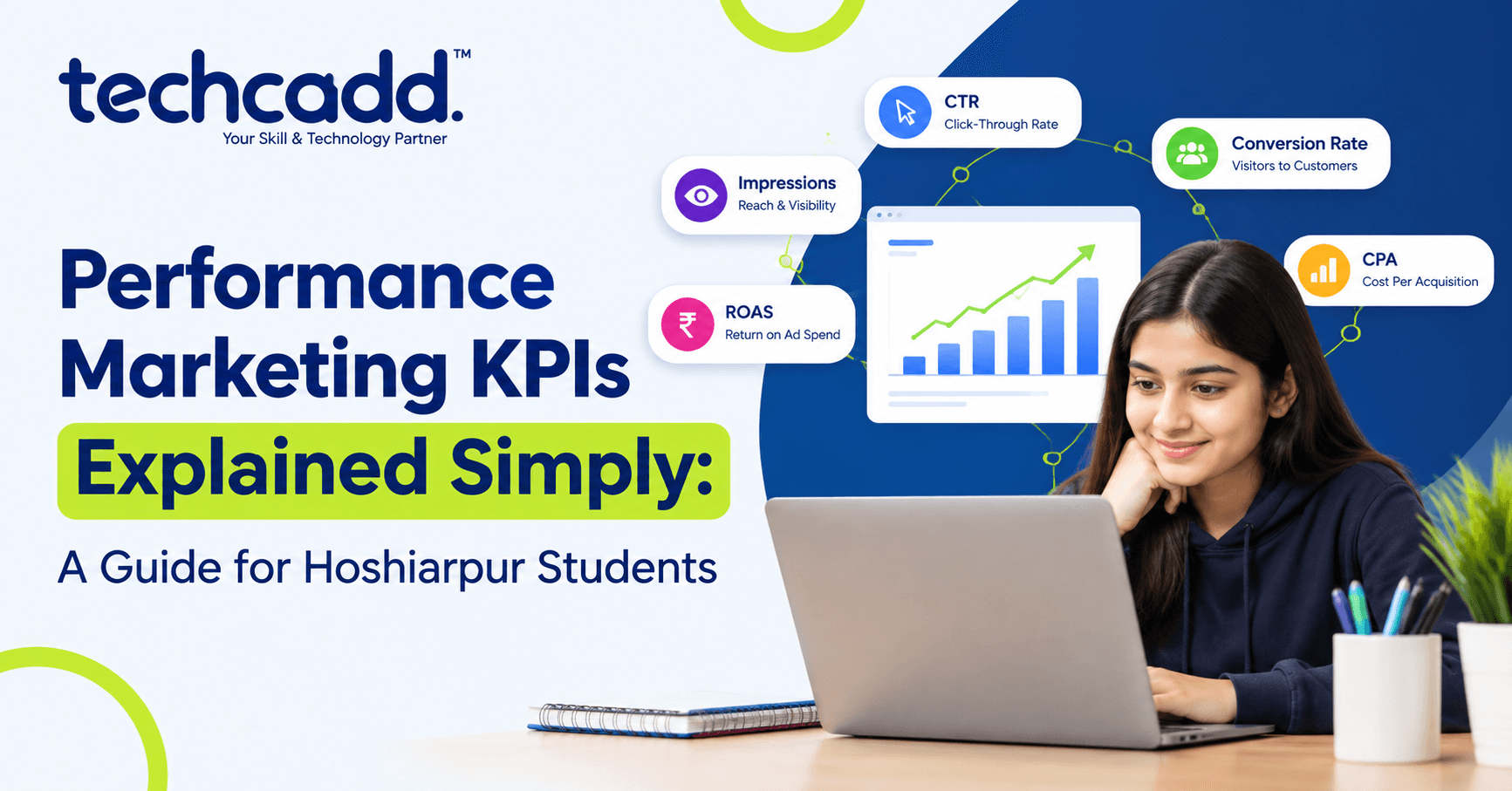
Performance Marketing KPIs Explained Simply: A Guide for Hoshiarpur Students
Have you ever seen a marketing dashboard for the first time and felt completely lost? Rows of numbers, weird abbreviations like CTR, CPC, CPA, ROAS — and everyone around you nodding like it all makes perfect sense? If that's you right now, take a breath. Almost every digital marketer felt exactly the same way in the beginning.
Here's the good news: KPIs (Key Performance Indicators) aren't actually complicated once someone explains them in plain language instead of jargon. They're just numbers that tell you whether your marketing efforts are working or not. That's it. Once you understand what each number is really telling you, the whole dashboard starts making sense.
What Exactly Is a KPI, in Simple Words?
A KPI is just a measurable value that tells you how well something is performing against a goal. If you're running an ad for a coaching institute, your goal might be "get more students to enroll." A KPI would be something that measures progress toward that goal — like how many people clicked the ad, or how many of those people actually filled out an enrollment form.
Think of KPIs like a report card. Just like a report card shows subject-wise scores instead of one vague "good" or "bad," KPIs break down your marketing performance into specific, trackable numbers so you know exactly what's working and what isn't.
Why Performance Marketing Relies So Heavily on KPIs
Traditional advertising — like a poster or a newspaper ad — doesn't tell you much about results. You put it out there and hope people notice. Performance marketing is different. Every click, every view, every purchase can be tracked. That's actually the entire point of performance marketing: you pay for and measure actual results, not just visibility.
Because everything is trackable, KPIs become the language marketers use to talk about success. Without them, you're just guessing whether an ad campaign worked.
The Core KPIs You'll Run Into Constantly
Let's go through the ones you'll see the most, explained the way you'd want a friend to explain them to you — not a textbook.
1. CTR (Click-Through Rate)
This tells you what percentage of people who saw your ad actually clicked on it. If 1,000 people saw your ad and 20 clicked, your CTR is 2%. A low CTR usually means your ad isn't grabbing attention or isn't relevant to the people seeing it. A high CTR generally means your message and audience match well.
2. CPC (Cost Per Click)
This is simply how much you're paying, on average, every time someone clicks your ad. If you spent ₹500 and got 100 clicks, your CPC is ₹5. Lower CPC usually means more efficient spending, but it's not the whole story — a cheap click that doesn't convert into anything useful isn't actually valuable.
3. CPM (Cost Per Mille / Cost Per 1,000 Impressions)
This tells you how much it costs to show your ad 1,000 times, regardless of clicks. It's more about visibility and brand awareness than direct action.
4. Conversion Rate
Out of everyone who clicked your ad, how many actually did the thing you wanted — filled a form, made a purchase, booked a call? If 100 people clicked and 5 converted, your conversion rate is 5%. This is one of the most important KPIs because clicks don't pay bills — conversions do.
5. CPA (Cost Per Acquisition)
This shows how much it costs you, on average, to get one actual conversion — like one enrollment or one sale. If you spent ₹2,000 and got 10 enrollments, your CPA is ₹200. Businesses care deeply about this number because it directly connects to profitability.
6. ROAS (Return on Ad Spend)
This tells you how much revenue you're generating for every rupee spent on ads. A ROAS of 4 means you're earning ₹4 for every ₹1 spent. This is often the number business owners care about most, because it directly reflects whether the marketing is actually making money or losing it.
A Common Doubt: "Do I Need to Memorize All These Formulas?"
Not really — and this is something a lot of beginners get anxious about unnecessarily. Most marketing platforms like Google Ads or Meta Ads calculate these numbers automatically for you. What actually matters is understanding what each number means and what a "good" or "bad" number looks like for a specific type of campaign.
For example, a low CTR might be a serious problem for a brand awareness campaign but might be perfectly normal for a very niche, high-value product where fewer people are the right audience anyway. Context matters more than the raw number.
Why This Matters More Than You Might Think
Here's something worth sitting with for a second. A lot of students learning digital marketing focus heavily on "how to run an ad" — which platform to use, which settings to click. That's important, sure. But without understanding KPIs, you won't actually know if the ad you ran was any good.
Imagine driving a car with no speedometer or fuel gauge. You could still drive, technically, but you'd have no idea how fast you're going or when you're about to run out of fuel. KPIs are your dashboard in marketing. Without them, you're just driving blind and hoping for the best.
More KPIs That Matter as You Go Deeper
Once you're comfortable with the basics, there are a few more KPIs that come up often, especially once campaigns get a bit more advanced.
7. Impressions
This is simply the number of times your ad was shown, whether or not anyone clicked. It sounds basic, but it's useful for understanding reach — how many eyeballs your campaign is actually getting.
8. Reach vs. Frequency
Reach tells you how many unique people saw your ad, while frequency tells you how many times, on average, each person saw it. If your frequency is too high, it usually means you're showing the same ad to the same people repeatedly, which can lead to what's called "ad fatigue" — people start ignoring or even getting annoyed by the ad.
9. Bounce Rate
This one isn't about the ad itself but about what happens after someone clicks. If people land on your website and leave almost immediately without doing anything, that's a high bounce rate. It often signals that the landing page didn't match what the ad promised, or the page loaded too slowly, or it just wasn't convincing enough.
10. Customer Lifetime Value (CLV or LTV)
This measures how much revenue a single customer is expected to bring in over the entire time they stay a customer, not just their first purchase. This matters a lot for businesses with repeat customers, like a gym or a subscription-based service, because it changes how much they're willing to spend to acquire one customer in the first place.
11. Quality Score (specific to Google Ads)
Google gives your ads a quality score based on relevance, expected CTR, and landing page experience. A higher quality score often means lower CPC and better ad placement, which is why it's worth paying attention to even though it's a bit more technical.
How These KPIs Connect to Each Other
Here's where it gets genuinely interesting, and where a lot of beginners start to see the bigger picture. These KPIs aren't separate, unrelated numbers — they're connected in a chain.
Let's walk through a simple example. Say you're running an ad for a local coaching institute in Hoshiarpur.
Your ad gets shown 10,000 times (impressions).
300 people click on it, giving you a CTR of 3%.
You spent ₹3,000 on the campaign, so your CPC is ₹10.
Out of those 300 clicks, 15 people actually filled the enrollment form, giving you a conversion rate of 5%.
Your CPA becomes ₹200 per enrollment (₹3,000 ÷ 15).
If each enrollment is worth ₹2,000 to the institute, your ROAS would be 10x.
See how one number leads into the next? This is exactly why marketers don't look at just one KPI in isolation. A great CTR with a terrible conversion rate might mean your ad is attractive but your landing page or offer isn't convincing. A great conversion rate with a high CPA might mean your targeting needs work. Understanding these connections is what separates someone who just "runs ads" from someone who genuinely understands performance marketing.
Common Mistakes Beginners Make with KPIs
Mistake 1: Focusing only on vanity metrics
Impressions and reach feel exciting because the numbers look big, but they don't always translate to actual business results. A campaign with a million impressions and zero conversions hasn't achieved much for the business, even if it looks impressive on paper.
Mistake 2: Ignoring the full funnel
Some beginners obsess over CTR alone, without checking what happens after the click. A high CTR with a low conversion rate usually points to a problem further down the funnel — maybe the landing page, maybe the offer itself.
Mistake 3: Comparing KPIs without context
A CPC of ₹15 might sound high, but if you're in a competitive industry like real estate or finance, it could actually be quite good. Comparing your numbers to a completely different industry or campaign type often leads to wrong conclusions.
Mistake 4: Not tracking conversions properly
This is a technical but crucial mistake. If your conversion tracking isn't set up correctly on your website, all your other KPIs become unreliable, because you won't actually know how many people converted in the first place.
Is This Suitable for Complete Beginners?
Yes, genuinely. You don't need a background in statistics or math to understand KPIs. Most of it is basic arithmetic — percentages, averages, ratios — combined with logical thinking about what the numbers actually represent for a real business.
What helps most isn't memorizing formulas but practicing with real or sample campaign data until the numbers start to feel familiar rather than intimidating. Many students find that after working through just a few real examples, KPIs stop feeling like abstract theory and start feeling like common sense.
What Should You Learn First?
If you're just starting to learn performance marketing KPIs, here's a practical order:
CTR, CPC, and Impressions — the foundational, easy-to-understand metrics.
Conversion Rate — understanding what happens after the click.
CPA — connecting spend directly to results.
ROAS — understanding actual profitability.
Bounce Rate and Landing Page metrics — since a lot of conversion issues live here.
CLV and Quality Score — more advanced concepts once you're comfortable with the basics.
This order builds understanding step by step, rather than throwing every metric at you at once.
How This Applies to Local Businesses in Hoshiarpur
It's easy to think KPIs only matter for big brands with massive ad budgets, but that's simply not true. A small boutique in Hoshiarpur running a ₹500 daily ad budget needs to understand KPIs just as much as a large company spending lakhs. Actually, arguably more — because with a smaller budget, every rupee wasted matters a lot more proportionally.
Local businesses here — clinics, coaching centers, real estate dealers, retail shops — are increasingly running their own social media ads or hiring someone to do it for them. When a business owner asks "was this ad worth it?", KPIs are literally the only honest way to answer that question. Someone who can walk into a local shop, look at their ad account, and clearly explain "your CPC is high because your targeting is too broad" or "your conversion rate is low because your landing page takes too long to load" brings genuine, practical value that businesses are willing to pay for.
This is a real opportunity for students here. You don't need to work for a massive agency in a big city to apply these skills. Local businesses need this expertise just as much, and there's often less competition for that kind of talent locally compared to saturated markets.
How Difficult Is It, Really?
Compared to a lot of technical skills, understanding performance marketing KPIs is genuinely one of the more approachable areas to learn. There's no complex coding involved, no advanced mathematics beyond basic percentages and ratios. The real difficulty, if there is one, lies in developing the judgment to interpret numbers correctly rather than just calculating them.
For instance, calculating a CPA is simple arithmetic. Understanding why your CPA is high, and what specific change might bring it down, requires more thought and experience. This is the part that takes time to build, and it usually comes from working with real campaigns rather than just reading theory.
Most students find the first few weeks a bit overwhelming simply because of the number of new terms. But once the core five or six KPIs become familiar, the rest tend to fall into place much faster, since many advanced metrics are just variations or combinations of these basics.
Do You Need Previous Experience?
No prior marketing or technical background is needed. In fact, some of the best performance marketers come from very different fields entirely — commerce, psychology, even fine arts — because performance marketing is as much about understanding human behavior and communication as it is about numbers.
What actually helps is curiosity. Being the kind of person who looks at a number and asks "why is this happening?" rather than just accepting it at face value will take you much further than any formal educational background.
What Can You Actually Do After Learning This?
Once you have a solid grasp of performance marketing KPIs, several paths become realistic:
Freelance digital marketing — managing ad campaigns for local businesses in and around Hoshiarpur, a genuinely in-demand service right now.
Agency roles — working as a performance marketing executive or media buyer at a digital marketing agency, where KPI analysis is a daily task.
In-house marketing roles — many companies now hire dedicated performance marketers to manage their own ad spend rather than outsourcing it.
Building your own campaigns — if you eventually run your own business or side project, understanding KPIs means you'll be able to market it yourself without relying entirely on paid consultants.
The demand for people who can genuinely read and act on marketing data, rather than just clicking "boost post," continues to grow steadily across almost every industry.
A Few Honest Thoughts to Wrap This Up
If you take away just one thing from this guide, let it be this: KPIs aren't there to confuse you or make marketing look more complicated than it is. They exist to answer one simple question — is this working, or not? Every metric, from CTR to ROAS, is just a different angle on that same core question.
Start by learning the basics — CTR, CPC, conversion rate, CPA, and ROAS. Practice looking at real campaign examples, even small ones, and try explaining in your own words what each number is telling you. Over time, reading a marketing dashboard will feel less like decoding a foreign language and more like reading a simple story about what happened and why.
For students in Hoshiarpur looking to build a career in digital marketing, this is genuinely one of the most practical, in-demand skills you can develop, and the good news is, it's far more learnable than it first appears.



Comments
Nothing here yet. Be the first to say something.