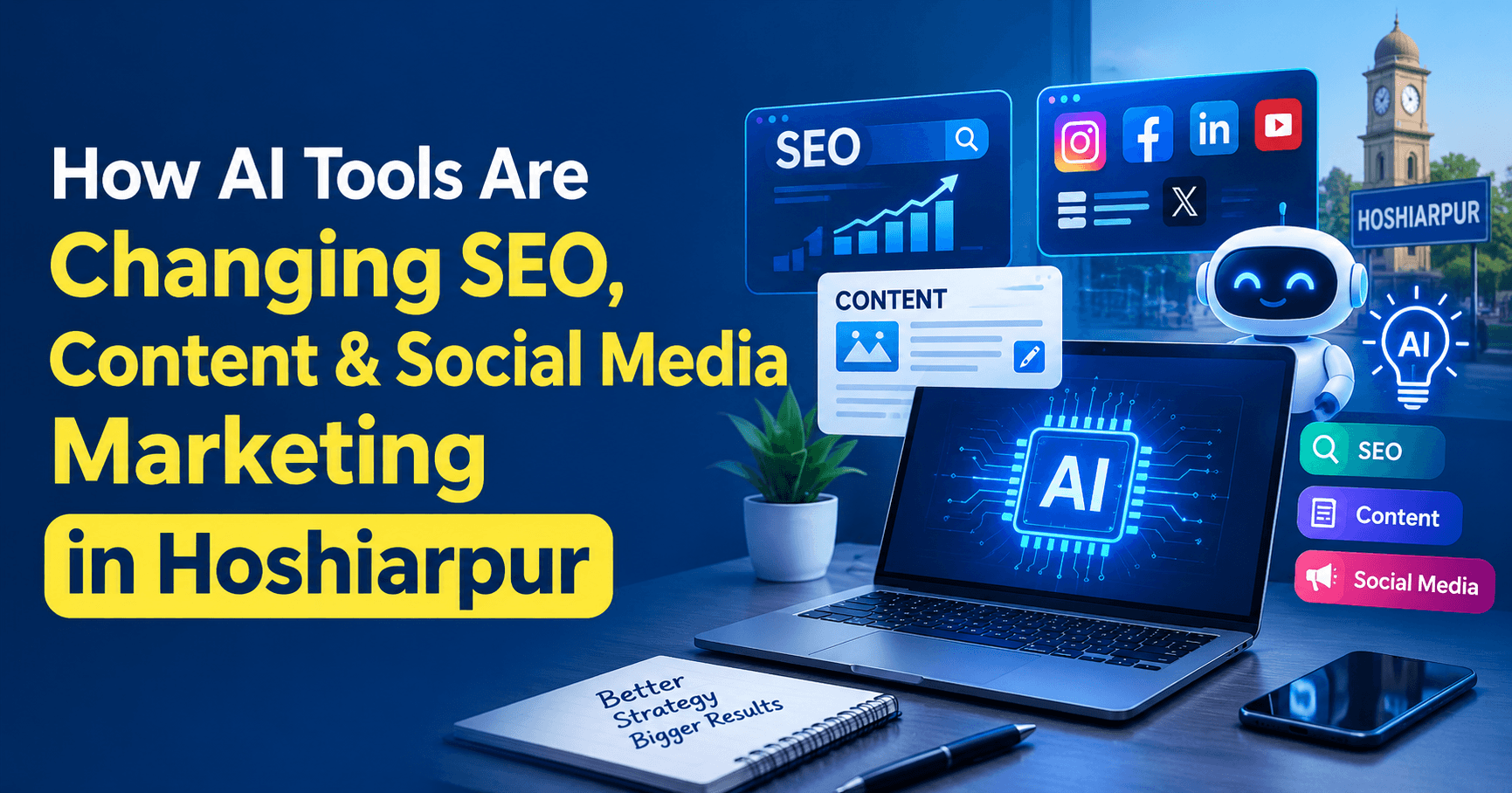
How AI Tools Are Changing SEO, Content & Social Media Marketing in Hoshiarpur
Picture this. A student sits down to write a blog post for a local clinic's website. Two years ago, that meant staring at a blank page for an hour, opening ten tabs for research, and rewriting the first paragraph five times. Today, that same student opens an AI tool, types a rough idea, and has a draft in under a minute.
Sounds amazing, right? It is. But it also raises a scary question that many students in Hoshiarpur are quietly asking: "If AI can do all this, what is left for me to do?"
Let's answer that properly, because the honest answer is more hopeful than you might think.
The Big Picture: What Has Actually Changed?
Digital marketing used to be built on a lot of manual effort. Keyword research took hours. Writing content was slow. Posting on social media meant scheduling everything by hand and guessing what might work.
AI tools have taken over much of that grunt work. They can suggest topics, draft outlines, analyze competitors, write captions, and even predict which post might perform better. But they haven't taken over the thinking. Deciding what a business actually needs, what its customers care about, and what feels genuine rather than robotic? That part still needs a human.
So marketing hasn't disappeared. It has shifted. The people who understand strategy and know how to use AI as a helper are the ones moving ahead.
How AI Is Changing SEO
SEO (Search Engine Optimization) is the practice of helping your website show up when people search on Google. This is probably the area where the changes are most visible right now.
1. Search results themselves are changing
Google now often shows AI-generated summaries at the top of results for many questions. Chat-based tools like ChatGPT and Perplexity are also becoming places where people look for answers. This means ranking well is no longer only about appearing as the first blue link. It's also about being the source that AI tools trust and mention.
You may have heard new terms like AEO (Answer Engine Optimization) and GEO (Generative Engine Optimization). Don't let the abbreviations scare you. They simply mean writing content that gives clear, direct, trustworthy answers, so both search engines and AI tools can pick it up.
2. Keyword research is faster and smarter
Earlier, you'd manually dig through lists of keywords. Now, AI-powered tools can group keywords by topic, spot gaps your competitors missed, and suggest questions people are really asking. What used to take a full afternoon can now be done in under an hour.
But here's the catch: the tool gives you suggestions, not decisions. You still need to judge which keywords match your client's goals. A coaching institute in Hoshiarpur cares about very different searches than a jewellery shop does.
3. Technical SEO checks are easier
AI-assisted tools can scan a website and flag slow pages, broken links, missing titles, and mobile problems. Beginners no longer need to be technical experts to spot the basics.
4. Quality matters more than volume
Because anyone can now produce hundreds of articles with AI, the internet is filling up with average, copy-paste style content. Google has repeatedly said it prefers helpful, people-first content, regardless of how it is produced. So the advantage goes to those who add real experience, local knowledge and honest insight, things that generic AI text often lacks.
Why This Matters for Students in Hoshiarpur
Here's a thought worth holding on to. When a local business owner searches for someone to handle their online presence, they don't want to hear "I know how to use ChatGPT." Everyone can do that. They want someone who can say, "Here's how we'll get more customers from Hoshiarpur searching on their phones."
That gap between using a tool and understanding marketing is exactly where you can stand out. AI raises the baseline for everyone. Your job is to build skills that sit above that baseline.
A Common Doubt: "Will AI Make SEO Useless?"
Short answer: no. The way people search is evolving, but people still need to find businesses, compare options and trust what they read. Someone has to make sure a business's website is clear, fast, credible and easy for both humans and AI systems to understand.
What is fading is the old style of SEO: stuffing keywords, publishing thin articles, and chasing tricks. What is growing is the style built on real usefulness. If you learn SEO with that mindset, you're learning something that will last.
A Quick Real-Life Example
Imagine a small dental clinic in Hoshiarpur. Earlier, their website had one page listing services, and hardly anyone visited it.
Now imagine a marketer using AI to find the questions patients actually ask, like "root canal cost in Hoshiarpur" or "is teeth whitening safe?" The marketer drafts helpful answers with AI's help, then edits them with the dentist's real advice, adds local details, and publishes them clearly. Within a few months, that clinic starts showing up for searches that matter.
Notice what happened. AI saved time on research and drafting. But the trust, accuracy and local flavour came from a human who understood the business. That's the winning combination.
Skills Worth Building for SEO in the AI Era
If you want to grow in this area, focus on these:
Understanding search intent, meaning why someone is typing a query, not just what they typed
Writing clear, direct answers that both people and AI tools can quote
Basic on-page SEO, such as titles, headings, meta descriptions and internal links
Local SEO, including Google Business Profile and local keywords
Checking facts, because AI can sound confident and still be wrong
None of these are out of reach for a beginner. They just need steady practice on real projects.
How AI Is Changing Content Marketing
Content marketing is anything you create to attract and help your audience: blog posts, videos, reels, emails, infographics. This is the area where AI feels the most magical, and also the most risky.
1. Drafting is quicker, but editing matters more
AI can produce a first draft of a blog, an email or a product description in seconds. That's a huge time-saver. But a first draft is just that: a first draft. It often sounds generic, repeats itself, and misses the small details that make writing feel real.
The marketers who do well are the ones who treat AI output like raw material. They add their own examples, fix awkward lines, check facts, and give it a voice. Think of AI as a fast intern. Helpful, but you'd never publish their work without reading it first.
2. Ideas are easier to find
Stuck on what to post this week? AI can suggest topics, angles, hooks and even content calendars. For a student handling a client's page, this removes the "blank page" fear that slows so many beginners down.
3. Repurposing has become simple
One blog post can now be turned into a LinkedIn post, an Instagram carousel script, a short video outline and an email, all in a few minutes. This lets small teams and freelancers do the work of a much bigger team.
4. Personalization is possible at a smaller scale
Even a small business can now write different messages for different customer groups. A coaching institute can send one message to Class 12 students and a different one to their parents, without hiring a separate writer for each.
5. Sameness is the new problem
When everyone uses the same tools with the same prompts, content starts sounding alike. Readers notice. They may not say it out loud, but they scroll past. The fix isn't avoiding AI. It's adding what AI can't: your own stories, local references, real customer questions and honest opinions.
How AI Is Changing Social Media Marketing
Social media moves fast, and AI has become a big part of how brands keep up.
1. Captions, hooks and scripts on demand
Writing ten caption options used to be tiring. Now AI can give you ten in seconds. You pick the best one and make it sound like the brand.
2. Smarter scheduling and analysis
Many platforms and tools now analyze when your audience is most active, which posts performed best and what to try next. Instead of guessing, you can make decisions with actual data.
3. Quick creative production
AI can help generate image ideas, edit videos, add subtitles and resize creatives for different platforms. Tasks that once needed a designer or an editor for every small change can now be handled much faster.
4. Chatbots and faster customer replies
Businesses increasingly use AI-powered replies on Instagram, WhatsApp and websites to answer common questions instantly, even at night. A boutique in Hoshiarpur can respond to "What's the price?" at 11 PM without anyone being awake.
5. Authenticity is the real currency
People follow people, not perfect posts. Audiences respond to real faces, real stories and real behind-the-scenes moments. An AI-written caption over a stock-looking image rarely builds trust. A genuine photo of the shop owner with a short, honest caption often does.
Common Mistakes Beginners Make with AI Marketing Tools
Almost every student makes a few of these at the start. Knowing them early saves a lot of embarrassment.
Mistake 1: Publishing AI content without editing
It's tempting to copy, paste and post. But unedited AI content often has wrong facts, stiff language or details that don't fit the business. Always read it as if you were the customer.
Mistake 2: Using the same prompt for every client
A dentist, a garment shop and a coaching centre speak to very different people. If your prompts don't include the audience, tone and goal, the output will feel bland for all of them.
Mistake 3: Trusting AI facts blindly
AI can invent statistics, prices or claims that sound believable. In areas like health, education or finance, a wrong claim can damage a business's reputation. Verify anything important.
Mistake 4: Chasing tools instead of skills
New AI tools appear almost every week. Students who jump from one to another without learning the basics of marketing end up confused. Tools change. Fundamentals like audience understanding, messaging and measurement stay useful for years.
Mistake 5: Ignoring the local angle
Generic content rarely works for local businesses. If your post could belong to any city in India, it probably won't connect with people in Hoshiarpur. Mention local areas, festivals, seasons and real customer concerns.
Is This Suitable for Complete Beginners?
Yes, and in some ways it's easier to begin now than ever. AI tools can explain marketing terms in simple words, suggest examples and help you practise. If you don't understand what a "call to action" is, you can simply ask and get an explanation in seconds.
But easier to start doesn't mean automatic success. You'll still need to practise on real pages, real websites and real campaigns, so you understand what works and what doesn't. No tool can give you that experience. Only doing it can.
What Should You Learn First?
If you're starting from zero, here's a sensible order:
Digital marketing basics, including how SEO, content and social media fit together
Audience research, meaning understanding who you're talking to and what they need
Writing and editing skills, so you can improve AI drafts instead of just accepting them
On-page and local SEO, the fastest way to make a real difference for a local business
One or two social platforms in depth, rather than trying everything at once
Basic analytics, so you can see what's working
AI tools for research, drafting and design, used as helpers on top of the above
This order builds understanding first and speed second, which is what makes you genuinely useful to a client.
How This Plays Out for Local Businesses in Hoshiarpur
It's easy to assume AI marketing is something only big brands in metro cities are using. In reality, small businesses here are already feeling the shift, even if they don't call it "AI."
A clinic owner sees a competitor showing up in Google's AI summary and wonders why they don't. A boutique owner notices that another shop posts daily reels and replies to every message within minutes. A coaching institute realizes parents are asking questions on WhatsApp late at night and expecting quick answers.
Most of these owners don't have time to figure it all out themselves. They're busy running their business. What they need is someone who understands both the marketing side and the tools, someone who can say, "Here's what to fix first, and here's how we'll do it without wasting your budget."
That someone could be you. And you don't need to relocate to a big city to do it. Local businesses in and around Hoshiarpur need this help right now, and there are far fewer people offering it well than you might expect.
How Difficult Is It, Really?
Let's be honest. The tools themselves are easy to pick up. You can learn to write a decent prompt in an afternoon. What's harder is knowing whether the result is actually good.
Is this headline right for a parent worried about board exams? Does this caption match the brand's personality? Will this blog answer what people are truly searching for? These judgment calls take time and practice, and no tool can make them for you.
Most students feel overwhelmed in the first few weeks because there's so much to absorb: SEO terms, content formats, platform rules, and new tools on top of it all. That's normal. Once the basics settle in, things start connecting, and you'll notice you're making better decisions faster.
Do You Need Previous Experience?
No. You don't need a marketing degree, a design background or technical skills to begin. Students from commerce, arts, science and even non-academic backgrounds have built strong careers in digital marketing.
What helps more than experience is curiosity. If you enjoy noticing why one post gets attention and another doesn't, or why you clicked on one search result and skipped another, you already have the instincts that good marketers rely on. Practice will sharpen them.
What Can You Actually Do After Learning This?
Once you're comfortable with SEO, content and social media, with AI as your assistant, a few real paths open up:
Freelancing, handling SEO, content and social pages for local businesses around Hoshiarpur
Agency roles, such as SEO executive, content marketer or social media manager, where AI-assisted workflows are quickly becoming standard
In-house marketing jobs, managing a single company's online presence
Content creation, building your own audience through blogs, reels or a YouTube channel
Your own business, marketing it yourself without depending on expensive outside help
Notice something here. Every one of these paths rewards people who can combine tool skills with real judgment. That's exactly the combination that's hard to replace.
Will This Skill Actually Help Your Career?
Yes, and probably more than it did a few years ago. Businesses of every size want more customers online, but they're overwhelmed by how fast things are changing. Someone who can cut through that confusion and deliver actual results will always find work.
The people at risk aren't marketers. They're the ones who only do what a tool can do in seconds, like copy-pasting generic posts or stuffing keywords. If you go beyond that, by understanding audiences, thinking strategically and adding a human touch, you become far more valuable, not less.
A Few Honest Thoughts Before You Go
AI isn't the enemy of marketers, and it isn't magic either. It's a very fast assistant that works best when someone with real understanding is guiding it.
If you're just starting out, don't try to learn every tool at once. Begin with the fundamentals: how people search, what makes content useful, and how social media builds trust. Then bring in AI to speed things up. Practise on real projects, even small ones like a friend's shop page or your own blog, and keep learning as things change.
The students who grow fastest aren't the ones who know the most tools. They're the ones who stay curious, stay honest with their audience, and keep improving a little every week.
If you're in Hoshiarpur and wondering whether this is the right time to step into digital marketing, it very much is. The field is changing, and that change is creating room for people who are willing to learn.
Comments
Nothing here yet. Be the first to say something.