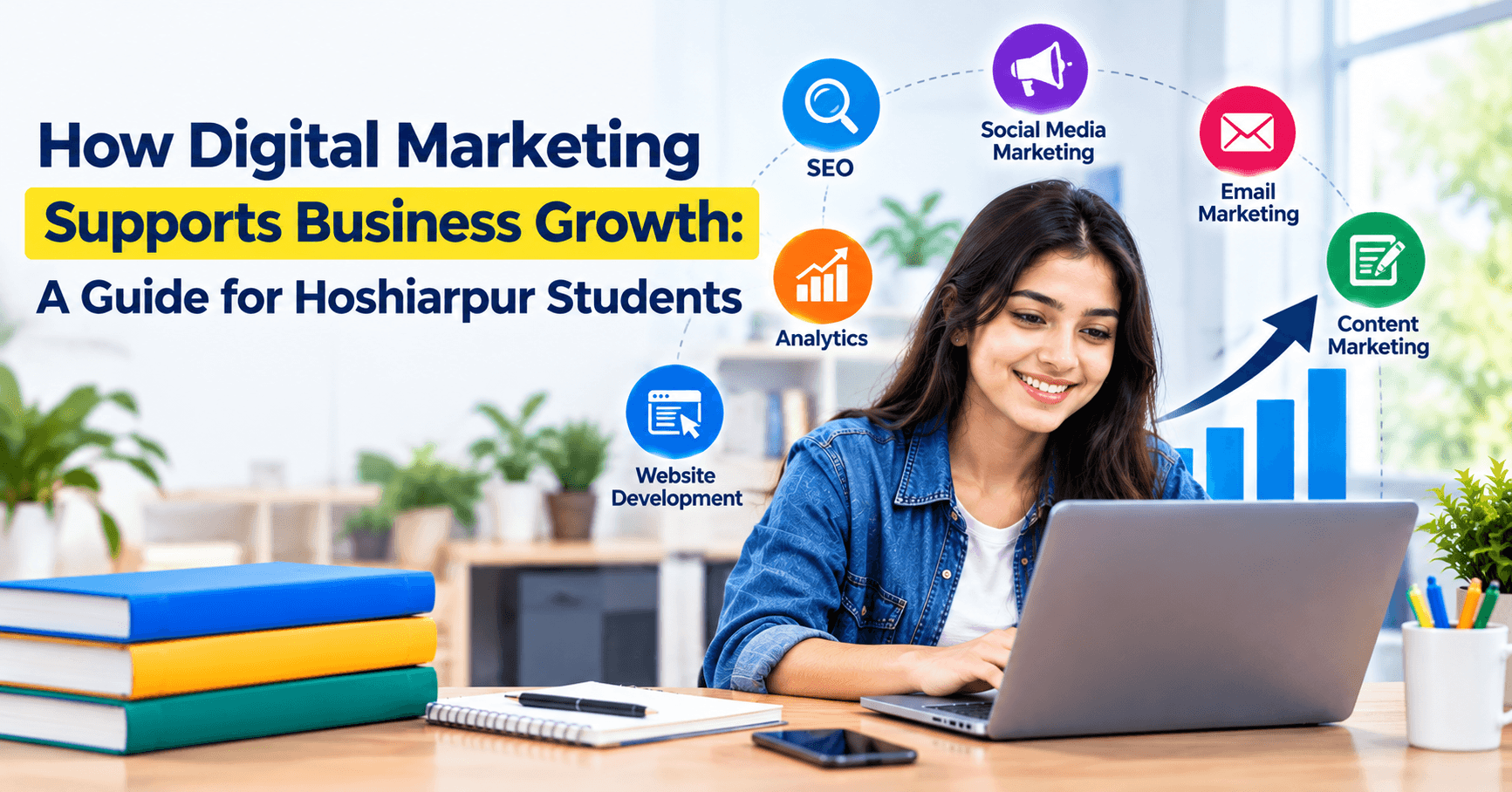
Drafting a student-friendly blog post for a Hoshiarpur audience.
How Digital Marketing Supports Business Growth: A Guide for Hoshiarpur Students
Part 1
Two sweet shops sit on the same street in Hoshiarpur. Both make good mithai. Both have loyal customers who’ve been coming for years. But one of them has a Google listing with fresh photos, a phone number that actually works and a few dozen honest reviews. The other doesn’t show up when someone searches “sweet shop near me.”
Come festival season, who gets the bulk orders from people who’ve just moved to the city, or from families searching on their phones the night before? The answer isn’t hard to guess.
That’s the quiet way digital marketing supports a business. It doesn’t replace a good product. It makes sure the right people can find that product, trust it and reach out. This guide explains how that works, in plain language, for students who want to understand it and maybe build a career around it.
What Digital Marketing Means for a Business
Digital marketing is the use of online channels to help a business get noticed, earn trust and win customers. Those channels include Google search, Google Maps, social media, websites, email, WhatsApp and paid ads.
Think of it as the online version of everything a shop does to attract customers: the signboard, the window display, the pamphlets, the friendly chat at the counter. The difference is that online, you can see what’s working. You know how many people saw an ad, how many clicked and how many sent a message. That visibility is what lets a business improve step by step instead of guessing.
What “Business Growth” Actually Looks Like
Growth is a big word, so let’s keep it practical. For a small or medium business, growth usually means a few concrete things: more people discovering the business, more enquiries and walk-ins, more repeat customers, a stronger reputation and, over time, higher sales.
Digital marketing supports each of these in a different way. Some of it works quickly, like a well-targeted ad. Some of it builds slowly, like a good website or a steady stream of useful posts. Understanding which is which helps a business plan sensibly instead of expecting overnight results.
Way 1: It Helps Customers Find the Business
Most people today look something up before they visit or buy. They search on Google, check Maps, glance at Instagram or ask a question on WhatsApp.
If a business isn’t visible in those places, it’s invisible to a large share of potential customers. Digital marketing fixes that. A properly set up Google Business Profile shows opening hours, location, photos and reviews. Search engine optimization helps a website appear for the phrases people actually type. Social media gives people a way to discover a business even when they weren’t searching for it.
For a local business, this is often the biggest early win. Many shops and clinics in smaller cities haven’t done the basics yet, which means a little effort can bring a noticeable difference.
Way 2: It Builds Trust Before the First Visit
Nobody wants to take a risk on an unknown business, especially for something important like a clinic, a coaching class or a home renovation.
Online presence quietly answers the “can I trust them?” question. Genuine reviews, clear photos, an informative website, regular posts and quick replies to messages all signal that a business is real and reliable. A customer who has read ten honest reviews and seen the shop’s work often arrives already half-convinced.
This is also why honesty matters. Fake reviews and exaggerated claims might look good briefly, but they damage trust badly once people notice. Real feedback, even with a few imperfect reviews, usually builds more credibility than a perfect-looking page that feels staged.
Way 3: It Reaches the Right People, Not Just Many People
A newspaper ad reaches everyone who reads that page, whether they need your service or not. Digital marketing lets a business be much more specific.
With online ads, you can choose a location, such as people within a few kilometres of Hoshiarpur. You can pick age ranges, interests and even the kind of searches people make. A coaching institute can show its ad mainly to parents of school students nearby. A boutique can reach women searching for wedding outfits. A clinic can appear when someone searches for a specific treatment in the city.
This precision means a small budget can go further. Instead of paying to reach thousands of people who’ll never be interested, a business can focus on the few hundred who might actually buy.
Way 4: It Makes Results Measurable
This is one of the biggest differences between digital marketing and older methods. A hoarding on the roadside may bring in customers, but nobody knows how many. Online, the numbers are there.
A business can see how many people viewed a post, how many clicked a link, how many called from the Google profile and how much each enquiry cost. Even simple numbers help. If one type of post keeps getting saved and shared while another gets ignored, the next month’s plan becomes clearer.
Measurement turns marketing from a guess into a process. Try something, check the result, keep what works and drop what doesn’t.
A Common Doubt: “Is Digital Marketing Only for Big Brands?”
Many small business owners assume it is. They picture large companies with big budgets and design teams, and think it isn’t for a family-run shop or a single-doctor clinic.
In reality, small businesses often benefit more, because even small improvements in visibility can change their numbers noticeably. A local business doesn’t need a huge ad budget. It needs a clear message, a tidy online presence and consistent effort. A well-maintained Google profile and a handful of useful posts each week can go a long way.
The honest caveat is that results take time and vary from business to business. Nobody can guarantee exactly how many customers a particular campaign will bring, and anyone who promises that deserves some suspicion.
Why This Matters for Students in Hoshiarpur
Local businesses across Hoshiarpur, from clinics and institutes to boutiques, restaurants and workshops, are slowly realizing they need to be visible online. Many don’t have anyone who understands how to do it properly.
For a student, that’s an opportunity to learn a skill that businesses genuinely need, and to start putting it to use close to home. Even if you never work in marketing professionally, understanding how digital marketing supports growth makes you a sharper business thinker, and that’s useful in almost any career.
Part 2
Way 5: It Keeps Customers Coming Back
Winning a new customer usually costs more than keeping an existing one. Digital marketing helps with the second part too, and many businesses forget about it.
A simple WhatsApp broadcast about a new batch, a festival offer or a service reminder keeps a business fresh in people’s minds. Email newsletters, social media stories and short updates do the same. A clinic can remind patients about follow-up visits. A salon can message regular clients before wedding season. A coaching institute can share exam tips with past students, who then recommend it to friends.
None of this needs to be complicated. A short, useful message sent at the right time often works better than a long, polished campaign. The key is permission and respect. Send things people actually want, and don’t flood them.
Way 6: It Lets Small Businesses Compete More Fairly
A small shop can’t outspend a big chain on hoardings and TV ads. Online, the playing field is closer to level.
A local business can rank well for searches in its own area. It can build a loyal following on Instagram with real stories and genuine photos. It can answer customer questions quickly on WhatsApp, which many big brands do poorly. A well-run local presence can feel more personal and trustworthy than a faceless national brand.
That doesn’t mean it’s easy or automatic. But it does mean that a smart, consistent small business can hold its own, which is encouraging for owners and for students who want to help them.
Way 7: It Brings in Leads Around the Clock
A shop closes in the evening. A website, a Google profile and a social media page don’t.
Someone searching at eleven at night can read about a service, look at photos and send an enquiry that the business sees the next morning. A well-built landing page with a simple form or a WhatsApp button can capture that interest instead of losing it. Automated replies can acknowledge messages right away, so people don’t feel ignored while they wait.
For businesses where customers research for days before deciding, such as education, real estate or healthcare, this always-available presence can make a real difference.
Way 8: It Gives Useful Feedback About What Customers Want
Digital marketing doesn’t just send messages out. It also brings information back.
The questions people ask in comments and messages show what confuses them. The searches that lead to a website show what they’re looking for. The posts they save or share show what they value. Reviews, both good and bad, show what’s working and what needs fixing.
A business that pays attention to this feedback can improve its products, services and pricing, not just its marketing. That’s one of the most underrated benefits, because it connects marketing to the whole business.
How the Channels Work Together
Businesses often ask which single channel is best. The honest answer is that they work better together, each doing a different job.
Search and Google Maps catch people who already know what they need. Social media builds familiarity and trust, and reaches people who weren’t searching yet. A website is the home base where details, prices and proof live. Paid ads speed things up and reach specific groups. WhatsApp and email keep conversations going and bring customers back. Analytics ties it all together by showing what’s working.
Picture a clinic in Hoshiarpur. A patient searches for a particular treatment and finds the clinic on Google Maps. They check recent reviews, then look at the Instagram page for helpful posts. They visit the website to read about the doctor and tap a WhatsApp button to book. After the visit, they get a friendly reminder about a follow-up. Each channel did a small job, and together they moved the patient from searching to visiting to returning.
A Realistic Example
Let’s follow a small coaching institute with admissions coming up in a few months.
First, the team cleans up its Google Business Profile with the right timings, a working phone number and recent photos. Then it asks past students for honest reviews. Next, it creates a few helpful posts on exam preparation and publishes them regularly. A small paid campaign targets parents within a few kilometres, inviting them to a free demo class. Enquiries come through WhatsApp, and the team replies quickly and keeps notes on who has asked what. After admissions close, the team reviews which posts and ads brought the most enquiries and plans the next round accordingly.
Nothing here is unusual or expensive. It’s a series of simple steps, done consistently and checked against real results. That’s what growth through digital marketing usually looks like for a local business.
Common Mistakes Businesses and Beginners Make
Mistake 1: Expecting instant results
Some things, like ads, can bring enquiries quickly. Others, like search rankings and a loyal following, take months. Treat marketing as ongoing work, not a one-time fix.
Mistake 2: Being everywhere and nowhere
Trying to manage five platforms with no plan leads to weak results on all of them. Pick one or two that suit the audience and do them properly.
Mistake 3: Promoting without a clear offer
People need a reason to act. “Visit us” is weak. “Free demo class this Saturday” or “festival box orders open until Diwali” gives them something to respond to.
Mistake 4: Ignoring messages and reviews
A slow reply or an ignored complaint can undo the effect of a good ad. Respond politely and promptly, even to criticism.
Mistake 5: Measuring only likes and followers
Those numbers feel good, but they don’t pay the bills. Track enquiries, calls, visits and sales.
Mistake 6: Making exaggerated claims
Overpromising brings customers in and then disappoints them. Honest claims build longer-lasting trust.
Mistake 7: Stopping too soon
Many businesses try for a few weeks, see modest results and quit. Steady effort, adjusted over time, usually does better than short bursts.
Is This Suitable for Complete Beginners?
Yes. Understanding how digital marketing supports growth doesn’t require any technical background. If you can think about how customers find, trust and choose a business, you already have the right mindset. Learning the tools comes afterward, and you can pick them up step by step.
Do You Need Previous Experience?
No. Students from commerce, arts, science and any other stream can build this understanding. A good way to start is by studying businesses you already know. Notice how they appear online, what they post and how they reply. That kind of observation teaches a lot before you touch a single tool.
What Should You Learn First?
Here’s a sensible order if you’re starting from scratch:
How customers search and decide, understanding the journey from “I need something” to “I bought it”
Google Business Profile and local search, the quickest win for local businesses
Social media basics, on one or two platforms
Simple content writing and design
Basic website and landing page ideas, including clear calls to action
Paid ads, with small, careful test budgets
WhatsApp and email follow-up
Analytics, to read what’s working and what isn’t
Reporting and communication, so you can explain results honestly to a business owner
This order starts with how people behave and moves gradually toward tools and numbers, which makes the technical parts easier to understand.
Part 3
How This Looks for Businesses Around Hoshiarpur
Think about the businesses that make up daily life here. A coaching institute that depends on admissions in a few key months. A clinic that wants patients to trust it before they walk in. A boutique that lives and dies by wedding and festival seasons. A restaurant that needs weekend bookings. A manufacturer or supplier who wants buyers from other cities to find them.
Each of them has a different goal, but the same pattern shows up. The ones that grow steadily usually do a few simple things well. They’re easy to find, they look trustworthy, they reply quickly and they keep an eye on what brings customers in. The ones that struggle are often just as good at their actual work, but invisible online or inconsistent about it.
This is where a student with practical skills can step in. You don’t need to promise dramatic results. You can start with useful, honest jobs: tidying a Google Business Profile, planning a month of posts, designing clean graphics, setting up a WhatsApp catalogue or running a small enquiry campaign with a clear budget. Business owners notice when someone is careful, reliable and willing to explain what they’re doing in plain language.
How Difficult Is It, Really?
Let’s be honest. Understanding how digital marketing supports growth is not hard. Doing it well, week after week, takes patience.
The concepts are simple: help people find you, build trust, reach the right audience, measure results and keep customers. The difficulty lies in the details. Writing messages that people respond to. Choosing a sensible budget. Reading numbers without jumping to wrong conclusions. Staying consistent when results are slow.
The first month often feels confusing, with many platforms, new terms and conflicting advice online. Early posts may get little response, and an early ad may bring clicks but no enquiries. That’s normal, and it’s how you learn what your audience actually cares about. Taking it one skill at a time makes it far more manageable.
Realistic Expectations: What Digital Marketing Can and Can’t Do
It helps to be clear about this, whether you’re a student or a business owner.
Digital marketing can increase visibility, bring in more enquiries, build credibility, keep customers engaged and give you data to make better decisions.
It can’t rescue a poor product or bad service, guarantee a specific number of sales, or produce lasting results from a few days of effort. Customers who arrive and have a bad experience won’t stay, no matter how good the ad was.
The best results come when marketing and the business itself support each other. A good service, honestly promoted and consistently managed, tends to grow steadily over time. Anyone who promises instant, guaranteed growth deserves a polite but firm “no, thank you.”
A Simple Four-Week Practice Plan
If you’d like a structure to practice with a real or imaginary local business, try this. It assumes about forty-five minutes a day.
Week 1: Understand the business and its customers
Choose a business, such as a coaching centre, clinic or boutique. Write down who its customers are, what they worry about and what they search for. List three things that make the business different.
Week 2: Set up the basics
Draft a complete Google Business Profile description and a list of useful photos to add. Plan the bio, profile picture and first ten posts for one social platform.
Week 3: Create and publish
Design five simple posts and write captions with a clear call to action. Plan a small WhatsApp message that a customer could receive after an enquiry.
Week 4: Measure and learn
Look at which posts got the most views, saves or messages. Write a one-page summary of what worked, what didn’t and what you’d try next. Note any questions that came up repeatedly.
By the end, you’ll have a small case study to show employers or clients, along with a much clearer sense of how the pieces connect.
What Can You Do With This Understanding?
Once you understand how digital marketing drives growth, and you build a few of the practical skills behind it, several paths open up:
Junior roles in marketing agencies and companies, such as social media executive, content writer, SEO assistant or ads assistant
Freelance work for local businesses, handling profiles, posts, simple campaigns and reporting
In-house marketing support, helping a single business manage its online presence
Business support roles, such as sales coordination or customer relations, where understanding online enquiries is valuable
Content creation, building an audience through blogs, reels or videos
Your own business, since you’ll know how to attract customers without relying entirely on others
None of these is guaranteed, and outcomes depend on your skills, consistency and the openings available. But the understanding is useful in many directions.
Will This Skill Actually Help Your Career?
In marketing, sales and business roles, yes, and it often helps in less obvious places too. Almost every organization now needs to be visible and trusted online. A person who understands how that works can contribute in many kinds of teams.
AI tools are changing the routine parts of marketing, such as drafting captions or summarizing data. That makes judgment more valuable, not less. Knowing your audience, spotting a weak message, checking facts, deciding where to spend a limited budget and explaining results honestly are skills that tools support but don’t replace.
Tips to Keep Growing
Study real businesses. Pick a few local and national brands and notice what they do well and where they fall short.
Test one change at a time. Alter the headline, or the image, or the posting time, but not everything together. That way you learn what actually made the difference.
Keep a simple record. Write down what you tried and how it performed. Patterns show up quickly.
Stay honest. Skip fake followers, inflated claims and copied content. They harm trust and rarely help in the long run.
Learn from feedback. Ask a trainer, a friend or a business owner to review your work, and take their comments seriously.
Keep up with changes. Platforms and search results change often, so spend a little time each month checking for updates.
A Few Honest Thoughts Before You Go
If there’s one idea to take from this guide, it’s that digital marketing supports business growth by doing a few simple things consistently: helping people find a business, giving them reasons to trust it, reaching the right audience, keeping customers engaged and using real numbers to improve.
It isn’t magic, and it isn’t only for big brands. A small shop, a clinic or an institute in Hoshiarpur can benefit just as much, sometimes more, because even modest improvements in visibility can be noticeable.
If you’re a student, start by observing. Look at how businesses around you appear online, what they do well and what they miss. Then pick one skill, practice it on a real or practice project and keep going. Compare your results with your own earlier attempts, and let your portfolio grow gradually.
You don’t need a big budget or a technical background. You need curiosity, patience and the habit of checking what actually works. Start with one small step this week, and keep building from there.

Comments
Nothing here yet. Be the first to say something.