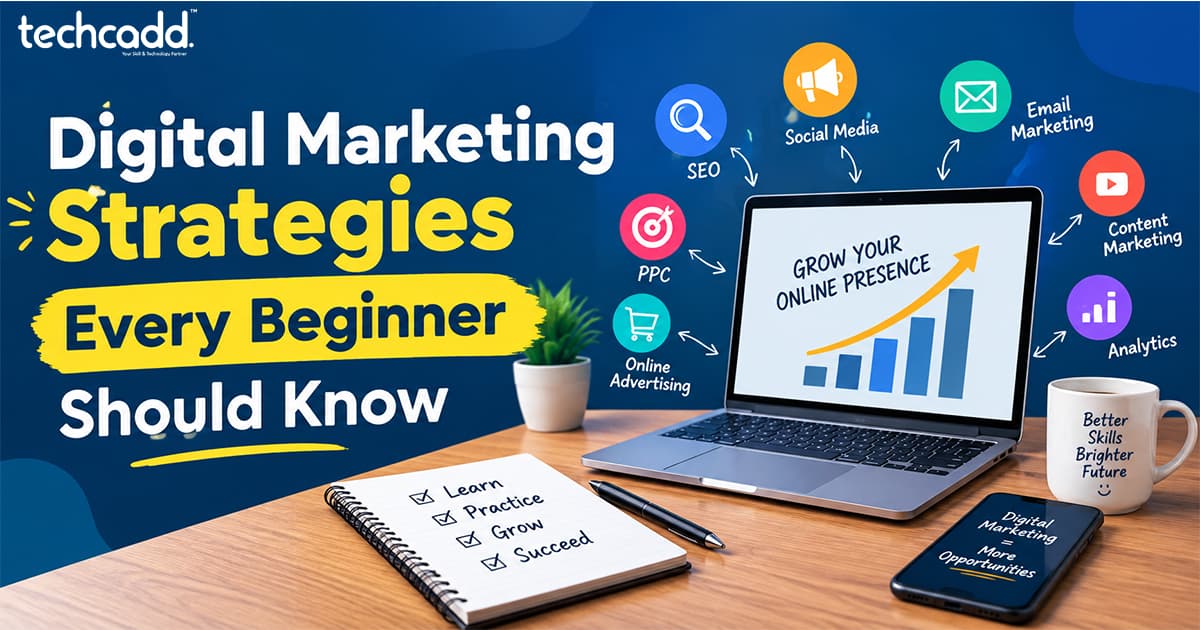
Digital Marketing Strategies Every Beginner Should Know
If you've ever opened Instagram, searched something on Google, or scrolled through YouTube, you've already interacted with digital marketing dozens of times without realizing it. That ad you skipped, that product recommendation that popped up, that blog post that answered your exact question — all of it is digital marketing at work.
For someone just starting out, though, digital marketing can feel overwhelming. SEO, PPC, social media, email marketing, content marketing — the terminology alone can make it seem like you need years of experience before you can even begin. The good news? That's not true at all.
Digital marketing is genuinely one of the most beginner-friendly career paths out there, precisely because it's built on a handful of core strategies that, once understood, apply across almost every platform and industry. You don't need to master everything at once. You need to understand the fundamentals first, and build from there.
Why Digital Marketing Is Worth Learning Right Now
Before diving into specific strategies, it helps to understand why this skill has become so valuable, especially for students and job seekers.
Every business today — whether it's a multinational brand or a small shop in Hoshiarpur — needs some form of online presence to survive and grow. Customers research products online before buying, compare options, read reviews, and follow brands on social media. Businesses that don't show up in this digital space simply lose out to competitors who do.
This has created massive demand for people who understand how to build, manage, and grow that online presence. And unlike some technical fields, digital marketing doesn't require a specific degree to get started. It requires understanding a set of practical strategies and knowing how to apply them.
Strategy #1: Search Engine Optimization (SEO)
SEO is often the first strategy beginners hear about, and for good reason — it's one of the most valuable long-term skills in digital marketing.
In simple terms, SEO means optimizing a website or content so it ranks higher on search engines like Google when people search for relevant terms. If someone searches "best mobile shop in Hoshiarpur" and your business shows up on the first page, that's SEO working in your favor.
For beginners, SEO can be broken down into a few core areas:
Keyword research — understanding what words and phrases people actually type into search engines when looking for something.
On-page SEO — optimizing individual web pages, including titles, headings, and content, so search engines understand what the page is about.
Off-page SEO — building credibility through backlinks (other websites linking to yours) and online mentions.
Technical SEO — ensuring the website itself is fast, mobile-friendly, and easy for search engines to crawl.
A common question beginners have is, "Isn't SEO too technical for someone with no coding background?" Not really. While advanced technical SEO does involve some technical understanding, the fundamentals — keyword research, writing SEO-friendly content, understanding on-page basics — are very approachable, even for complete beginners.
Strategy #2: Social Media Marketing
This is usually the most relatable strategy for beginners, simply because most people already use social media daily in their personal lives. The shift is learning to use it strategically for a business or brand.
Social media marketing involves creating content, building an audience, and engaging with followers across platforms like Instagram, Facebook, LinkedIn, and YouTube. But there's an important distinction beginners often miss — posting randomly isn't a strategy. Effective social media marketing involves:
Understanding which platform your target audience actually uses
Creating a consistent content calendar rather than posting sporadically
Using a mix of content formats — reels, static posts, stories, and live sessions
Engaging genuinely with comments and messages, not just posting and disappearing
Analyzing what content performs well and adjusting strategy accordingly
For a business in Hoshiarpur trying to reach local customers, platforms like Instagram and Facebook often work particularly well because they allow location-based targeting and community engagement that feels personal rather than purely promotional.
Strategy #3: Content Marketing
Content marketing is the practice of creating valuable, relevant content — blogs, videos, infographics, guides — to attract and engage an audience, rather than directly advertising a product or service.
The core idea is simple: instead of constantly telling people to buy something, you provide genuinely useful information that builds trust over time. Eventually, that trust translates into customers choosing your business when they're ready to make a purchase decision.
For beginners, this might look like:
Writing blog posts that answer common customer questions
Creating how-to videos related to your industry
Designing simple infographics that simplify complex information
Building an email newsletter that shares useful tips regularly
This strategy requires patience — content marketing rarely produces instant results. But it builds a foundation of trust and authority that paid advertising alone can't replicate.
Strategy #4: Pay-Per-Click Advertising (PPC)
While SEO and content marketing build results gradually, PPC advertising offers something different — speed. PPC means paying for ads that appear on search engines or social media, where you're charged each time someone clicks on your ad.
Google Ads and Meta Ads (Facebook and Instagram) are the two most common platforms beginners start with. The appeal is straightforward: you can launch a campaign today and start seeing traffic or leads almost immediately, unlike SEO, which can take months to show results.
For someone new to PPC, the fundamentals include:
Setting a clear campaign objective — are you trying to generate leads, drive website traffic, or increase sales?
Understanding targeting options — reaching the right audience based on location, age, interests, or search behavior.
Writing compelling ad copy — the headline and description need to grab attention within seconds.
Managing budget wisely — starting with a small budget to test what works before scaling up.
Tracking performance — understanding metrics like click-through rate and cost per click to evaluate whether a campaign is actually working.
A common beginner mistake is assuming more budget automatically means better results. In reality, a well-targeted campaign with a smaller budget often outperforms a poorly targeted one with a larger budget. Understanding your audience matters more than how much you spend.
Strategy #5: Email Marketing
Email marketing might sound old-fashioned compared to social media, but it remains one of the most effective digital marketing strategies, particularly because it directly reaches people who have already shown interest in your business.
Unlike social media, where algorithms decide who sees your content, email marketing gives you direct access to your audience's inbox. This makes it incredibly valuable for nurturing leads and maintaining customer relationships over time.
Beginner-friendly email marketing practices include:
Building an email list through website sign-ups or lead magnets (like a free guide or discount code)
Sending regular newsletters with useful content, not just promotional messages
Segmenting your audience so different groups receive relevant content
Writing clear, action-oriented subject lines that encourage people to open the email
Testing different approaches to see what resonates best with your audience
For businesses in Hoshiarpur building a loyal local customer base, email marketing combined with WhatsApp broadcast messages often creates a powerful, low-cost way to stay connected with customers without relying entirely on social media algorithms.
Strategy #6: Influencer and Affiliate Marketing
This strategy involves partnering with individuals who already have an engaged audience to promote your product or service. For beginners, understanding the difference between the two matters:
Influencer marketing typically involves paying or providing free products to influencers in exchange for promotion, based on their reach and audience trust.
Affiliate marketing involves paying a commission to partners only when they generate an actual sale or lead, making it a performance-based approach.
For smaller businesses or those just starting out, working with micro-influencers (those with smaller but highly engaged local audiences) is often more practical and cost-effective than chasing influencers with massive follower counts who may not have genuine engagement or local relevance.
Strategy #7: Analytics and Data-Driven Decision Making
This might be the most overlooked strategy by beginners, yet it's arguably one of the most important. Digital marketing generates enormous amounts of data — website visits, click rates, engagement numbers, conversion rates — and understanding how to read and act on this data separates effective marketers from those simply guessing.
Tools like Google Analytics and native platform insights (Instagram Insights, Facebook Ads Manager) provide real, measurable feedback on what's actually working. For beginners, developing comfort with basic analytics means:
Understanding which metrics actually matter for your specific goals
Recognizing patterns in what content or campaigns perform well
Making decisions based on data rather than assumptions or personal preference
Continuously testing and refining strategies based on real performance
A common mistake beginners make is focusing on vanity metrics (like follower counts) rather than metrics that actually indicate business impact, like conversion rates or cost per lead.
How Beginners Should Actually Start Learning Digital Marketing
With so many strategies to learn, a common question students ask is, "Where do I even begin?" Trying to master everything simultaneously usually leads to confusion rather than genuine skill-building. Here's a more practical approach:
Step 1: Understand the Fundamentals First
Before diving into any specific platform or tool, get comfortable with core concepts — how digital marketing funnels work, the difference between organic and paid strategies, and basic customer psychology. This foundation makes every subsequent strategy easier to understand.
Step 2: Pick One Strategy to Start With
Rather than trying to learn SEO, social media, PPC, and email marketing all at once, choose one area to focus on initially. Many beginners start with social media marketing or content marketing since these require less initial investment and offer a relatively gentle learning curve.
Step 3: Practice on Real or Simulated Projects
Theory alone won't build genuine skill. Try managing a social media page (even a personal project or a local business willing to let you experiment), writing blog content, or running a small-budget ad campaign. Hands-on practice is where real understanding develops.
Step 4: Learn to Read Analytics Early
Even as a beginner, get comfortable checking basic analytics for whatever you're working on. Understanding what's working and what isn't, even at a small scale, builds a data-driven mindset early rather than relying purely on guesswork.
Step 5: Build Consistency Before Expanding
Once you're comfortable with one strategy, gradually expand into others. Digital marketing skills tend to complement each other — understanding content marketing makes social media easier, and understanding social media makes paid advertising more effective.
Common Mistakes Beginners Make
A few recurring patterns show up consistently among those just starting out in digital marketing:
Trying to learn everything at once — This often leads to surface-level knowledge across many areas rather than genuine competency in any single one.
Ignoring analytics — Posting content or running campaigns without checking whether they're actually working wastes time and resources.
Copying strategies without understanding context — What works for one business or industry doesn't automatically work for another; understanding the "why" behind a strategy matters more than copying the "what."
Expecting instant results — Strategies like SEO and content marketing take time to show measurable results; giving up too early is a common reason beginners don't see success.
Neglecting the basics of good writing and design — Even the best strategy falls flat without clear, compelling content and visuals to support it.
Being aware of these patterns early helps beginners avoid wasted time and build genuine, lasting skills.
Why This Matters for Students in Hoshiarpur
For students in Hoshiarpur exploring career options, digital marketing offers something particularly valuable — the opportunity to build in-demand, practical skills without necessarily needing to relocate to a metro city immediately.
Local businesses across Hoshiarpur increasingly need people who understand these strategies — helping them manage social media, run local ad campaigns, improve their Google Business Profile, or create content that resonates with their community. This creates genuine, accessible opportunities for students building these skills locally.
Additionally, digital marketing skills translate well into freelance and remote work opportunities, meaning students aren't limited to only local job openings. A solid foundation in these strategies opens doors to working with businesses across India and even internationally, all while being based in Hoshiarpur.
Final Thought
Digital marketing might seem like a vast, complicated field from the outside, but at its core, it's built on understanding people — what they search for, what content resonates with them, and what motivates them to take action.
For beginners, the key isn't trying to master every strategy immediately. It's understanding the fundamentals, choosing one area to build genuine competency in, and gradually expanding from there. The students who start with this mindset — patient, consistent, and willing to learn from real data rather than assumptions — tend to build far more sustainable digital marketing careers than those chasing every trending tactic without a solid foundation.
Starting today, even with just one strategy, puts you ahead of those still waiting for the "perfect" moment to begin.
Comments
Nothing here yet. Be the first to say something.