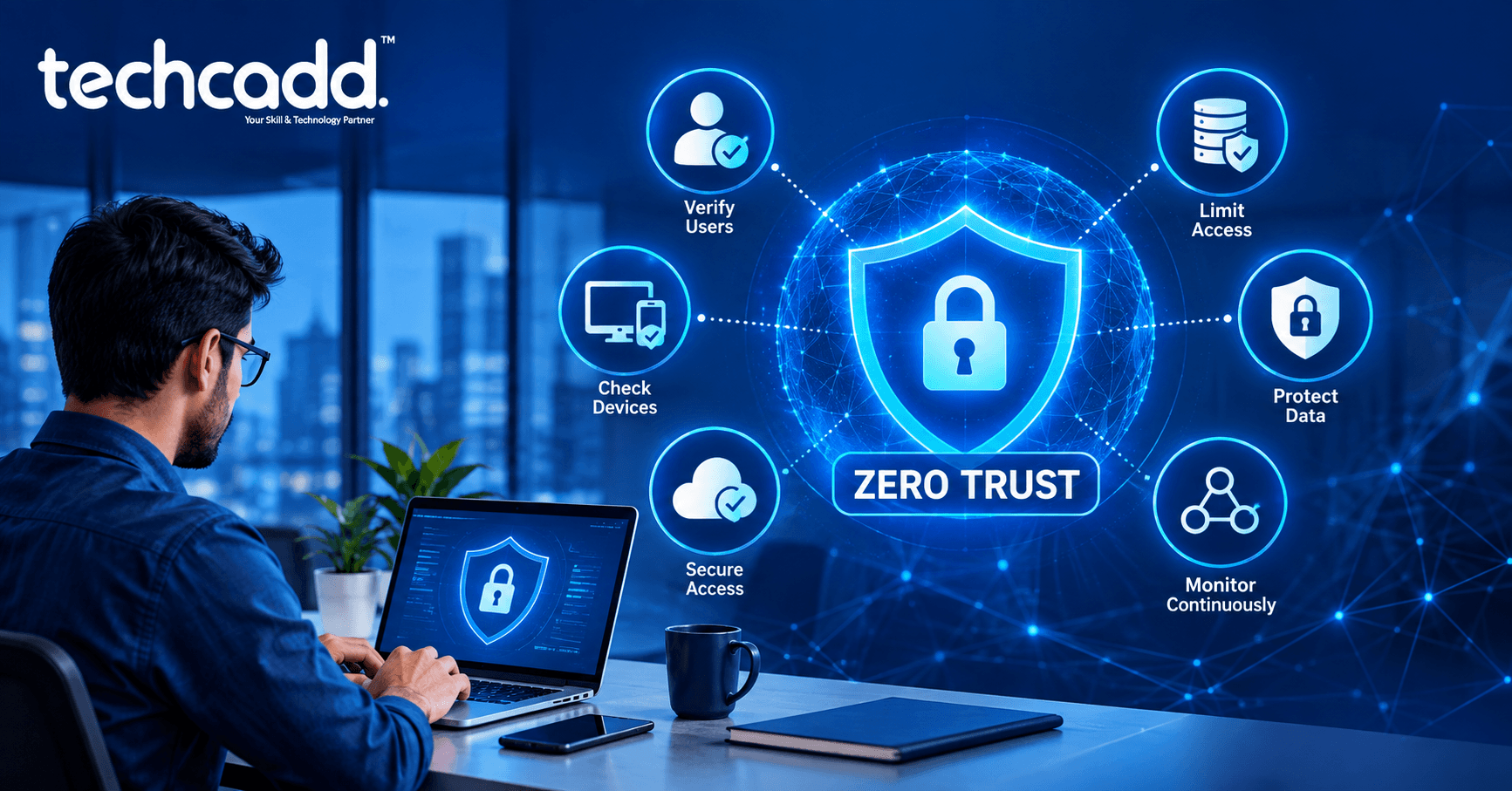
Zero Trust Security Explained: Why Businesses Are Adopting It
For years, cyber security worked a lot like a castle with a big wall around it. Once you were inside the wall — connected to the company network — you were trusted. You could access files, systems, and data with relatively little friction, because the assumption was simple: if you're inside, you must belong here.
That assumption has completely broken down. Employees now work from home, coffee shops, and shared offices. Data lives across multiple cloud platforms instead of one central server. Personal devices connect to company systems constantly. The "wall" businesses used to rely on simply doesn't exist in the same way anymore.
This is exactly why Zero Trust Security has become one of the most talked-about cyber security approaches among businesses today, including many organizations that support or work alongside businesses in Hoshiarpur. Understanding what Zero Trust actually means — and why it's spreading so quickly — matters not just for IT professionals, but for anyone studying business, technology, or planning to work in an increasingly digital-first environment.
What Zero Trust Security Actually Means
The core idea behind Zero Trust can be summarized in one simple phrase: "Never trust, always verify."
Traditional security models trusted anyone or anything already inside the network. Zero Trust flips this completely. It assumes that no user, device, or system should be automatically trusted, regardless of whether they're inside or outside the company network. Every single request for access — whether it's an employee opening a file or a device connecting to a system — must be verified before access is granted.
This might sound like it creates unnecessary friction, but the logic behind it is sound. In today's environment, threats don't just come from outside a network anymore. A compromised employee account, an infected personal device, or an insider threat can cause just as much damage as an external hacker, and traditional "trust once you're inside" models simply weren't designed to catch these situations.
The Problem With the Old Security Approach
To understand why Zero Trust matters, it helps to understand exactly what was failing about the traditional approach, often called "perimeter security."
Perimeter security worked reasonably well when most employees worked from a single office, using company-owned devices, connected to one internal network. The "wall" made sense because there was a clear boundary between "inside" (trusted) and "outside" (untrusted).
But several major shifts broke this model:
Remote and hybrid work means employees connect from countless different locations and networks, many of which aren't secure.
Cloud computing means company data no longer sits in one physical location behind one firewall — it's spread across multiple cloud services, each with its own access points.
Personal devices (BYOD) used for work introduce security risks that a traditional company-controlled network was never designed to manage.
Increasingly sophisticated attacks mean that once an attacker gets past the outer defense, they often have free movement within the entire network, since internal systems assumed anyone inside was already trustworthy.
This last point is particularly important. Once an attacker breached the perimeter in old security models, they often had significant freedom to move around undetected, accessing far more than they should have been able to, simply because internal systems didn't continuously verify trust.
The Core Principles of Zero Trust
Zero Trust isn't a single tool or product — it's a security philosophy built on several core principles that work together.
Principle #1: Verify Explicitly
Every access request is verified based on all available information — user identity, device health, location, and behavior patterns — rather than assuming trust based on network location alone.
Principle #2: Use Least-Privilege Access
Users and systems are given only the minimum level of access necessary to perform their specific tasks, nothing more. If someone only needs access to one folder for their role, that's all they get, rather than broad access "just in case."
Principle #3: Assume Breach
Rather than assuming a breach won't happen, Zero Trust architecture is designed with the assumption that a breach could already be happening or could happen at any moment. This changes how systems are designed, focusing on limiting damage and detecting unusual activity quickly, rather than solely trying to prevent every possible entry point.
Principle #4: Micro-Segmentation
Instead of one large network where, once inside, movement is relatively unrestricted, Zero Trust divides networks into smaller, isolated segments. This means even if an attacker compromises one segment, they can't automatically move freely into others, significantly containing potential damage.
Principle #5: Continuous Monitoring
Access isn't verified once and then trusted indefinitely. Zero Trust systems continuously monitor user behavior and device status, re-evaluating trust throughout a session rather than just at the initial login point.
How Zero Trust Actually Works in Practice
Understanding the principles is one thing, but seeing how they come together in an actual business environment makes the concept much clearer.
Imagine an employee trying to access a company's financial reporting system. In a traditional security model, once they're logged into the company network, they might have relatively easy access to this system, since they're already "inside."
Under a Zero Trust model, the process looks different. The system checks the user's identity through multi-factor authentication, verifies that their device meets security requirements (updated software, no known malware), checks whether their typical behavior pattern matches this request (are they usually accessing this system at this time, from this location?), and grants access only to the specific financial data relevant to their role — not the entire system.
If anything seems unusual — an unfamiliar device, an unusual location, or behavior that doesn't match typical patterns — the system might require additional verification or block access entirely, even if the correct password was entered. This continuous, context-aware verification is what makes Zero Trust fundamentally different from traditional approaches.
Key Technologies That Support Zero Trust
Implementing Zero Trust typically involves several supporting technologies working together, rather than a single tool.
Multi-Factor Authentication (MFA): Requiring more than just a password — a code sent to a phone, biometric verification, or a hardware security key — significantly strengthens identity verification.
Identity and Access Management (IAM): Systems that manage who has access to what, ensuring permissions align with the least-privilege principle and can be adjusted quickly as roles change.
Endpoint Security: Continuously monitoring the health and security status of devices connecting to company systems, ensuring compromised or outdated devices don't gain access.
Network Segmentation Tools: Technology that divides networks into isolated zones, preventing free movement across an entire system if one segment is compromised.
Security Information and Event Management (SIEM): Systems that continuously monitor and analyze activity across an organization, helping detect unusual patterns that might indicate a security threat.
Why Businesses Are Adopting Zero Trust So Rapidly
Several converging factors have pushed Zero Trust from a niche security concept to a mainstream business priority.
The Rise of Remote and Hybrid Work
With employees connecting from countless locations and networks, the traditional idea of a secure "company network perimeter" has essentially disappeared. Zero Trust doesn't rely on network location for security, making it naturally suited to this new working reality.
Increasing Cloud Adoption
As businesses move data and applications across multiple cloud platforms, traditional perimeter security becomes increasingly difficult to maintain, since there's no longer one central location to secure. Zero Trust's identity-based approach works regardless of where data physically resides.
Rising Cost and Frequency of Data Breaches
Data breaches have become both more common and more expensive, with significant financial and reputational consequences for businesses. Zero Trust's approach of limiting potential damage — through least-privilege access and micro-segmentation — directly addresses this by containing the impact of any single breach.
Regulatory and Compliance Pressure
Many industries now face increasing regulatory requirements around data protection and security practices. Zero Trust frameworks often align well with these compliance requirements, making adoption not just a security choice but increasingly a regulatory expectation.
Insider Threats and Compromised Credentials
A significant percentage of security incidents involve legitimate credentials being misused, either through insider threats or compromised accounts. Zero Trust's continuous verification approach helps catch unusual activity even when correct login credentials are used.
Common Doubts Businesses Have About Zero Trust
"Isn't Zero Trust just for large enterprises with big security budgets?"
While large enterprises were early adopters, many Zero Trust principles and tools have become increasingly accessible and affordable for small and medium businesses. Even implementing basic elements — like multi-factor authentication and least-privilege access — provides significant security improvement without requiring enterprise-level budgets.
"Won't this create too much friction for employees trying to do their jobs?"
This is a valid concern, and well-implemented Zero Trust systems are designed to minimize unnecessary friction for legitimate, expected behavior while adding verification primarily for unusual or higher-risk requests. Modern systems increasingly balance security with user experience, rather than creating constant, disruptive verification steps.
"Is Zero Trust a one-time implementation or an ongoing process?"
Zero Trust is best understood as an ongoing security philosophy and architecture, not a one-time software installation. It requires continuous refinement as business needs, technology, and threats evolve over time.
Zero Trust in the Context of Remote and Hybrid Businesses
For businesses embracing remote or hybrid work models, Zero Trust isn't just a security enhancement — it's often becoming a practical necessity. When employees connect from home networks, coworking spaces, or while traveling, the traditional assumption that "internal network access equals trustworthy access" simply doesn't hold up.
Zero Trust allows businesses to maintain strong security regardless of where employees are physically located, verifying trust based on identity, device security, and behavior rather than network location. This makes it particularly relevant for businesses in Hoshiarpur and similar growing business hubs, where remote work and cloud-based operations are increasingly common, even among small and medium enterprises.
How Businesses Can Start Moving Toward Zero Trust
Implementing Zero Trust doesn't require a complete system overhaul overnight. Most businesses adopt it gradually, starting with foundational elements and expanding over time. A practical starting approach includes:
Step 1: Start With Strong Identity Verification
Implement multi-factor authentication across all critical business systems and accounts. This single step significantly strengthens security and forms the foundation that other Zero Trust principles build upon.
Step 2: Audit and Limit Access Permissions
Review who currently has access to what systems and data, and adjust permissions based on the least-privilege principle. Many businesses discover employees have far broader access than their actual role requires, simply because permissions were never revisited after initial setup.
Step 3: Segment Critical Systems
Rather than treating the entire network as one trusted zone, begin separating critical systems — financial data, customer information, administrative tools — into distinct segments with their own access controls.
Step 4: Implement Continuous Monitoring
Deploy tools that monitor user behavior and flag unusual activity, rather than relying solely on initial login verification. This helps catch potential threats that occur after someone has already gained initial access.
Step 5: Educate Employees on the Shift
Since Zero Trust changes how employees interact with company systems — potentially requiring additional verification steps — clear communication about why these changes matter helps reduce resistance and confusion during implementation.
A Realistic Example: Zero Trust in a Growing Business
Consider a mid-sized business with employees working both from a central office and remotely, using a mix of company-issued and personal devices to access cloud-based systems.
Under a traditional security model, once employees connected to the company VPN, they typically had broad access to internal systems, regardless of their specific role or the security status of their device. This created significant risk — a compromised personal laptop connecting through the VPN could potentially access far more than necessary.
After adopting Zero Trust principles, the business implements multi-factor authentication for all system access, ensures employees only access data and systems relevant to their specific role, and continuously monitors for unusual access patterns, such as someone attempting to access financial systems from an unfamiliar location at an unusual time.
When an employee's laptop later gets compromised through a phishing attack, the Zero Trust system immediately detects unusual behavior — attempts to access systems outside the employee's normal permissions — and blocks the activity before significant damage occurs, containing what could have otherwise been a much more serious breach.
Common Mistakes Businesses Make When Adopting Zero Trust
Trying to implement everything at once — Attempting a complete Zero Trust overhaul immediately often leads to significant disruption and employee frustration; a gradual, phased approach tends to work better.
Focusing only on technology without addressing culture — Zero Trust requires a shift in how employees think about security, not just new tools; skipping employee education undermines effective adoption.
Neglecting to regularly review and update access permissions — Zero Trust isn't a one-time setup; permissions and access levels need continuous review as roles and business needs change.
Creating excessive friction without balancing user experience — Overly aggressive verification requirements for every single action can frustrate employees and potentially lead to workarounds that undermine security.
Assuming Zero Trust eliminates all security risk — While significantly more effective than traditional models, Zero Trust reduces risk rather than eliminating it entirely; ongoing vigilance remains necessary.
Why This Matters for Students and Job Seekers
Understanding Zero Trust Security isn't just relevant for IT professionals anymore. As more businesses adopt this approach, understanding its principles has become increasingly valuable across various roles — from IT support to business operations to management positions overseeing technology decisions.
For students in Hoshiarpur pursuing careers in IT, cyber security, or even general business and operations roles, familiarity with Zero Trust concepts demonstrates awareness of current industry standards that employers increasingly expect, even in roles that aren't purely technical.
This is particularly relevant given how rapidly businesses are shifting toward cloud-based, remote-friendly operations, where traditional security assumptions simply don't apply anymore.
Where This Is Heading
Zero Trust Security continues to evolve as a standard expectation rather than an optional advanced security measure. As remote work, cloud computing, and increasingly sophisticated cyber threats continue shaping how businesses operate, the "never trust, always verify" approach is likely to become the default security philosophy across industries, rather than a specialized approach only large enterprises consider.
For businesses in Hoshiarpur and similar growing markets, adopting Zero Trust principles early — even gradually — provides a genuine competitive advantage, both in terms of actual security and in meeting increasingly common client and regulatory expectations around data protection.
Final Thought
Zero Trust Security represents a fundamental shift in how businesses think about protecting their systems and data — moving away from outdated assumptions about "safe" internal networks toward a model that verifies trust continuously, regardless of location or apparent familiarity.
For businesses navigating an increasingly remote, cloud-based, and threat-prone digital environment, Zero Trust isn't just a technical upgrade. It's a necessary evolution in security thinking that acknowledges a simple reality: trust should be earned and continuously verified, not assumed based on convenience or historical practice.
Understanding these principles, whether you're a business owner making security decisions or a student building relevant career skills, provides genuine, practical value in navigating a digital landscape where old security assumptions simply no longer hold up.


Comments
Nothing here yet. Be the first to say something.