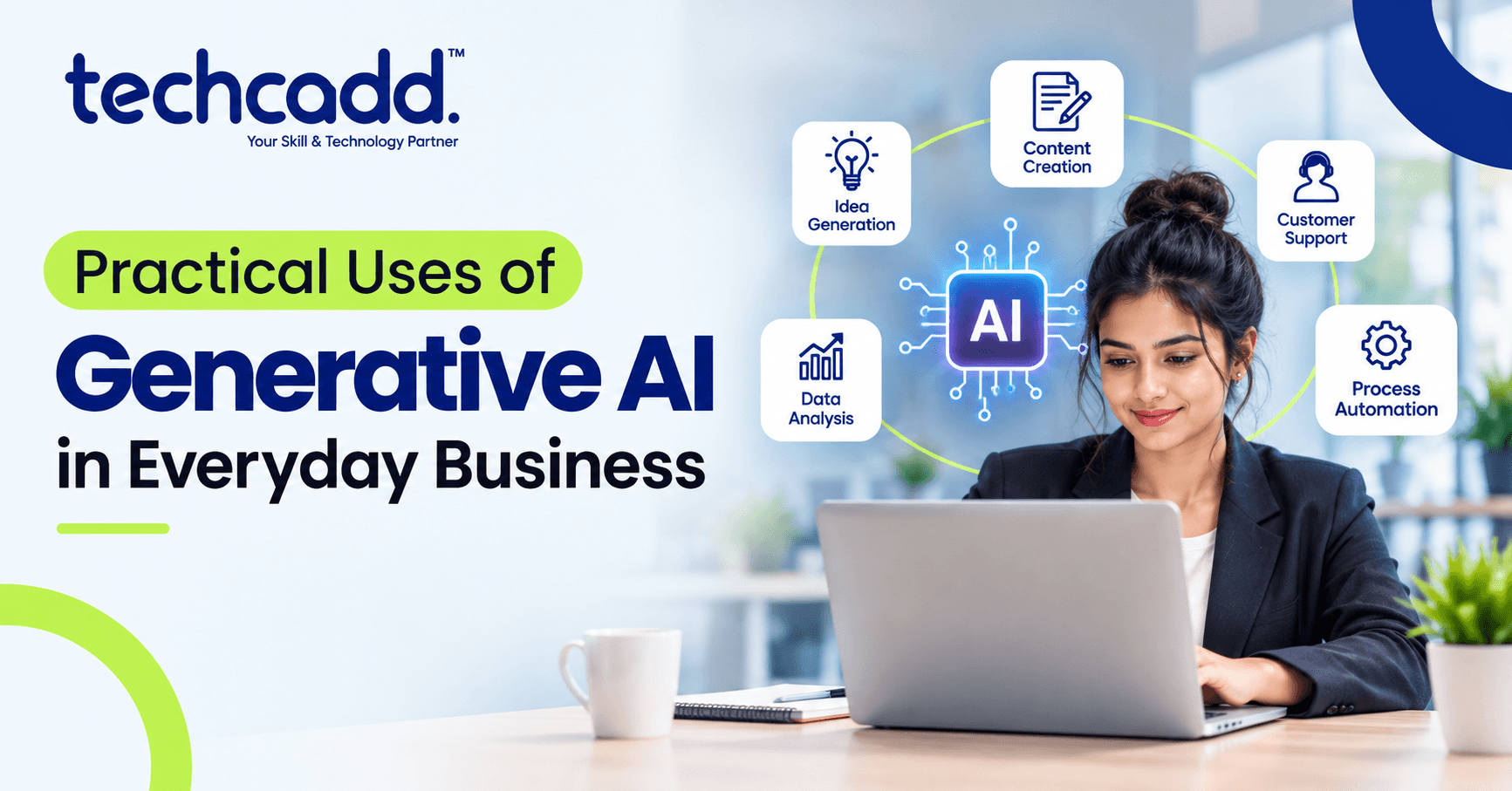
Practical Uses of Generative AI in Everyday Business
A couple of years back, "AI" sounded like something out of a sci-fi movie — robots, self-driving cars, futuristic labs. Today, if you've ever typed a prompt into ChatGPT to write a caption, used Canva's AI tool to design a poster, or asked an AI chatbot to draft an email for you, you've already used Generative AI. And chances are, you didn't even think of it as "advanced technology." It just felt... normal.
That's exactly how fast this shift has happened.
For business owners — whether you're running a coaching institute, a retail shop, or a small manufacturing unit in Hoshiarpur — Generative AI isn't some far-off concept reserved for big tech companies anymore. It's becoming a practical, everyday tool that's already changing how work gets done, often in ways people don't even realize.
What Exactly Is Generative AI?
Let's keep this simple, because a lot of confusion around AI comes from overcomplicated explanations.
Generative AI refers to AI tools that can create something new — text, images, videos, code, even voice — based on a prompt or instruction you give it. Unlike traditional software that follows fixed rules, generative AI learns patterns from huge amounts of data and uses that understanding to generate original content.
Tools like ChatGPT, Google Gemini, Midjourney, and Canva's AI features are all examples of generative AI already being used by millions of people daily — including small business owners who don't have a technical background at all.
You don't need to understand the complex algorithms behind it to use it effectively. In fact, that's the whole point — it's designed to be usable by everyone, not just engineers.
Why This Matters for Everyday Businesses, Not Just Tech Companies
Here's a common misconception — a lot of business owners assume AI tools are only relevant for IT firms, software companies, or large corporations with big budgets. In reality, generative AI often benefits small and medium businesses more, simply because it removes the need for hiring specialized staff for tasks that used to take hours.
A small business in Hoshiarpur trying to write social media captions, respond to customer queries quickly, or design a simple promotional poster doesn't need to hire a full marketing team anymore. Many of these tasks can now be done faster, and often just as effectively, with the right generative AI tools.
Practical Use #1: Writing Content Faster
This is probably the most widely used application of generative AI today, and for good reason.
Business owners use AI tools to:
Draft social media captions and post ideas
Write product descriptions for online stores
Create email newsletters or promotional messages
Draft replies to common customer queries
Generate blog content or website copy (with human review and editing)
The key thing to understand here — AI doesn't replace good writing judgment, but it removes the "blank page problem." Instead of staring at an empty screen wondering how to start, you get a rough draft in seconds that you can refine, personalize, and make your own.
For a business owner juggling multiple responsibilities, this alone saves hours every week.
Practical Use #2: Creating Visual Content Without a Design Team
Not every business can afford a dedicated graphic designer. This used to mean either learning basic design tools yourself or outsourcing every single poster, banner, or social media graphic.
Generative AI tools like Canva AI, Adobe Firefly, and various AI image generators have changed this completely. Now, a business owner can describe what they want — "a festive sale banner with red and gold colors for a clothing store" — and get a usable starting design within minutes.
This doesn't mean professional designers are becoming irrelevant. For high-stakes branding or complex campaigns, human expertise still matters significantly. But for everyday, quick-turnaround visual needs — a WhatsApp status update, a simple Instagram post, a flyer for a local event — generative AI has made design far more accessible for businesses without big budgets.
Practical Use #3: Customer Support and Communication
Ever noticed those chatbots on websites that answer basic questions instantly, even at 2 AM? Many of these are now powered by generative AI, capable of understanding natural language questions and responding conversationally, not just with pre-programmed scripted replies.
For businesses in Hoshiarpur dealing with repetitive customer questions — store timings, product availability, pricing, return policies — AI-powered chat support can handle a significant chunk of these queries automatically, freeing up staff to focus on more complex customer needs.
This doesn't mean removing the human touch entirely. Most businesses still want a real person available for detailed conversations or complaint resolution. But for the repetitive, predictable questions that eat up staff time daily, generative AI provides a genuinely practical solution.
Practical Use #4: Brainstorming and Idea Generation
Sometimes the hardest part of running a business isn't execution — it's coming up with fresh ideas. New product names, marketing campaign themes, festive offers, event concepts — generative AI tools are surprisingly good at rapid brainstorming.
Instead of spending an entire meeting trying to come up with ideas from scratch, business owners and teams increasingly use AI as a starting point — generating 10-15 rough ideas in minutes, then picking and refining the ones that actually fit their brand and audience.Practical Use #5: Simplifying Data and Reports
Not everyone enjoys going through long spreadsheets or complicated sales reports. Generative AI tools can now take raw data and summarize it into plain, easy-to-understand language.
Instead of manually analyzing a month's worth of sales numbers, a business owner can now ask an AI tool to summarize key trends — "Which products sold best this month?" or "Compare this month's sales to last month" — and get a clear, readable summary instantly.
This is particularly useful for small business owners who don't have a dedicated analyst on their team but still need to make informed decisions based on their numbers. It doesn't replace the need to understand your business, but it does remove a lot of the tedious manual work involved in interpreting data.
Practical Use #6: Translating and Localizing Content
For businesses operating in Hoshiarpur and nearby regions, communication often happens in a mix of Hindi, Punjabi, and English — sometimes within the same conversation. Generative AI tools have become remarkably good at translation and localization, helping businesses communicate more naturally with different customer segments.
Whether it's translating a product description, creating bilingual social media posts, or adapting marketing content for a specific regional audience, AI tools can generate a solid first draft that a business owner can then fine-tune based on local tone and cultural context.
Practical Use #7: Training and Onboarding New Employees
Creating training material — SOPs (standard operating procedures), FAQs, or onboarding guides — used to be a time-consuming task that often got postponed indefinitely because nobody had the time to sit down and write it properly.
Generative AI makes this process significantly faster. A business owner can describe a process in a few rough sentences, and AI tools can help structure it into a clear, step-by-step document. This is especially useful for small businesses where the owner or a senior employee holds most of the "tribal knowledge" that never gets written down properly.
Practical Use #8: Meeting Summaries and Follow-Ups
If you've ever left a meeting with vague notes and struggled to remember exactly what was decided, this use case will feel immediately relevant.
Several generative AI tools can now transcribe and summarize meetings automatically — pulling out key decisions, action items, and follow-up tasks. For a busy business owner attending multiple calls or meetings in a day, this eliminates the need to manually take detailed notes while also trying to actively participate in the discussion.
Common Doubts Business Owners Have About Using AI
A few questions come up repeatedly when business owners are introduced to generative AI tools for the first time.
"Will AI replace my employees?"
For most everyday business tasks, the honest answer is no — not replace, but assist. Generative AI works best as a productivity tool that handles repetitive or time-consuming tasks, freeing up employees to focus on higher-value work like building customer relationships, strategic decisions, and creative problem-solving that AI genuinely can't replicate.
"Is it expensive to start using AI tools?"
Not necessarily. Many popular generative AI tools, including ChatGPT and various design tools, offer free versions with substantial capabilities. Businesses often start with free tools, understand what genuinely helps their workflow, and only invest in paid versions once they see clear, practical value.
"Do I need technical knowledge to use these tools?"
This is one of the most encouraging aspects of generative AI today — most tools are designed with simple, conversational interfaces. If you can type a sentence describing what you need, you can use these tools effectively. No coding or technical background required for everyday business use cases.
"Is the content generated by AI reliable and accurate?"
This is an important and fair concern. Generative AI is excellent at producing drafts and starting points, but it can occasionally get facts wrong or produce generic content. The best approach is treating AI output as a first draft — something to review, verify, and personalize — rather than a final, ready-to-publish product.
How Businesses in Hoshiarpur Can Start Using Generative AI Today
You don't need a big transformation plan to start benefiting from generative AI. Most businesses see the best results by starting small:
Pick one repetitive task that takes up significant time each week — writing social media captions, responding to common customer queries, or drafting basic reports.
Experiment with a free AI tool for that specific task for two to three weeks.
Evaluate whether it genuinely saves time and improves quality.
Gradually expand to other areas once you're comfortable with how these tools work.
This gradual approach helps business owners build genuine confidence with AI tools, rather than feeling overwhelmed by trying to implement everything at once.
Real-World Example: A Small Business Using AI Practically
Let's take a simple, relatable example. Imagine a small clothing boutique in Hoshiarpur that wants to run a festive season promotion.
Without AI, this would typically involve: brainstorming a catchy offer, writing multiple social media captions, designing a banner (possibly outsourced), drafting a WhatsApp broadcast message, and maybe translating it into Punjabi for certain customer groups. This entire process could easily take a day or two, especially if the business owner is handling it alone alongside daily operations.
With generative AI tools, the same business owner could generate offer ideas in minutes, create multiple caption variations instantly, design a decent starting banner using an AI design tool, draft the WhatsApp message, and get a quick Punjabi translation — all within an hour or two, leaving time to review, personalize, and add the human touch that makes the content feel authentic to their brand.
This isn't about removing effort or creativity from the process. It's about removing the time-consuming, repetitive parts so business owners can focus their energy on the decisions that actually require human judgment — tone, brand voice, and what genuinely resonates with their local customers.
Common Mistakes Businesses Make With Generative AI
As more businesses start experimenting with AI tools, a few recurring mistakes are worth being aware of:
Publishing AI content without review — Treating AI output as final, ready-to-use content without checking for accuracy, tone, or relevance to your specific business and audience.
Expecting AI to understand your brand instantly — Generic prompts produce generic results. The more specific and detailed your instructions, the better the output.
Ignoring the human touch entirely — Customers can often sense when communication feels robotic or impersonal. AI should enhance your voice, not replace it completely.
Not verifying facts or numbers — Especially for data-related content, always double-check AI-generated numbers or claims before sharing them externally.
Trying to do too much too soon — Attempting to overhaul every business process with AI at once often leads to confusion rather than genuine productivity gains.
Being aware of these patterns early helps businesses use AI tools more effectively, without falling into common traps.
Why Understanding This Skill Matters for Students Too
This isn't just relevant for business owners. For students and job seekers in Hoshiarpur, understanding how to use generative AI tools effectively is quickly becoming a genuinely valuable skill across multiple career paths — not just for those pursuing technical roles.
Marketing roles increasingly expect familiarity with AI-assisted content creation. Business and operations roles benefit from AI-powered data summarization. Even customer support roles now often involve working alongside AI chatbot systems rather than being replaced by them entirely.
Learning to use these tools thoughtfully — understanding both their capabilities and limitations — gives students a practical edge, whether they're planning to join an existing business or start their own venture eventually.
Where This Is Heading
Generative AI is evolving rapidly, and new practical applications are emerging constantly — from more advanced customer service automation to AI-assisted product design and even AI-powered market research.
For businesses in Hoshiarpur, the opportunity isn't about competing with big tech companies on cutting-edge AI research. It's about practically applying accessible AI tools to save time, reduce repetitive workload, and focus more energy on what genuinely grows the business — building relationships with customers, improving products and services, and making informed decisions faster.
The businesses that start experimenting with these tools today, even in small ways, tend to build a genuine comfort and advantage over those who wait until AI adoption becomes unavoidable.
Final Thought
Generative AI isn't about replacing human effort in business — it's about removing the repetitive, time-consuming parts of daily work so business owners and employees can focus on what actually requires human judgment, creativity, and relationship-building.
For businesses and students in Hoshiarpur, starting small with practical, everyday use cases — writing, design, customer communication, data summaries — is a genuinely accessible way to build comfort with a technology that's quickly becoming a standard part of how modern businesses operate.
The gap isn't between businesses that use AI and those that don't anymore. It's between those who understand how to use it thoughtfully, and those who either avoid it completely or rely on it blindly without review.

Comments
Nothing here yet. Be the first to say something.