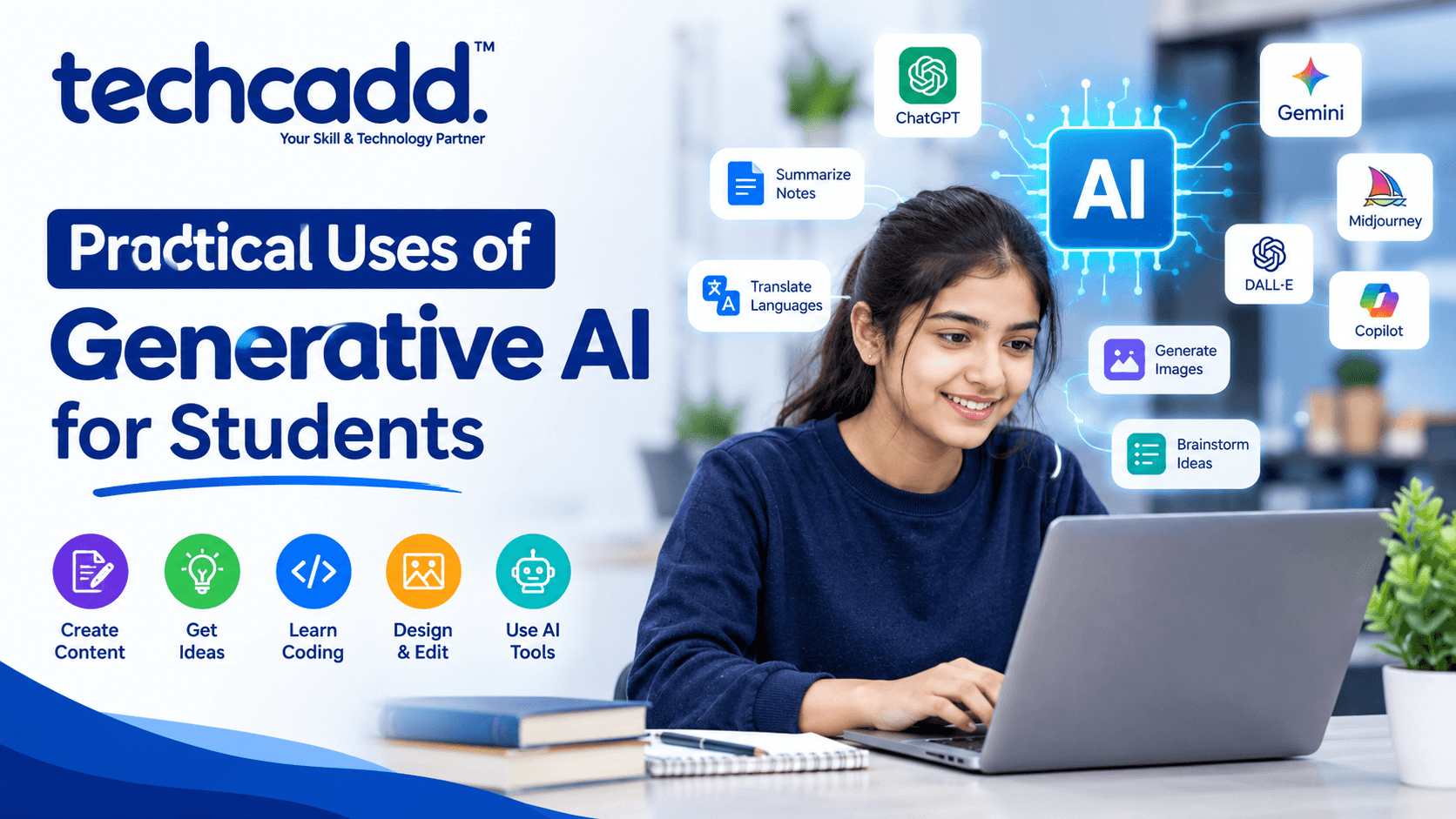
Practical Uses of Generative AI for Students
A few years ago, if you were stuck on a tricky assignment at midnight, your options were limited — flip through textbooks, wait until morning to ask a teacher, or hope a random forum post online had the answer. Today, a student in Hoshiarpur can open ChatGPT, ask a question in plain language, and get a clear explanation within seconds.
This shift has happened so quickly that many students are already using generative AI tools daily, often without fully realizing how much potential these tools actually have beyond just "getting quick answers." Understanding how to use generative AI properly — not just casually, but strategically — has quickly become a genuinely valuable skill for students, regardless of what field they're studying.
What Generative AI Actually Means for Students
Let's keep this simple. Generative AI refers to tools that can create content — text, images, code, summaries, even practice questions — based on what you ask it. Tools like ChatGPT, Google Gemini, and Claude are the most commonly used examples among students today.
For a student, this isn't just about asking a chatbot random questions. Used thoughtfully, generative AI can genuinely support studying, project work, skill-building, and even career preparation — as long as it's used to enhance learning rather than replace the actual effort of learning.
This distinction matters a lot, and we'll come back to it throughout this blog.
Practical Use #1: Simplifying Difficult Concepts
Every student has faced that moment where a textbook explanation just doesn't click, no matter how many times you read it. Generative AI tools are remarkably good at breaking down complex topics into simpler, more relatable explanations.
Instead of struggling with a dense paragraph about a difficult concept — whether it's a physics formula, a historical event, or a grammar rule — students can ask AI to explain it "like I'm a beginner" or "using a simple real-life example." This often makes concepts click faster than re-reading the same confusing textbook paragraph repeatedly.
A common concern here is, "Isn't this just doing the thinking for me?" Not if used correctly. The goal isn't to skip understanding — it's to get a clearer starting point, then verify and reinforce that understanding through practice and your own textbooks or class notes.
Practical Use #2: Creating Practice Questions and Self-Testing
One of the most underused features of generative AI among students is its ability to generate custom practice questions on any topic.
Instead of only relying on the practice questions provided in textbooks, students can ask AI tools to create additional questions on a specific topic they're struggling with, at whatever difficulty level they need. This is particularly useful for:
Preparing for exams by testing understanding of specific chapters
Practicing problem-solving in subjects like math or science
Creating quiz-style questions to reinforce memorization for subjects with heavy content
Generating scenario-based questions that test practical application, not just definitions
This transforms AI from a passive answer-giving tool into an active study partner that helps reinforce learning through practice.
Practical Use #3: Improving Writing and Language Skills
Whether it's an assignment, a project report, or even a college application essay, writing is a skill many students want to improve. Generative AI can play a genuinely useful role here, though the approach matters significantly.
Rather than asking AI to write an entire assignment (which raises both ethical and learning concerns we'll address shortly), students can use AI to:
Get feedback on grammar, clarity, and structure in their own writing
Understand why a particular sentence doesn't read well and how to improve it
Learn new vocabulary or better ways to phrase specific ideas
Practice different writing styles — formal, persuasive, descriptive — by comparing their own attempt with AI suggestions
Used this way, AI becomes a writing coach that helps students improve their own skills over time, rather than a shortcut that skips the learning process entirely.
Practical Use #4: Breaking Down Research and Summarizing Information
Research projects often involve going through large amounts of information — articles, papers, reports — which can feel overwhelming, especially for students still developing research skills.
Generative AI tools can help by summarizing long articles or documents into key points, explaining unfamiliar terminology found during research, and helping organize scattered information into a clearer structure before writing a final report.
This doesn't replace the need to read and understand the actual source material — especially for academic integrity and genuine learning. But it does help students navigate large amounts of information more efficiently, particularly when starting research on an unfamiliar topic.
Practical Use #5: Learning to Code and Understanding Technical Concepts
For students studying computer science, IT, or even just exploring coding as a beginner, generative AI has become an incredibly useful learning companion.
When stuck on a coding error, instead of spending hours confused about what went wrong, students can share their code and ask AI to explain the issue in simple terms. This doesn't just fix the immediate problem — it often teaches the underlying concept that caused the error in the first place.
Beyond debugging, students use AI tools to:
Get step-by-step explanations of how a piece of code works, line by line
Generate practice coding problems at their current skill level
Understand programming concepts explained in multiple different ways until one explanation clicks
Get suggestions on how to approach a coding project structurally before writing any code
The key habit worth building here is using AI to understand the "why" behind code, not just copying working solutions without comprehension. Students who copy code without understanding it often struggle later when facing similar problems independently, especially in interviews or practical exams.
Practical Use #6: Preparing for Interviews and Career Readiness
As students get closer to internships or job applications, generative AI becomes a genuinely practical tool for interview and career preparation.
This includes:
Practicing common interview questions and getting feedback on sample answers
Understanding what skills and qualifications are typically expected for specific roles
Getting help structuring a resume or cover letter (with the student's own experiences and achievements, not fabricated content)
Simulating mock interview scenarios to build confidence before the real thing
For students in Hoshiarpur preparing to enter competitive job markets, this kind of preparation — which used to require expensive coaching or mentorship — is now accessible for free or at minimal cost, leveling the playing field significantly.
Practical Use #7: Organizing Study Schedules and Time Management
Balancing multiple subjects, assignments, and exam preparation is a genuine challenge for most students. Generative AI can help create personalized study schedules based on exam dates, subject difficulty, and available study time.
Rather than a generic study plan found online, students can describe their specific situation — "I have five subjects, three exams in two weeks, and I struggle most with chemistry" — and get a customized study plan that accounts for their actual circumstances.
This doesn't guarantee discipline in following the plan, but it removes the initial mental effort of figuring out how to organize study time, which many students find genuinely overwhelming when juggling multiple priorities.
Practical Use #8: Exploring Career Options and Skill Gaps
Many students, especially in earlier years of college, aren't entirely sure which career path suits them best. Generative AI can serve as a useful exploratory tool here — not to make the decision for them, but to provide information that helps them think through options more clearly.
Students can ask about what a specific career path actually involves day-to-day, what skills are typically required for certain roles, or how to transition from their current field of study into a different career interest. This kind of accessible career exploration used to require access to mentors or career counselors, which not every student has readily available.
The Important Line: Using AI to Learn vs Using AI to Avoid Learning
This is perhaps the most important distinction every student needs to understand clearly.
Using generative AI to understand a concept better, practice additional questions, get writing feedback, or organize your study approach — this genuinely enhances learning. You're still doing the thinking, just with better support and faster access to explanations.
Using generative AI to write entire assignments without understanding the content, or complete work meant to test your own understanding — this creates a false sense of accomplishment while genuinely undermining learning and skill development, and often violates academic integrity policies.
The difference isn't about which tool you're using. It's about whether you're using it to build your own understanding or to bypass the process of building understanding entirely. Students who develop this awareness early tend to get significantly more genuine value from these tools throughout their academic and professional lives.
Common Concerns Students Have About Using AI
"Will using AI make me dependent and unable to think for myself?"
This depends entirely on how it's used. If AI becomes a replacement for thinking rather than a support for thinking, dependency becomes a genuine risk. The healthiest approach treats AI as a tutor that explains and guides, not as a tool that does the work for you.
"Is it considered cheating if I use AI for my studies?"
This varies significantly by institution and specific assignment. Using AI to understand a concept better is generally different from submitting AI-generated work as your own. When in doubt, it's always worth checking your institution's specific academic integrity policies regarding AI use.
"Do I need to pay for these tools to get real benefit?"
Not necessarily. Many powerful generative AI tools offer substantial free versions that are more than sufficient for typical student use cases like studying, practice questions, and basic research support.
How Students in Hoshiarpur Can Start Using AI Effectively
Getting started doesn't require any special technical background or complicated setup. A practical approach for students looking to genuinely benefit from these tools:
Step 1: Start With Understanding, Not Shortcuts
Begin by using AI purely for explanation and clarification — asking it to explain concepts you're already trying to learn, rather than asking it to complete assignments for you. This builds the right habit from the beginning.
Step 2: Use It as a Practice Partner
Once comfortable with basic usage, start generating practice questions and quizzes for subjects you find challenging. Test yourself, then use AI to check your understanding and explain anything you got wrong.
Step 3: Apply It to Real Skill-Building
Whether it's coding, writing, or research skills, use AI as a feedback tool on your own attempts rather than a replacement for the attempt itself. This is where genuine skill development happens.
Step 4: Extend Into Career Preparation
As you get closer to internships or job searching, start using AI for interview practice, resume feedback, and understanding what specific career paths actually require.
Step 5: Stay Aware of Institutional Policies
Different colleges and teachers have different views on acceptable AI use for coursework. Staying informed about your specific institution's policies prevents unintentional academic integrity issues.
A Realistic Example: A Day in the Life of a Student Using AI Well
Consider a college student in Hoshiarpur preparing for upcoming exams while also working on a project report and thinking about upcoming internship applications.
In the morning, they use AI to get a simplified explanation of a confusing chapter before their class, helping them follow the lecture more easily. During project work, they use AI to summarize a few lengthy research articles, helping them grasp the key points faster before diving into detailed reading. In the evening, while revising, they generate practice questions on topics they feel less confident about, testing themselves before checking explanations for anything they got wrong.
Over the weekend, preparing for an upcoming internship interview, they practice answering common questions with AI feedback, refining their responses based on suggestions. None of this replaces their own effort — it supports and accelerates their learning and preparation, while the actual thinking, understanding, and skill-building remains genuinely theirs.
This is a realistic, sustainable way students are already using these tools productively, without falling into the trap of using AI as a substitute for genuine learning.
Common Mistakes Students Make With AI Tools
A few patterns are worth being aware of, based on how students commonly misuse or underuse these tools:
Accepting AI explanations without verification — AI can occasionally provide incorrect information, so cross-checking important facts, especially for exams, remains important.
Using AI to complete entire assignments — This might save time short-term but genuinely undermines skill development and often violates academic policies.
Not customizing prompts for their specific needs — Generic questions produce generic answers; being specific about your exact confusion or requirement produces much more useful responses.
Ignoring institutional AI policies — Different teachers and institutions have different rules; not clarifying this can lead to unintended academic consequences.
Underusing AI for career preparation — Many students only use AI for academic subjects, missing out on its genuine usefulness for interview practice and career skill-building.
Why This Skill Matters Beyond Just Studying
Understanding how to use generative AI effectively isn't just useful during your student years — it's increasingly becoming an expected workplace skill across almost every industry and role.
Employers increasingly value candidates who understand how to use AI tools productively and responsibly, rather than either avoiding them entirely or misusing them as a complete substitute for genuine skill and effort. Students who develop thoughtful AI usage habits during their academic years enter the workforce with a genuine advantage, already comfortable with tools that are becoming standard across most professional environments.
Final Thought
Generative AI offers students in Hoshiarpur genuinely powerful support for learning, practicing, and preparing for their careers — but only when used thoughtfully, as a tool that enhances understanding rather than replaces the effort of building it.
The students who develop this balanced approach early — using AI to clarify, practice, and prepare, while still doing the genuine work of learning — tend to build both stronger academic performance and more valuable long-term skills than those who either avoid these tools entirely or misuse them as a shortcut around real effort.
Learning to use AI well isn't about working less. It's about learning smarter, understanding faster, and preparing more effectively for whatever comes next.
Comments
Nothing here yet. Be the first to say something.