How Machine Learning Is Used in Everyday Applications: A Guide for Hoshiarpur Students
Part 1
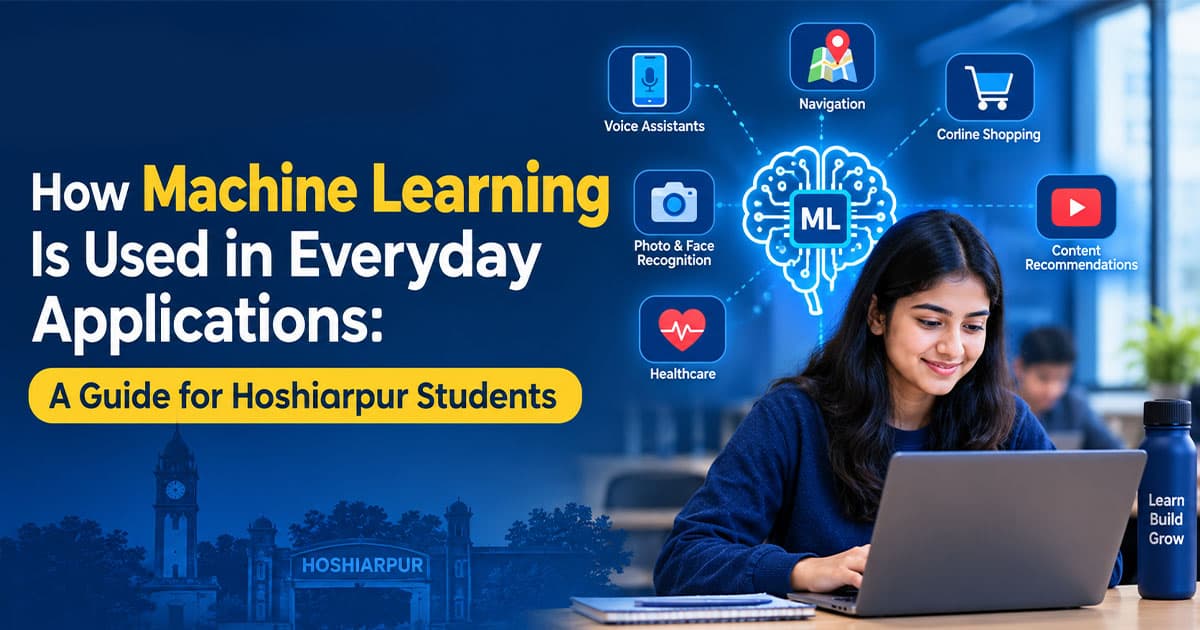
Think about the last time you opened YouTube. You probably didn't search for anything, you just scrolled, and somehow the app already knew what kind of video would keep you watching. Or think about the last time Google Maps rerouted you because of traffic, almost like it was watching the road for you. That's not magic. That's machine learning, quietly working in the background of apps you use every single day.
Here's the interesting part. Most people use machine learning dozens of times a day without ever realizing it. And if you're a student in Hoshiarpur wondering whether this "AI stuff" is too advanced or too far removed from real life, this blog is here to show you otherwise.
What Is Machine Learning, in Plain Words?
Machine learning is a way of teaching computers to learn patterns from data and make decisions or predictions, instead of being told exact rules for every single situation.
Here's a simple way to picture it. If you wanted to teach a child to recognize a dog, you wouldn't hand them a rulebook listing every possible dog breed, size, and color. You'd show them pictures of many dogs, and over time, they'd start recognizing dogs on their own, even ones they've never seen before. Machine learning works in a similar way. You feed a computer system lots of examples, and it learns to spot patterns and make predictions based on what it has seen.
This is different from traditional programming, where a developer writes out exact instructions for every scenario. With machine learning, the system builds its own understanding from data, which is exactly why it can handle situations a programmer never explicitly planned for.
Everyday Apps Where Machine Learning Is Quietly Working
Let's go through examples you've almost certainly experienced yourself, because understanding the "why" behind the apps you already use makes this topic feel a lot less abstract.
1. Streaming recommendations (Netflix, YouTube, Spotify)
Ever wondered how YouTube seems to know you'll enjoy a video before you even click it? Machine learning models study your watch history, how long you stayed on a video, what you skipped, and what similar users enjoyed. Based on these patterns, the system predicts what you're likely to watch next. The more you interact, the more refined these suggestions become.
2. Google Maps and traffic prediction
When Google Maps tells you a route will take 23 minutes instead of the usual 15, that's machine learning analyzing real-time data from thousands of phones on the road, combined with historical traffic patterns for that time of day. It's constantly updating its predictions as new data comes in.
3. Voice assistants (Google Assistant, Siri, Alexa)
When you say "set an alarm for 7 AM," the assistant needs to convert your spoken words into text, understand your intent, and then act on it. This involves a branch of machine learning called natural language processing, which helps computers understand human language, including different accents and speaking styles.
4. Spam filters in email
Your email inbox filters out spam almost silently. Machine learning models are trained on millions of emails, learning the patterns that typically appear in spam, like certain phrases, suspicious links, or sender behavior. Over time, these filters adapt as spammers change their tactics.
5. Face unlock and photo tagging
When your phone unlocks by recognizing your face, or when Google Photos automatically groups pictures of the same person together, that's a machine learning model trained to recognize facial features and patterns.
6. Online shopping recommendations
Ever noticed how Amazon or Flipkart shows you "customers who bought this also bought" suggestions? This comes from analyzing buying patterns across millions of users to predict what might interest you specifically.
7. Banking and fraud detection
When your bank sends an alert about a suspicious transaction, machine learning is comparing that transaction against your normal spending patterns and flagging anything unusual, often within seconds.
Why This Matters for Students in Hoshiarpur
Here's something worth sitting with. Machine learning isn't some far-off futuristic concept restricted to big tech companies in Silicon Valley. It's already woven into daily life, and the businesses using it are expanding into every city, including smaller cities like Hoshiarpur.
Local businesses are starting to use recommendation systems, chatbots, and predictive tools in their own small ways. A student who understands even the basics of how machine learning works has a genuine head start, not because everyone needs to become a data scientist, but because this understanding is becoming part of general digital literacy, much like knowing how to use Excel was a decade ago.
A Common Doubt: "Isn't Machine Learning Too Difficult for Someone Like Me?"
This is probably the biggest fear holding students back, and it's worth addressing honestly.
Yes, building advanced machine learning models that power something like Google's search engine requires serious mathematical and programming expertise. Nobody is pretending otherwise. But understanding how machine learning works, what it's good at, what its limitations are, and how to apply basic machine learning tools to solve real problems? That's genuinely accessible, even to someone starting from zero.
Think of it like driving a car. You don't need to understand how an engine is manufactured to become a confident driver. Similarly, you don't need to build a neural network from scratch to use machine learning tools effectively or to understand how they're shaping the products around you.
A Quick Way to See It in Action
Try this sometime. Open YouTube and watch three or four videos on a topic you don't normally watch, maybe cooking videos if you usually watch gaming content. Within a day or two, you'll start seeing more cooking-related recommendations on your homepage. That shift you're witnessing is a machine learning model updating its understanding of your preferences in real time.
This small experiment is actually a great way to internalize what machine learning does. It's not guessing randomly. It's learning from behavior, constantly adjusting its predictions based on new information.
Different Types of Machine Learning (Explained Without the Jargon)
If you start exploring this topic further, you'll come across terms like "supervised learning" or "reinforcement learning" that can sound intimidating at first. Let's break them down in a way that actually makes sense.
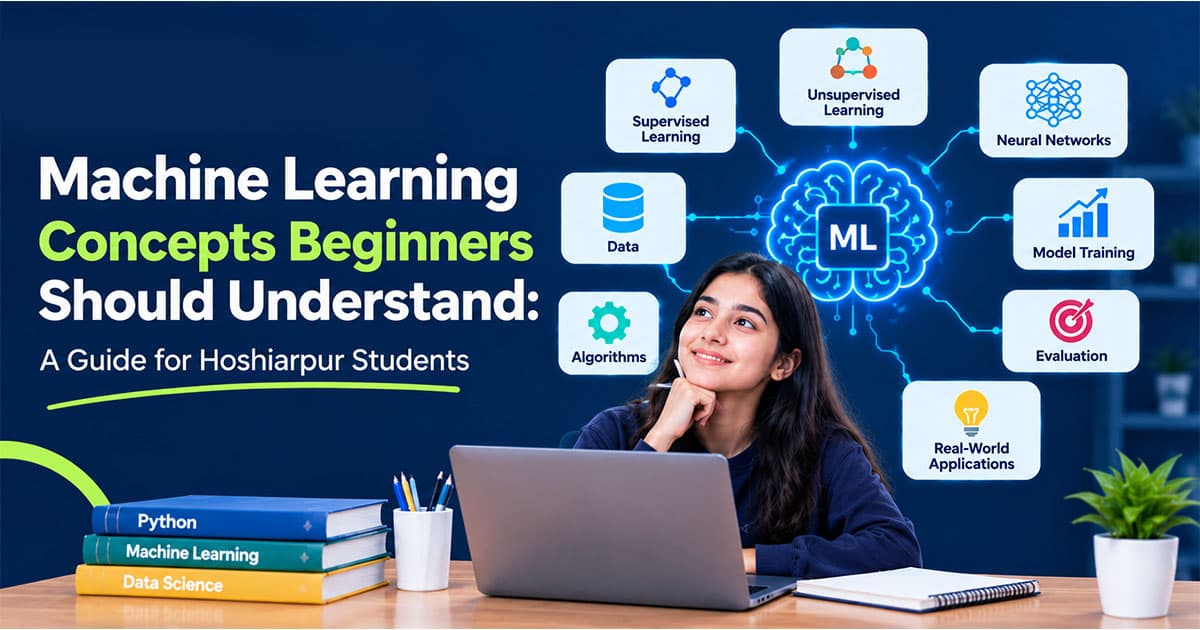
1. Supervised learning
This is like learning with an answer key. You show the computer lots of examples along with the correct answers, and it learns to predict the answer for new, unseen examples. For instance, if you show a system thousands of emails labeled "spam" or "not spam," it learns the patterns that separate the two, so it can later classify a brand new email on its own.
2. Unsupervised learning
Here, there's no answer key. The system looks at data and finds patterns or groups on its own. A good example is how e-commerce platforms group customers into segments, like "frequent discount shoppers" or "premium buyers," without anyone manually labeling each customer first.
3. Reinforcement learning
This works through trial and error, similar to how you'd train a pet with rewards. The system takes an action, gets feedback on whether it was good or bad, and adjusts future behavior accordingly. This is commonly used in things like game-playing AI and robotics, where a system improves through repeated attempts.
You don't need to memorize these definitions word for word. What matters is understanding that machine learning isn't one single technique. It's a collection of approaches, each suited to different kinds of problems.
How Machine Learning Actually Learns: A Simple Walkthrough
Let's say a company wants to build a system that predicts whether a customer will like a particular product. Here's roughly what happens, broken into simple steps.
Step 1: Collecting data
The system needs examples to learn from, like past purchases, browsing behavior, ratings, and reviews.
Step 2: Cleaning the data
Real-world data is messy. There might be missing values, duplicate entries, or inconsistent formatting. This step involves fixing those issues so the model doesn't learn from flawed information.
Step 3: Choosing a model
Depending on the problem, different mathematical approaches work better than others. This is where the technical, math-heavy side of machine learning comes in, usually handled by trained data scientists or machine learning engineers.
Step 4: Training the model
The model studies the data repeatedly, adjusting itself to get better at making accurate predictions.
Step 5: Testing and refining
Before deployment, the model is tested on new data it hasn't seen before, to check if it actually generalizes well rather than just memorizing the training examples.
Step 6: Deployment and continuous learning
Once live, the model keeps receiving new data and, in many cases, continues to improve over time.
Notice something here. While building the model from scratch requires technical expertise, understanding this process, what each step means and why it matters, is something anyone can grasp with a bit of patience.
Common Mistakes Beginners Make When Learning About Machine Learning
Mistake 1: Trying to learn everything at once
Machine learning is a huge field. Beginners often try to learn deep mathematics, multiple programming languages, and advanced algorithms simultaneously, which leads to burnout. Start with the big picture concepts first, then go deeper gradually.
Mistake 2: Skipping the "why" and jumping straight to tools
Some students rush to use machine learning tools or libraries without understanding what's actually happening underneath. This works for simple tasks but creates confusion the moment something goes wrong or needs adjustment.
Mistake 3: Assuming machine learning is always accurate
Machine learning models make predictions based on patterns, not certainties. They can be wrong, sometimes confidently wrong. Understanding this limitation is important, especially if you plan to work with these systems professionally.
Mistake 4: Ignoring the data quality problem
A common saying in this field is "garbage in, garbage out." If the data used to train a model is biased or flawed, the model's predictions will reflect those flaws. Beginners sometimes focus only on the algorithm and forget that data quality often matters more.
Mistake 5: Comparing yourself to advanced practitioners too early
It's easy to feel discouraged scrolling through impressive projects online. Remember that those creators started exactly where you are now. Everyone's learning curve looks different, and comparing your week one to someone else's year five rarely helps.
Is This Suitable for Complete Beginners?
Yes, particularly if you approach it the right way. You don't need to start with complex mathematics or advanced coding. Begin with understanding concepts: what problems machine learning solves, how it's used around you, and why certain approaches work better for certain tasks. Once these foundations feel comfortable, moving into basic coding and simple projects becomes much less overwhelming.
Many students assume they need a strong background in statistics or advanced math before even starting. While deeper math definitely helps as you advance, plenty of beginner-friendly tools and platforms let you experiment with machine learning concepts using simple, guided interfaces first.
Do You Need Previous Experience?
Not necessarily. Students from various academic backgrounds, including those without a strong computer science foundation, have successfully built careers touching machine learning, especially in roles that focus on applying existing tools rather than building algorithms from scratch.
That said, having some comfort with basic logical thinking and a willingness to learn fundamental programming concepts will make your journey noticeably smoother. If terms like variables, loops, or functions sound completely foreign right now, spending some time on basic programming first will pay off later.
What Should You Learn First?
If you're genuinely starting from zero, here's a practical learning order:
Basic programming concepts, ideally starting with Python, since it's widely used in this field
Core machine learning concepts, understanding what supervised, unsupervised, and reinforcement learning actually mean
Basic statistics and data concepts, enough to understand what the numbers behind a model actually represent
Simple hands-on projects, using beginner-friendly tools and datasets
Specific libraries and frameworks, once fundamentals feel solid
Real-world applications, exploring how industries like healthcare, finance, or marketing use these techniques
This order helps you build genuine understanding rather than memorizing steps without grasping what's actually happening.
How This Connects to Opportunities Around Hoshiarpur
It's easy to assume machine learning careers only exist in big metro cities or at massive tech companies, but that picture is changing quickly. Many companies now hire remotely for roles that involve working with data and machine learning tools, which means your location matters far less than it used to.
Beyond that, local businesses are also beginning to explore these technologies in smaller, practical ways. A retail business might want to understand buying patterns among its customers. A coaching institute might want to predict which students are likely to need extra support based on their test performance. An local online seller might want a basic recommendation feature on their website. These aren't massive, complex projects requiring a huge team. Someone with foundational machine learning knowledge, combined with practical problem-solving skills, can genuinely help with projects like these.
This matters because it means your learning journey doesn't require you to move away immediately or compete only in saturated job markets. There's genuine room to build skills here and work either remotely or with growing local businesses that are just beginning to explore what's possible.
How Difficult Is It, Really?
Let's be honest instead of just encouraging. Machine learning does have a real learning curve, and pretending otherwise wouldn't be fair to you. Concepts like probability, statistics, and certain algorithms take time and repeated exposure before they truly click.
However, the difficulty often gets overstated because people imagine they need to understand everything at an expert level immediately. In reality, your understanding deepens gradually. The first time you learn about something like a decision tree, it might feel confusing. By the third or fourth time you encounter it in a different context, it usually starts making much more sense.
Most students find the conceptual side, understanding what machine learning can and cannot do, significantly more approachable than the technical implementation side. Starting with concepts before diving into heavy coding tends to make the entire learning experience feel far less intimidating.
What Can You Actually Do After Learning This?
Once you've built a foundational understanding of machine learning, several paths become realistic, even if you don't go on to become a highly specialized machine learning engineer:
Data analyst roles, where you work with data and sometimes use basic machine learning tools to find patterns and insights
AI-assisted marketing or business roles, applying machine learning-powered tools to improve business decisions without needing to build the underlying models yourself
Further specialization, moving toward becoming a machine learning engineer or data scientist if you enjoy the technical, mathematical side
Product and project roles, where understanding machine learning concepts helps you work effectively with technical teams, even if you're not writing the code yourself
Freelance or consulting work, helping smaller businesses understand and implement simple, practical machine learning tools suited to their needs
Notice that not every path requires becoming a deeply technical expert. Many valuable roles exist at the intersection of understanding machine learning concepts and applying them sensibly to real problems.
Will This Skill Actually Help Your Career?
Yes, and the relevance continues growing rather than fading. Almost every industry, from healthcare to agriculture to retail, is finding new ways to apply machine learning and AI more broadly. Even if your main career path isn't purely technical, having a working understanding of how these systems function makes you noticeably more adaptable and valuable across many roles.
Think about it this way. A marketing professional who understands how recommendation systems work can make smarter decisions about customer targeting. A business owner who understands basic fraud detection concepts can ask better questions when evaluating software solutions. This kind of applied understanding often matters more day-to-day than deep technical expertise, unless you're specifically pursuing a highly technical role.
A Few Honest Thoughts to Wrap This Up
If there's one thing worth remembering, it's that machine learning isn't some distant, abstract concept reserved for tech giants. It's already shaping the apps on your phone, the ads you see, and the recommendations guiding your daily choices. Understanding even the basics changes how you interact with technology, moving from simply using these tools to actually understanding what's happening behind them.
If you're a student in Hoshiarpur curious about this field, start small. Don't feel pressured to master everything immediately. Begin with understanding core concepts, notice machine learning at work in your everyday apps, and gradually build toward hands-on practice. This steady, curious approach tends to work far better than trying to rush toward expert-level knowledge overnight.
The field continues to grow, and the demand for people who genuinely understand how these systems work, whether at a technical or applied level, shows no signs of slowing down anytime soon.
Comments
Nothing here yet. Be the first to say something.