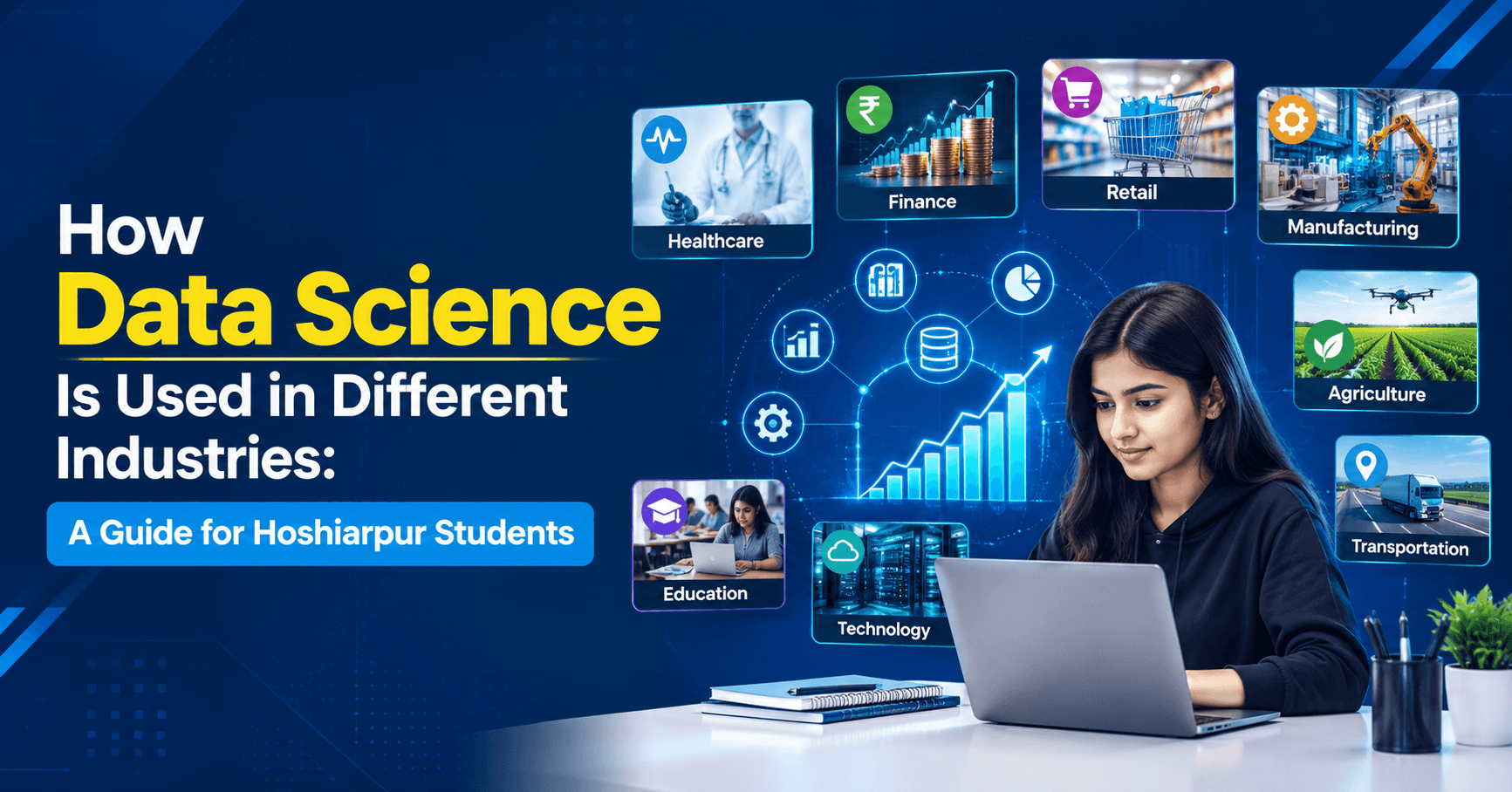
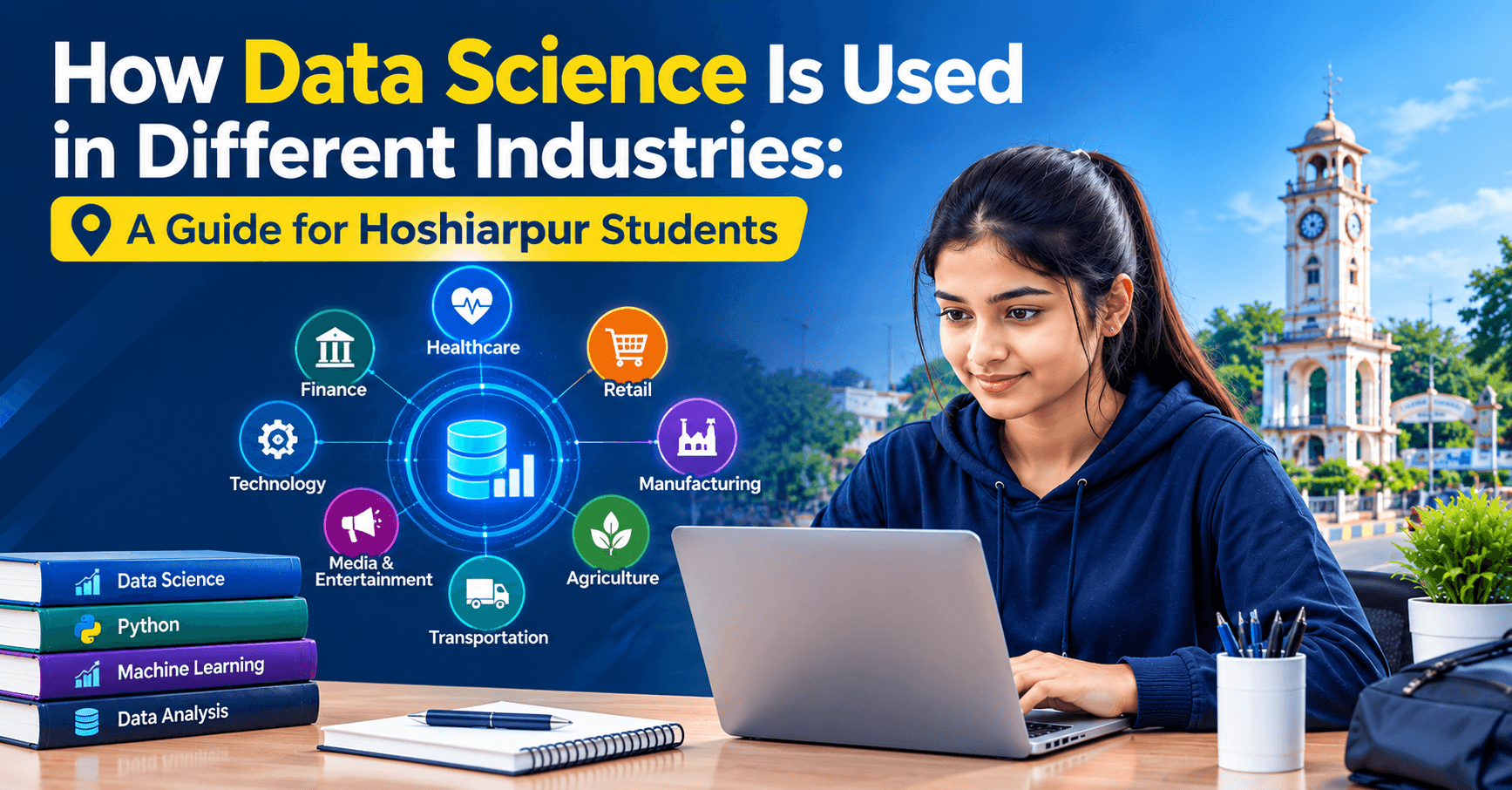
How Data Science Is Used in Different Industries
Think about the last time you opened a shopping app and saw a product you were just thinking about. Or when a map app told you to leave ten minutes early because of traffic you couldn't even see yet.
Nobody sat in an office guessing these things. Data did the work. And behind that data is a field called data science.
If you're a student in Hoshiarpur and you keep hearing "data science is the future" without anyone explaining what it actually does, this blog is for you. We'll look at how real industries use it, in plain language, and by the end you'll know whether it's something you'd like to explore.
So, what is data science?
Data science is the practice of collecting information, cleaning it, studying it and using it to answer questions or make better decisions.
That's really it. The word "science" makes it sound complicated, but the idea is something you already do in daily life.
Imagine you run a small tuition centre. You notice that students who attend the Saturday revision class usually score better in tests. You check last year's records and see the same pattern. So you decide to make Saturday classes a regular part of the schedule.
You collected information, studied it, found a pattern and made a decision. Data science does exactly this, just with much larger amounts of information and much better tools.
How does it actually work?
Most data science projects follow a similar path. Here's the simple version.
1. Ask a clear question. Everything starts here. "Why are our sales dropping?" or "Which patients are at higher risk?" A vague question leads to a vague answer.
2. Collect the data. Information can come from sales records, website visits, sensors, surveys, medical reports or app usage.
3. Clean the data. Real data is messy. There are missing values, spelling mistakes and duplicate entries. This step takes up a large part of the work, and it's less glamorous than people expect.
4. Explore and analyse. Here, you look for patterns using charts, tables and statistics. What changed? What repeats? What stands out?
5. Build a model (when needed). Sometimes you go further and teach a computer to predict something, like next month's demand or whether a customer might leave. This is where machine learning comes in.
6. Explain the result. A finding that nobody understands is useless. A good data scientist turns numbers into a clear story that a manager or shop owner can act on.
Notice that the last step is about communication, not coding. This surprises many students, and it's good news if you think you're "not a technical person."
Data science, data analytics and AI: are they the same?
They overlap, which is why people mix them up.
Data analytics mostly looks at past data to explain what happened and why.
Data science includes analytics but goes further, often predicting what might happen next.
Artificial intelligence is a broader area where machines perform tasks that normally need human thinking. Data science often supplies the information and methods that AI relies on.
You don't need to memorise these differences right now. Just know that they're connected, and learning one makes the others easier.
Healthcare: finding problems earlier
Hospitals and clinics produce huge amounts of information, from test reports to appointment records. Data science helps make sense of it.
Doctors and researchers use it to spot patterns in medical scans, predict which patients may need extra care and plan how many beds or staff a hospital will need during busy seasons. Pharmacies and labs use it to manage stock and avoid running out of important items.
On a smaller scale, even a local clinic can use basic data to understand which months bring more patients and prepare accordingly.
The key point isn't that computers replace doctors. It's that data gives doctors one more useful tool, so problems can be noticed earlier and resources used wisely.
Banking and finance: spotting risk and fraud
Think about how your bank sometimes sends an alert when a transaction looks unusual. That alert comes from data science.
Banks study millions of transactions to learn what normal behaviour looks like. When something doesn't match, such as a sudden large payment from a new location, the system flags it.
Data science also helps banks decide who is likely to repay a loan, helps insurance companies estimate risk and helps investment firms study market trends. Even payment apps you use daily rely on these methods to keep transactions safe.
For students, finance is a good example of why numbers and careful thinking matter. A small mistake in analysis can cost real money, so accuracy and honesty are part of the job.
What's coming next
So far, we've covered what data science is, how a typical project works, how it differs from analytics and AI, and how healthcare and banking use it.
In the next part, we'll look at more industries closer to everyday life, such as retail, agriculture, education, manufacturing, transport and marketing, and see how data science shows up in each.
In Part 1, we saw how data science works and how healthcare and banking use it. Now let's look at industries you meet in daily life, many of which are closer to Hoshiarpur than you might think.
Retail and e-commerce: knowing what people want
Ever noticed that a shopping app seems to know your taste? That's data science studying what you searched, what you bought and what people similar to you liked.
Retailers use it to:
Recommend products based on browsing and purchase history
Predict demand, so popular items don't run out and slow items don't pile up
Set prices based on season, competition and customer behaviour
Plan offers by finding which discounts actually bring customers back
A small garment shop can use the same thinking without any fancy software. Write down which items sell before festivals, which sizes finish first and which month is slow. That simple record, studied properly, is data science in its most basic form.
Agriculture: smarter decisions for farmers
Punjab's economy is closely tied to farming, so this one matters locally.
Data science helps farmers and agri-businesses by studying weather patterns, soil information, crop yields and market prices. Satellite images and sensors can show which part of a field needs more water. Models can estimate when a crop is likely to be ready and which market may offer better prices.
The idea isn't to replace a farmer's experience. It's to give them extra information, so decisions about water, fertiliser and selling time are less of a guess. This is also an area where young people with data skills can find real, meaningful work.
Education: understanding how students learn
Schools, colleges and online learning platforms collect information such as attendance, test scores and how long students spend on lessons.
Data science helps them notice patterns. Which topics do most students struggle with? Which students might fall behind if nobody helps? Which teaching method gives better results?
Online platforms also use it to suggest the next lesson or practice question based on how you performed earlier. If you've used a learning app that adjusts difficulty as you improve, that's data science at work.
For a coaching centre in Hoshiarpur, even a simple sheet comparing attendance and test marks can show which students need attention before exams.
Manufacturing and engineering: fewer breakdowns, better quality
Factories run on machines, and machines produce data: temperature, vibration, speed and output.
Data science helps predict when a machine is likely to fail, so repairs can happen before a breakdown stops production. This is called predictive maintenance, and it saves a lot of time and money. Cameras and sensors can also spot defects in products faster than the human eye, helping keep quality consistent.
Punjab has a strong base of small and medium manufacturing units, from tools and machinery to textiles and sports goods. Many of them are beginning to use data to track production, reduce waste and plan orders. People who understand both the work and the numbers are becoming valuable here.
Transport and logistics: faster, cheaper movement
Delivery apps, cab services, railways and courier companies all rely heavily on data.
They study traffic patterns, past delivery times and weather to estimate arrival times and choose better routes. Logistics companies plan how many vehicles to send and where to place goods so orders reach customers faster. Even bus and train operators use passenger data to adjust schedules.
When a delivery app shows "arriving in 18 minutes" and it's usually accurate, thousands of past trips are quietly being used to make that prediction.
Marketing and advertising: reaching the right people
Marketing is one of the most visible users of data science, and it's a field many students are curious about.
Businesses study which ads get clicks, which posts get shared and which customers actually buy. They divide audiences into groups, test different messages and track what brings real results instead of just likes.
Data helps answer practical questions: Which platform should we spend on? What time should we post? Which offer works better? Which customers are likely to return?
This is why digital marketing and data skills go well together. A marketer who can read numbers properly makes better decisions than one who relies on guesswork.
Entertainment and media: what you watch next
Streaming platforms, music apps and social media all use data science to recommend what you might enjoy. They study what you watch, skip, replay and share, then compare your behaviour with millions of others.
It's also used to decide what content to create, when to release it and which thumbnails attract more clicks. Even news apps arrange stories based on what readers tend to open.
Government and public services: better planning
Governments and city planners use data to plan roads, manage water supply, track disease outbreaks and understand population needs. Census information, traffic data and public surveys help decide where to build schools, hospitals and transport links.
Careful use of data can make public services more efficient and fair, though it also raises important questions about privacy, which we'll touch on later.
The common thread
Look back at all these industries and a pattern appears. Each one follows the same basic steps:
Collect information
Clean and study it
Find a pattern
Use it to make a better decision
The industry changes, but the thinking stays the same. That's good news for you, because learning data skills once can open doors in many fields instead of just one.
What's coming in the final part
So far, we've covered how retail, agriculture, education, manufacturing, transport, marketing, media and public services use data science.
In the final part, we'll get practical. We'll look at the skills you need, career options, a simple learning roadmap, project ideas, common mistakes, and how to take your first step from Hoshiarpur.
Skills, Careers and Your First Step into Data Science
You've seen how data science works across industries. The last part is about you: what to learn, what jobs exist, and how to start from Hoshiarpur without feeling lost.
"Is data science suitable for beginners?"
Yes, if you start in the right order. You don't need to be a maths topper or a coding expert on day one. Most people begin with spreadsheets and simple charts, then add programming and statistics step by step.
What you do need is curiosity and patience. Data is often messy, and answers don't appear instantly. If you enjoy asking "why is this happening?", you already have the right mindset.
Skills worth building
Technical skills:
Excel or Google Sheets: sorting, filtering, formulas and charts. Many real jobs start here.
SQL: the language used to pull information out of databases. It's simpler than most people expect.
Python: the most popular language for data work, with libraries like Pandas and NumPy for handling data.
Statistics basics: averages, percentages, probability and how to tell whether a pattern is real or just chance.
Data visualisation: turning numbers into clear charts using tools like Power BI, Tableau or Python.
Machine learning basics: only after the above, once you're comfortable with data.
Human skills:
Asking good questions: a clear question saves hours of confused analysis.
Communication: explaining findings in simple words to people who don't know the technical side.
Critical thinking: checking whether a result makes sense before trusting it.
Domain knowledge: understanding the industry you work in, whether that's marketing, healthcare, finance or farming.
If you only learn tools, you'll struggle to be useful. If you only understand the business, you'll struggle to find answers. The mix is what employers look for.
Career options
Data science isn't one job. It's a group of roles, and many are open to freshers who build a solid base.
Data Analyst: studies data and explains findings through reports and dashboards. This is the most common starting point.
Business Analyst: connects data with business decisions.
Marketing Analyst: tracks campaigns, customer behaviour and ad results.
Data Engineer: builds the systems that collect and organise data.
Machine Learning Engineer: builds and deploys prediction models.
Data Scientist: combines analysis, statistics and modelling to answer bigger questions.
BI Developer: creates dashboards that help teams track performance.
Salaries vary a lot by city, company and experience, so check current job listings instead of trusting one number from social media.
A simple roadmap
Adjust the pace to your own schedule. A slower pace is perfectly fine.
Months 1 to 2: Foundations. Learn Excel properly and understand basic statistics. Practise on small, real datasets, like your own expenses or class marks.
Months 3 to 4: SQL and Python basics. Learn to query data and write simple Python programs. Start using Pandas to clean and explore data.
Months 5 to 6: Visualisation and projects. Learn Power BI or similar tools. Build two or three projects and put them on GitHub with short explanations.
Months 7 to 8: Machine learning basics. Understand training and testing, and try simple models, such as predicting prices or classifying data.
Month 9 and beyond: Specialise and show your work. Pick a direction, such as marketing analytics or business analysis. Build one larger project, update your resume and LinkedIn, and start applying for internships or entry-level roles.
Project ideas
Local shop sales tracker: analyse which products sell best by month.
Student result analysis: find patterns between attendance and marks.
Social media performance report: study which posts get the most engagement.
Price predictor: estimate house or used-bike prices from a public dataset.
Crop or weather trend dashboard: use public agricultural data to visualise patterns.
Customer feedback analysis: group reviews into common complaints and compliments.
Local problems make stronger projects than copied tutorials. A real story about helping a shop or coaching centre in Hoshiarpur is far more convincing in an interview.
Mistakes beginners usually make
Jumping straight into machine learning. Without data basics, models feel like magic and break easily. Build the foundation first.
Watching tutorials without practising. Close the video and try it alone. That's where learning happens.
Ignoring data cleaning. A big part of real work is fixing messy data. Don't skip it.
Trusting results blindly. Always ask whether the numbers make sense.
Collecting certificates instead of projects. Certificates help, but projects prove your ability.
Forgetting communication. An insight nobody understands has no value.
Comparing yourself with others online. Everyone's pace is different. Compare with last month's you.
A word about privacy and responsibility
Data often contains personal details, like names, phone numbers, health information or bank transactions. Handling it carelessly can harm real people.
Good data professionals ask permission, protect private information and avoid using data in unfair ways. If a model gives biased results, they notice and fix it. This habit of care is a real skill, and employers value it.
Common questions students ask
Do I need a computer science degree?
Not necessarily. Many analysts come from commerce, science, arts and engineering backgrounds. Skills and projects matter a lot.
Do I need advanced maths?
Not to begin. Basic statistics and logical thinking are enough for early stages.
Is Python compulsory?
It's very useful, but you can start with Excel, SQL and Power BI and add Python later.
How long does it take to get job-ready?
Often six to twelve months of steady practice, depending on your time and background.
Can I learn it after graduation?
Yes. Many people start after college or even switch careers.
Will AI replace data analysts?
AI tools can speed up routine tasks, but someone still has to ask the right question, check the results and explain them. People who combine data skills with business understanding stay valuable.
Final thoughts
Data science isn't magic, and it isn't only for experts. It's a way of thinking: ask a clear question, look at the evidence and make a better decision. That approach is already shaping hospitals, banks, farms, shops and schools, and it will keep growing.
You don't have to master everything at once. Start with a spreadsheet, practise a little every day and build small projects that solve real problems. Over a few months, those small steps add up to skills people will pay for.
If you'd like guided, hands-on learning with real projects and regular feedback, techcadd in Hoshiarpur can help you build these skills step by step. Begin this week by taking a small set of data, like your monthly expenses, and finding one pattern in it. That's your first data science project.

Comments
Nothing here yet. Be the first to say something.