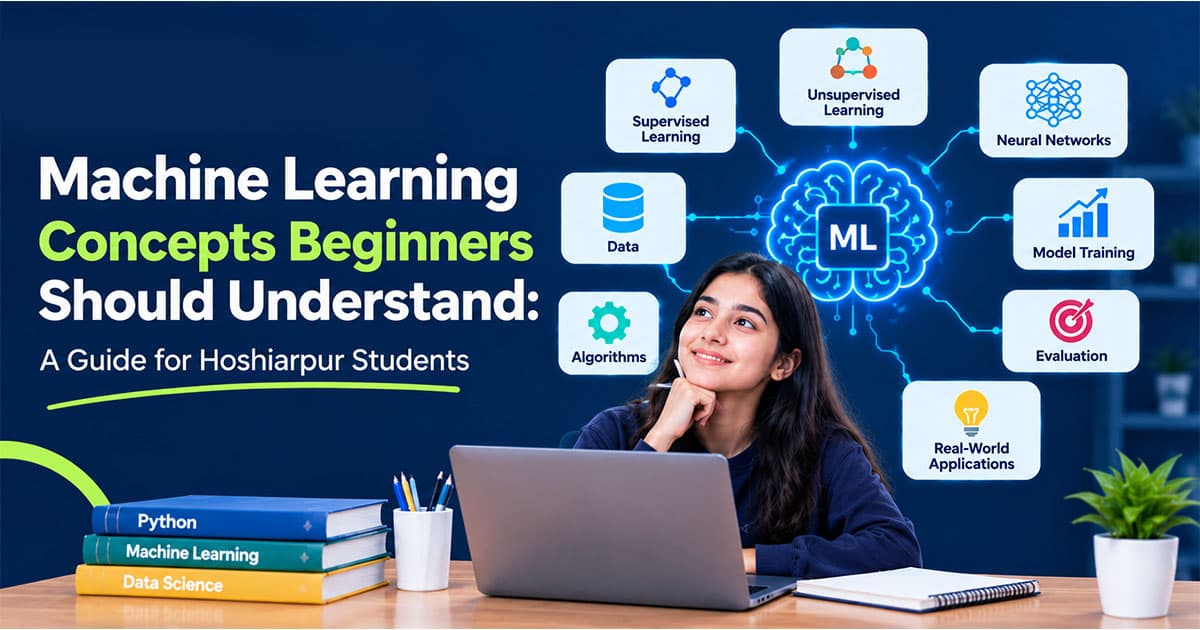
Machine Learning Concepts Beginners Should Understand: A Guide for Hoshiarpur Students
If you've ever opened a machine learning tutorial and closed it within five minutes because the page was full of terms like "gradient descent," "overfitting," and "feature engineering," you're not alone. Most beginners hit this wall early, and it's one of the biggest reasons people give up before they even get started.
Here's the thing though. Machine learning concepts aren't actually as complicated as the vocabulary makes them sound. Once someone breaks them down in plain language, with everyday examples, they start making real sense. That's exactly what this guide is here to do.
Why Understanding Concepts Matters More Than Jumping Straight to Code
A lot of students make the mistake of opening a coding tutorial on day one, copying code line by line, and running it without really understanding what's happening. It works for a short while, until something breaks or needs to be changed, and then they're stuck.
Think of it like learning to cook. You could follow a recipe exactly and get a decent dish once. But if you don't understand why you're adding salt at a certain stage, or why the pan needs to be hot before the oil goes in, you won't be able to adjust the recipe, fix a mistake, or cook something slightly different next time. Machine learning works the same way. Understanding the core concepts first means the code will actually make sense when you get to it, instead of feeling like magic you're copying blindly.
Concept 1: Data Is the Foundation of Everything
Before anything else, understand this: machine learning doesn't work without data. Lots of it, and ideally, good quality data.
Imagine trying to teach someone to recognize different fruits, but you only show them three blurry photos. They'd struggle to recognize fruits correctly later. Now imagine showing them hundreds of clear photos from different angles, lighting conditions, and fruit varieties. They'd learn to recognize fruits far more reliably.
Machine learning models learn in a similar way. The more relevant, accurate, and diverse the data, the better the model tends to perform. This is why data collection and cleaning are such a big part of any real machine learning project, even though they don't get as much attention as the flashy algorithms.
Concept 2: Features Are What the Model Actually Looks At
A "feature" is simply a measurable piece of information used to make a prediction. If you're building a model to predict house prices, features might include the size of the house, number of rooms, location, and age of the building.
Choosing the right features is often more important than choosing a fancy algorithm. A model with well-chosen features and a simple algorithm often outperforms a model with poor features and a complex algorithm. This is why experienced practitioners spend so much time thinking about which pieces of information actually matter for a given problem.
Concept 3: Training and Testing, Not Just "Running" a Model
One of the most important ideas in machine learning is the separation between training data and testing data.
Training data is what the model learns from. Testing data is a separate set the model has never seen before, used to check if it actually learned useful patterns, rather than just memorizing the examples it was shown. This is similar to how a good exam tests whether you actually understood a subject, rather than just memorized the exact questions from your practice papers. If you only ever answer questions you've already seen before, you can't be sure you've truly learned the subject.
Concept 4: Overfitting and Underfitting
These two terms confuse a lot of beginners, but they're genuinely simple once explained with an example.
Overfitting happens when a model learns the training data too precisely, including random noise and tiny details that don't actually matter. It performs great on the data it has seen but struggles with new, unseen data. Imagine a student who memorizes answers to last year's exact exam paper instead of understanding the subject. They'll do great if the same exact paper repeats, but poorly if even slightly different questions appear.
Underfitting is the opposite problem. The model is too simple to capture the actual patterns in the data, so it performs poorly even on the training data itself. This is like a student who barely studied and can't even answer basic questions correctly, let alone handle variations.
The goal is always to find a balance between the two, a model that has genuinely learned the underlying patterns well enough to handle new situations, without being so rigid that it only works on exact examples it has already seen.
A Common Doubt: "How Do I Know Which Concept Applies to My Problem?"
This is a fair question, and the honest answer is that it takes practice and exposure to different types of problems before this becomes intuitive. In the beginning, you're not expected to instantly know which approach fits a given situation. You learn this gradually, by working through examples, making mistakes, and slowly building a mental library of patterns you recognize from past problems.
Don't pressure yourself to "just know" this early on. Even experienced practitioners often experiment with a few different approaches before settling on what works best for a specific problem.
Why This Matters for Students in Hoshiarpur
If you're thinking about a career touching data, AI, or machine learning, understanding these foundational concepts gives you a real advantage over someone who only knows how to copy-paste code from tutorials. Employers and clients notice the difference between someone who can explain why a model isn't performing well and someone who can only say "it's not working" without understanding why.
This foundational understanding also makes you far more adaptable. Tools and specific coding libraries change over time, but core concepts like data quality, overfitting, and feature selection remain relevant no matter which specific tool or framework becomes popular next.
Concept 5: Labels and the Idea of "Supervised" Learning
A label is simply the correct answer attached to a piece of data during training. If you're building a model to identify whether an email is spam, each email in your training data would be labeled "spam" or "not spam." The model studies these labeled examples and learns to predict the label for new emails it hasn't seen before.
This is the foundation of supervised learning, probably the most common type of machine learning you'll encounter as a beginner. The word "supervised" makes sense once you think about it this way: the model is being supervised by correct answers during its learning process, similar to a student learning with a teacher checking their work.
Not all problems come with labels though, and that's where things get a bit different, which brings us to the next concept.
Concept 6: Finding Patterns Without Labels
Sometimes you don't have correct answers to learn from. You just have data, and you want to find patterns or groupings within it. This is where unsupervised learning comes in.
A practical example: imagine a business wants to understand its customers better, but there's no "correct" category each customer belongs to. An unsupervised learning model might look at purchase history, browsing behavior, and spending patterns, then group customers into clusters, like "occasional bargain shoppers" or "frequent high-spenders," without anyone manually labeling each customer beforehand.
The key difference to remember: supervised learning predicts something specific based on known answers, while unsupervised learning discovers hidden structure in data where no known answers exist.
Concept 7: Bias in Machine Learning
This concept matters more than most beginners initially realize. Bias in machine learning refers to a model producing unfair or skewed results, usually because the training data itself contained unfair patterns or didn't represent everyone fairly.
For example, if a hiring model was trained mostly on data from one type of candidate, it might unintentionally favor similar candidates in the future, even if that wasn't the intention. This isn't about the algorithm being "evil." It genuinely reflects patterns in the data it learned from, which is exactly why data quality and fairness matter so much in real-world applications.
Understanding this concept early builds a responsible mindset, one where you think critically about where your data comes from and whether it fairly represents the situations your model will actually face.
Concept 8: Accuracy Isn't the Whole Story
Beginners often assume that a model's "accuracy" is the single number that tells you whether it's good or not. In reality, accuracy alone can be misleading, especially when dealing with imbalanced situations.
Here's an example that makes this click instantly. Imagine building a model to detect a rare disease that only affects 1 in 1,000 people. A lazy model that simply predicts "no disease" for everyone would be 99.9% accurate, technically. But it would be completely useless, since it would miss every single actual case.
This is why practitioners look at other measures alongside accuracy, checking things like how well a model catches actual positive cases, and how often it raises false alarms. You don't need to memorize these measures in detail as a beginner, but understanding that "high accuracy" doesn't automatically mean "good model" is an important mental shift.
Concept 9: Algorithms Are Just Different Problem-Solving Approaches
A lot of beginners feel intimidated by the sheer number of algorithm names floating around, like decision trees, random forests, or neural networks. Here's a simpler way to think about it: these are just different strategies for finding patterns in data, each with its own strengths.
A decision tree works a bit like a flowchart of yes-or-no questions leading to a final decision. A neural network is inspired loosely by how the human brain processes information through connected layers. Different algorithms suit different types of problems, data sizes, and complexity levels.
You don't need to master every algorithm's inner mathematics as a beginner. What matters more initially is understanding that choosing an algorithm is a practical decision based on the specific problem, not a one-size-fits-all choice.
Common Mistakes Beginners Make With These Concepts
Mistake 1: Memorizing definitions without real examples
Many students try to memorize textbook definitions word for word, which rarely sticks. Understanding a concept through a relatable example, like the spam email or disease detection cases above, tends to stay with you far longer.
Mistake 2: Confusing correlation with causation
Just because two things appear related in data doesn't mean one causes the other. For instance, ice cream sales and drowning incidents both increase in summer, but ice cream doesn't cause drowning. Both are simply connected to hot weather. Beginners sometimes assume patterns in data automatically imply a cause-and-effect relationship, which isn't always true.
Mistake 3: Ignoring the business or real-world context
It's easy to get absorbed in technical details and forget what problem you're actually trying to solve. A technically impressive model that doesn't solve a real, practical problem isn't genuinely useful.
Mistake 4: Believing more data always equals a better model
While data generally helps, poor quality or irrelevant data can actually hurt a model's performance. Beginners sometimes assume quantity alone solves every problem, when quality and relevance often matter just as much, sometimes more.
Is This Suitable for Complete Beginners?
Yes, genuinely. None of these concepts require advanced mathematics to understand at a conceptual level. The examples used throughout, spam emails, disease detection, customer grouping, are everyday situations anyone can relate to, regardless of their academic background.
What matters is approaching these concepts patiently, one at a time, rather than trying to absorb everything in a single sitting. Most students find that once two or three concepts genuinely click, the remaining ones start connecting much faster, since many of these ideas build on each other.
What Should You Learn First?
If you're building your understanding from scratch, here's a sensible order to follow:
Data and features, understanding what the model actually learns from
Training versus testing, grasping why this separation matters
Supervised versus unsupervised learning, the two broad approaches to most problems
Overfitting and underfitting, recognizing these common pitfalls
Bias and fairness, building a responsible, critical mindset early
Evaluation beyond accuracy, understanding how models are actually judged
Basic algorithms, exploring a few common approaches once the fundamentals feel solid
This order prioritizes genuine understanding over memorization, which pays off significantly once you move into more technical, hands-on work.
How These Concepts Apply Beyond Just Theory
It's worth pausing here to connect these ideas back to real situations, because concepts that stay purely theoretical rarely stick for long.
Think about a local business in Hoshiarpur that wants to predict which customers are likely to return for a repeat purchase. Understanding features means knowing that things like purchase frequency, average order value, and time since last purchase probably matter more than, say, the customer's favorite color. Understanding training and testing means the business wouldn't trust a model just because it performed well on past data; they'd want to see how it performs on new, upcoming customers too. Understanding bias means checking whether the model is unfairly favoring one type of customer based on incomplete or skewed historical data.
Notice how none of this requires writing complex code to understand. It requires clear thinking about what the data represents and what the model is actually being asked to do. This is exactly the kind of thinking that makes someone genuinely useful in this field, regardless of how advanced their coding skills eventually become.
How Difficult Is It, Really?
Let's be honest rather than overly reassuring. Some of these concepts take a few attempts to truly click, especially ideas like overfitting or the limitations of accuracy as a measure. It's completely normal to read an explanation, feel like you understood it, and then feel confused again when you encounter it in a slightly different context a week later.
This back-and-forth is a normal part of learning, not a sign that you're bad at this. Revisiting concepts multiple times, through different examples and explanations, is often what makes them finally stick for good. Give yourself permission to revisit ideas rather than assuming you should understand everything perfectly on the first pass.
Most students find that once they build a comfortable grasp of five or six foundational concepts, everything else starts connecting far more naturally, since advanced topics are usually just extensions or combinations of these basics.
Do You Need Previous Experience?
No. These concepts are designed to be understood at a conceptual level before any serious coding or mathematics enters the picture. Students from commerce, arts, and science backgrounds, as well as complete beginners with no technical exposure, can genuinely grasp these ideas with patience and the right explanations.
What helps most is curiosity and a willingness to sit with slightly uncomfortable confusion for a bit, rather than giving up the moment something doesn't make immediate sense. This mindset matters more than any prior technical background.
What Can You Actually Do After Understanding These Concepts?
Once these foundational concepts genuinely make sense, several paths open up, even before you dive into heavy coding or advanced mathematics:
Moving confidently into hands-on learning, since code and tools will make far more sense once the underlying concepts are clear
Data analyst roles, where understanding these concepts helps you interpret and question data-driven insights more critically
Working alongside technical teams, in roles like product management or business analysis, where understanding machine learning concepts helps you communicate effectively with data scientists and engineers
Further specialization, moving toward becoming a machine learning engineer or data scientist, building on this conceptual foundation with deeper technical skills
Making smarter decisions as a business owner or marketer, by understanding what machine learning tools can realistically deliver and where their limitations lie
Notice that a solid conceptual foundation benefits you regardless of which specific direction you eventually choose.
Will This Skill Actually Help Your Career?
Yes, and perhaps more than many students initially expect. As more industries integrate machine learning and AI into their everyday operations, the ability to think clearly about data, question results critically, and understand both the capabilities and limitations of these systems becomes genuinely valuable, even outside purely technical roles.
Someone who understands these concepts can ask sharper questions, spot potential issues earlier, and communicate more effectively with technical teams, regardless of whether their own role involves writing code.
A Few Honest Thoughts to Wrap This Up
If you take away just one thing from this guide, let it be this: machine learning concepts aren't reserved for people with advanced math degrees. They're built from everyday logic, examples you already understand intuitively, like training versus testing, or recognizing when something feels unfairly skewed.
Take your time with these ideas. Revisit them when they feel confusing. Connect them to real situations around you, whether that's a recommendation you noticed online or a local business problem you've thought about. This steady, patient approach to understanding concepts first will make every technical skill you learn afterward feel far more intuitive and far less intimidating.
For students in Hoshiarpur genuinely curious about this field, there has rarely been a better time to start building this understanding, one concept at a time.
Comments
Nothing here yet. Be the first to say something.