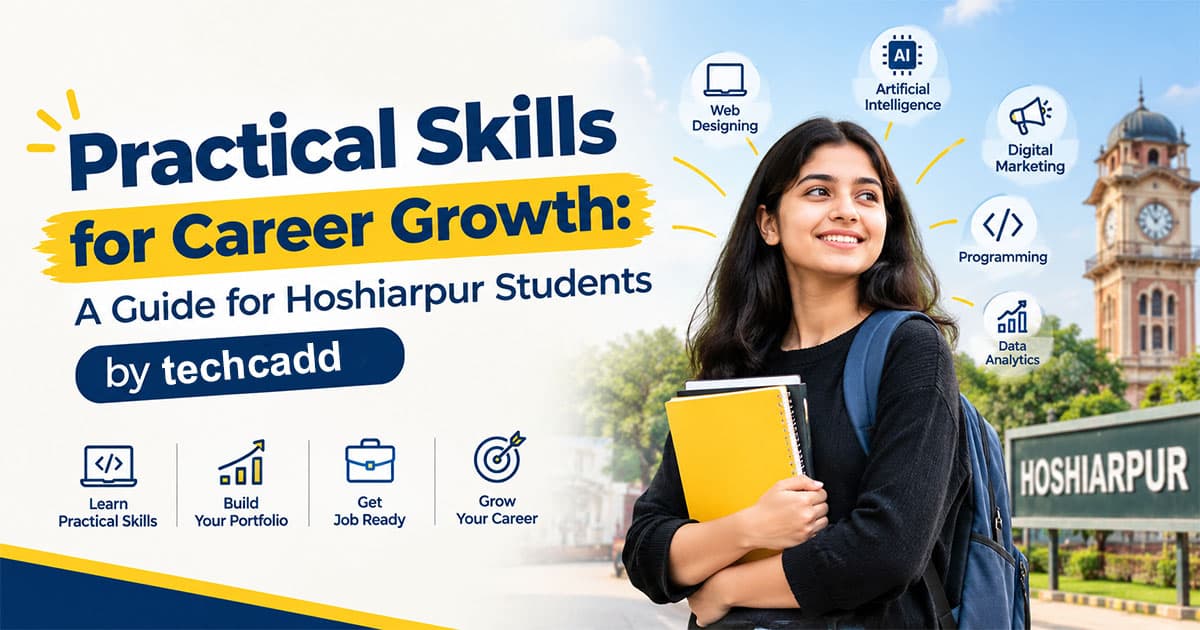
How Practical Skills Can Support Career Growth in Hoshiarpur
Here's a situation that plays out in thousands of homes every year. A student finishes graduation with good marks, updates the resume, applies for a few jobs, and then hears the same question in every interview: "Okay, but what can you actually do?"
Suddenly the marks feel less powerful. The degree is real, the effort was real, but the interviewer wants to see something else. A skill. A project. Proof.
If you're a student in Hoshiarpur wondering why some people around you get good opportunities quickly while others with similar marks struggle, this blog is for you. Let's talk honestly about practical skills, what they are, and why they matter more than most students realise.
What do we mean by "practical skills"?
A practical skill is something you can do, not just something you know about.
Knowing that Google Ads exists is theory. Setting up a small campaign, spending a little budget and explaining what happened is a practical skill.
Knowing the definition of AutoCAD is theory. Drawing a clean floor plan with layers and dimensions is a practical skill.
Reading about websites is theory. Building one that actually loads on a phone and collects enquiries is a practical skill.
You can see the pattern. Theory answers "what is it?" Practical skill answers "can you do it?" And employers, clients and even your own confidence depend a lot on the second answer.
"But I already have a degree. Isn't that enough?"
Your degree matters. Please don't ignore it. It gives you a foundation, it's often required for jobs, and it shows you can finish something difficult.
But here's the uncomfortable truth. A degree tells an employer what you studied. It doesn't always tell them what you can deliver on day one.
Think about it from a business owner's side. Suppose a shop in Hoshiarpur wants someone to manage its Instagram page and run a few ads. Two candidates walk in. One has a good degree and no experience. The other has a smaller qualification, but shows a page they grew from scratch and a campaign they ran with real results.
Who would you hire? Most people pick the second one, not because the degree is useless, but because the second candidate reduces the owner's risk. Practical skills make you a safer choice.
The best position, of course, is having both. A degree plus real skills is a strong combination.
Why practical skills matter more now than before
A few years ago, many companies were willing to hire freshers and train them for months. That's getting rarer. Businesses are working with smaller teams and tighter budgets, so they prefer people who can start contributing quickly.
At the same time, tools have changed how work is done. Designers use software that didn't exist ten years ago. Marketers track results in real time. Even small shops take orders through WhatsApp and Instagram. Knowing how to use these tools isn't a bonus anymore. It's often the baseline.
Also, the internet has levelled the field. A student in Hoshiarpur can learn the same tools as someone in Delhi or Bengaluru, work on remote projects and even freelance for clients in other cities. Your location no longer limits your skills. What limits you is whether you've built them.
How practical skills actually support career growth
Let's make this concrete. Practical skills help your career in several ways, and it's worth understanding each one.
1. You get shortlisted more often
A resume with a "Projects" section stands out. When a recruiter sees that you've built a website, designed a set of posters or completed a live campaign, you look more prepared than someone who only lists subjects.
2. Interviews become easier
This surprises many students. When you've actually done something, you can talk about it naturally. You don't need to memorise answers. You can say, "I faced this problem, tried this, it didn't work, then I fixed it like this." That kind of honest story is far more convincing than a textbook definition.
3. You learn faster on the job
Someone who has already practised the basics doesn't panic when the first task arrives. They still make mistakes, but they know how to figure things out. Managers notice this quickly, and it often leads to more responsibility.
4. You have more options
With a real skill, you're not limited to one path. You can apply for jobs, take internships, try freelancing or even start something on your own. Someone who can design, build a website or run ads always has more choices than someone waiting for the "perfect job" to appear.
5. Your confidence grows
This one is rarely mentioned, but it matters a lot. Many students feel anxious about the future because they don't feel "ready." Practical work is the cure. Every small thing you build or fix makes you a little more sure of yourself.
A small story to make it real
Imagine a student, let's call him Arjun, finishing his final year in Hoshiarpur. His marks are decent, nothing special. He's worried because most of his friends are also applying for the same jobs.
Instead of only sending resumes, he spends three months learning basic website building and social media marketing. He builds a simple site for a local tailor shop, sets up their Google Business Profile and starts posting on their Instagram page. The results are small at first. A few more phone calls, a few more walk-ins.
But now Arjun has something to show. He has a live website, a profile that appears on Google Maps and a page with growing followers. In interviews, he doesn't just say "I'm interested in digital marketing." He opens his phone and shows the work.
That's the difference practical skills make. Arjun isn't a genius. He just started, stayed consistent and built proof.
"Do I need to be a topper to build practical skills?"
No. This is a common worry, so let's clear it up.
Practical skills reward effort and consistency, not marks. Plenty of students who struggled with exams turn out to be excellent at hands-on work, because they finally get to learn by doing instead of memorising. If you're someone who feels bored in a classroom but comes alive when you're building or fixing something, you may have a real advantage here.
You also don't need to know everything. You just need to be able to do one thing reasonably well, and then add more skills over time.
What comes next
So far, we've covered what practical skills are, why a degree alone isn't always enough, and five ways practical skills support your career growth.
In the next part, we'll get specific. We'll look at which skills are worth learning, how to choose the right one for you, how to practise without wasting time, and the mistakes many students make when they start.
Choosing the Right Skills and Practising Them Properly
In Part 1, we saw why practical skills matter and how they support your career. Now comes the question most students actually get stuck on: "Okay, but which skill should I learn?"
There are so many options that choosing can feel harder than learning. Let's simplify it.
Skills that are worth your time
Not every skill suits every person, but these areas have steady demand and are realistic for students to learn from scratch.
Digital marketing. Almost every business now needs customers online, from clinics and coaching centres to garment shops and restaurants. Skills like social media management, SEO, Google Business Profile and running ads are useful for jobs, internships and freelancing.
Graphic design and video editing. Businesses always need posters, reels, logos and social media creatives. If you enjoy visual work, tools like Photoshop, Canva and CapCut can turn that interest into a real skill.
Web development and WordPress. Every business wants a website, and many still don't have a good one. Building simple, working sites is one of the fastest routes to freelance income.
AutoCAD and design drafting. For civil, mechanical and architecture students, this is a strong base skill. Clean, accurate drawings are needed by builders, contractors and interior designers.
Programming and data skills. Python, basic SQL and data handling open doors to software, analytics and even AI-related work. They take longer to learn, but the long-term options are wide.
Communication and basic business sense. Not glamorous, but it multiplies every other skill. Someone who can explain their work clearly and handle a client politely always moves ahead faster.
You don't need all of these. Pick one, go deep, and add others later.
How to choose the right one for you
Don't choose based on what's trending on social media. Choose based on three simple questions.
1. What do you enjoy doing, even when nobody is watching?
If you lose track of time while designing posters, look at design. If you like solving puzzles, look at programming. If you enjoy talking to people and understanding what they need, look at marketing. Interest makes practice feel lighter.
2. What does your background allow?
A civil student can combine AutoCAD with estimation. A commerce student can pair digital marketing with accounting knowledge. A science student may find data skills natural. Your existing studies can make your new skill more valuable.
3. What can you realistically practise every day?
A skill that fits your schedule beats an "ideal" skill you'll abandon in two weeks. Be honest about the time and equipment you have.
If you're still unsure, try a small experiment. Spend one week on each of two options, doing beginner tasks. By the end, you'll usually feel a clear pull toward one of them.
Learning by doing: how to practise properly
Many students think they are practising when they're really just watching. Here's how to tell the difference.
Build a small project early. Don't wait until you "know enough." Within the first few weeks, make something real. A poster set, a one-page website, a floor plan, a small campaign for a friend's shop. Imperfect but finished is better than perfect and never started.
Practise a little every day. Forty-five minutes daily works better than one exhausting Sunday. Regular practice helps your hands and brain remember.
Use real problems. Instead of copying sample exercises, look around Hoshiarpur. A local shop with a weak Instagram page. A coaching centre with a poor website. A small business with no Google Maps listing. Even if you help for free at first, you get real feedback and real experience.
Keep a simple record. Save your work in a folder, take screenshots of results and write two lines about what you learned. After three months, you'll have a portfolio without having planned one.
Ask for feedback. Show your work to a teacher, a mentor or someone working in the field. A single honest comment can save you weeks of guessing.
Fix, don't just finish. After completing a project, ask what you'd do differently. Then redo one part. That habit is where real improvement happens.
Practical skills need guidance, not just tutorials
Free videos are a great starting point, and you should use them. But many students hit the same walls: they don't know what to learn next, they can't tell if their work is good, and they lose motivation when nobody is checking in.
That's where structured, hands-on training helps. A good course gives you a clear order to follow, real tasks instead of random exercises and someone who points out mistakes early. At techcadd, the focus is on practical learning, so students work on tasks that look like real workplace assignments and build work they can actually show.
Whether you learn on your own or through a course, the principle is the same: do real work, get feedback and repeat.
Mistakes students commonly make
Almost everyone makes some of these. Knowing them in advance saves months.
Trying to learn everything at once. Design, coding, marketing and video editing in the same month leads to shallow knowledge in all of them. Focus on one skill for at least a few months.
Collecting certificates instead of building skills. Certificates can help, but a certificate without any work behind it doesn't convince anyone. Pair every course with projects.
Only watching, never doing. Tutorials feel productive because you understand while watching. The real test is whether you can repeat the task alone the next day.
Waiting to feel "ready." Nobody feels ready. Confidence usually shows up after you start, not before.
Comparing yourself with people online. Someone posting a great result may have been practising for a year. Your pace is your own, and steady progress adds up.
Ignoring communication. A skilled person who can't explain their work or reply to clients properly often loses opportunities to someone less skilled but more professional.
Giving up at the boring stage. Every skill has a dull, frustrating phase where progress feels slow. That's the stage most people quit. If you push through it, you're already ahead of a large group.
A quick self-check
Ask yourself these questions honestly:
Can I show at least one finished project?
Can I explain what I did and why?
Have I practised this skill in the last seven days?
Do I know what to learn next?
If most answers are "no," don't worry. That simply tells you where to start.
What's coming in the final part
We've covered which skills are worth learning, how to pick the right one, how to practise properly and which mistakes to avoid.
In the final part, we'll talk about turning skills into actual career growth: building a portfolio, getting your first opportunity, freelancing, growing over the long term and a simple plan you can start following this month.
Turning Skills Into Real Career Growth
You now know what practical skills are, which ones are worth learning and how to practise them. The last step is the one that actually changes your life: turning those skills into opportunities.
Build a portfolio before you need one
A portfolio is simply proof of your work. It doesn't need to be fancy. A neat folder, a PDF or a simple online page is enough to begin.
What to include:
Four to six of your best pieces, not twenty average ones
A short note on each: what the project was, what you did and what result you got
Screenshots, before-and-after images or numbers wherever possible
Your contact details, kept simple and easy to find
What to avoid:
Unfinished work
Copied tutorial projects with no changes
Long descriptions that nobody will read
Think of your portfolio as an answer to the interviewer's question, "What can you actually do?" Instead of speaking about your skills, you show them.
If you're in Hoshiarpur and can't find a client yet, create your own project. Redesign a local shop's poster, build a sample website for a coaching centre or plan a mock campaign for a nearby business. Label it clearly as a practice project. Honest practice work still shows your ability.
Getting your first opportunity
The first opportunity is usually the hardest, and it rarely looks like the dream job. That's fine. Here are realistic ways to begin.
Internships. Even a short internship gives you workplace experience, real feedback and something to add to your resume. Apply to local businesses, agencies and training institutes, not only big companies.
Small local clients. Clinics, shops, salons, coaching centres and restaurants often need help with social media, posters, websites or Google Maps listings. Start with one or two. Do good work, ask for a short testimonial and let word of mouth do the rest.
Entry-level jobs. Look for roles like executive, assistant, trainee or junior. Read the job description carefully, and match your portfolio to what they ask for.
Freelancing. Platforms and social media can connect you with clients in other cities. Remote work has made this possible from Hoshiarpur without relocating. Start with small projects, deliver on time and build your reputation slowly.
Networking. Talk to seniors, teachers, trainers and professionals in your field. Many opportunities come from a simple message like, "I'm learning this skill. Do you know anyone who needs help?" It feels awkward at first, but it works more often than you'd expect.
How to present yourself
Skills get you noticed, but presentation helps you get chosen.
Keep your resume simple. One page. Put skills and projects near the top, and keep education clear and short.
Use LinkedIn properly. A clear photo, a headline that says what you do, and a few posts showing your work can make a difference. Recruiters do search there.
Practise explaining your work. Say it out loud in simple words: what the problem was, what you did, what happened. If you can explain it to a friend who knows nothing about it, you can explain it to an interviewer.
Be honest. Don't claim skills you don't have. It's fine to say, "I haven't done that yet, but I'm learning it." Honesty builds trust, and trust gets people hired.
Reply politely and on time. This sounds small, but it's one of the most valued qualities in any workplace.
Growing after the first job
Getting started is one part. Growing is another.
Keep learning one new thing at a time. After you're comfortable, add a related skill. A designer can learn basic video editing. A marketer can learn analytics. An AutoCAD user can learn 3D modelling. Related skills make you more valuable without starting from zero.
Take ownership. People who complete tasks without needing constant reminders get noticed. Small habits like double-checking your work and asking useful questions build a strong reputation.
Ask for feedback regularly. It can be uncomfortable, but it speeds up your growth more than anything else.
Track your results. Keep a running list of what you've achieved. Whether it's an increase in followers, a faster website or a completed project, numbers help during appraisals and interviews.
Be patient. Career growth isn't a straight line. There will be slow months. Consistent skill-building over a year or two usually changes your position more than you expect.
Common questions students ask
Can practical skills replace a degree?
Not completely. A degree still matters for many jobs. Practical skills work best alongside it, or as a strong path if you're choosing a skill-based career.
How long before I see results?
It varies. Many students feel real progress within two to three months of steady practice, and get their first opportunity within six months. Consistency matters more than speed.
Do I need to move to a big city?
Not necessarily. Many skills can be used for local clients, remote jobs and freelancing. A city may offer more options, but you can build a strong start from Hoshiarpur.
Is it too late to start?
No. Whether you're in college, just graduated or looking to change direction, starting now is better than waiting for a perfect time.
What if I fail or make mistakes?
You will make mistakes, and that's normal. Every professional you admire once made the same beginner errors. What matters is learning from them.
A simple 90-day plan
If you'd like a clear starting point, try this.
Days 1 to 30: Choose one skill. Learn the basics daily, even if it's only 45 minutes. Finish one small project.
Days 31 to 60: Build two or three more projects, ideally for real people or businesses. Collect feedback and improve them.
Days 61 to 90: Create your portfolio, update your resume and LinkedIn, and start applying or approaching local clients. Keep learning while you do.
By the end of these three months, you won't be an expert, but you'll be far ahead of where you started, and you'll have proof of your progress.
Final thoughts
Practical skills don't guarantee overnight success, but they give you something more reliable: the ability to create value, again and again, wherever you are. Marks show that you studied. Skills show that you can contribute.
You don't need to be the smartest person in the room. You just need to start, keep practising and let your work speak for you.
If you're in Hoshiarpur and would like guided, hands-on learning with real projects and regular feedback, techcadd can help you build these skills step by step. The best moment to begin is today, with one small task. Finish it, learn from it and take the next one.

Comments
Nothing here yet. Be the first to say something.