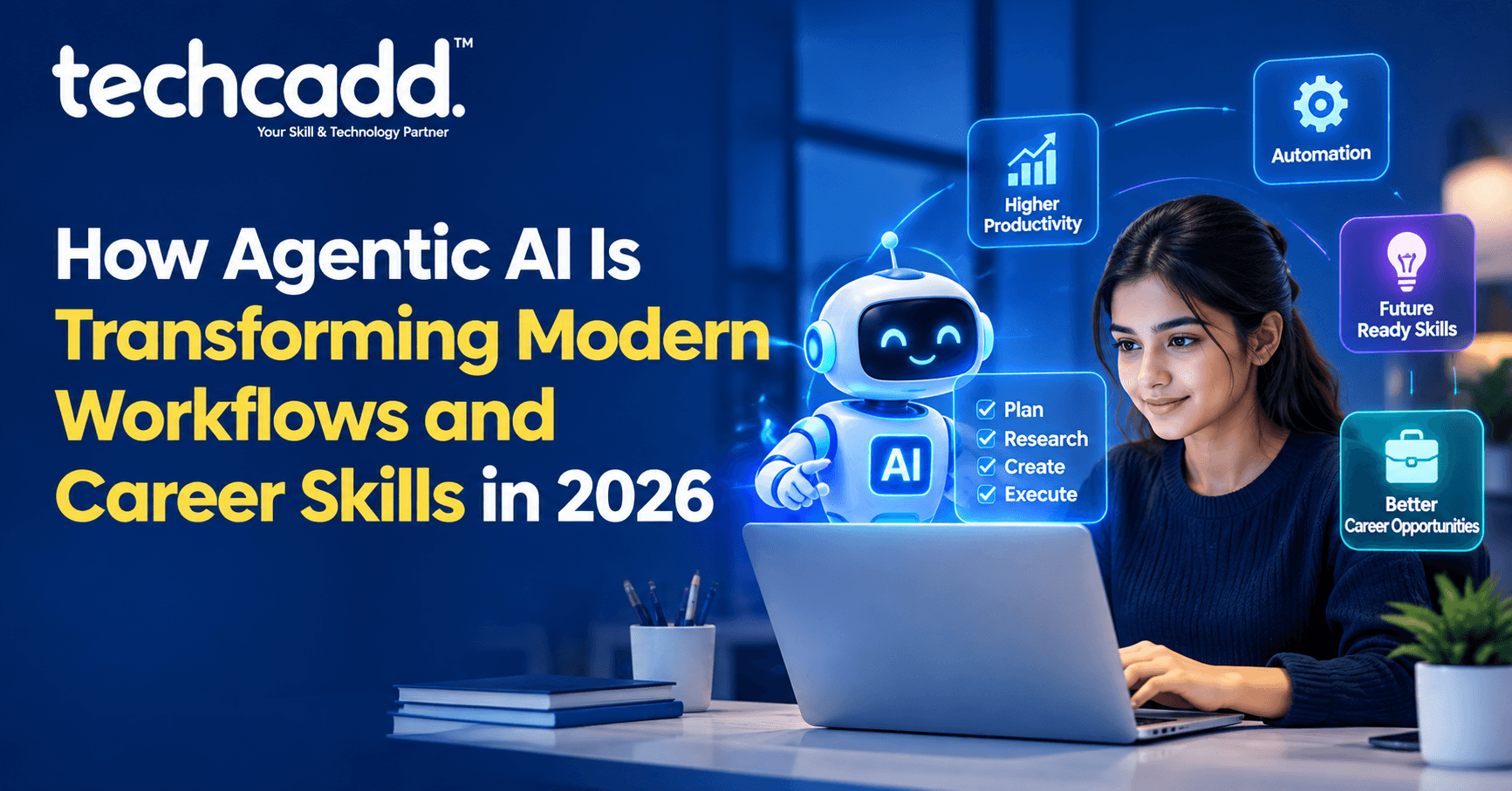
How Agentic AI Is Transforming Modern Workflows and Career Skills in 2026
Until recently, using AI usually meant a simple back-and-forth conversation — you ask a question, the AI responds, and you decide what to do with that answer. But something has shifted. AI tools today aren't just answering questions anymore. They're planning, executing multi-step tasks, and completing entire workflows with minimal human intervention.
This shift has a name: Agentic AI. And in 2026, it's quietly becoming one of the most significant changes to how businesses operate and what skills actually matter in the job market.
For students in Hoshiarpur trying to figure out which skills will actually stay relevant over the coming years, understanding agentic AI isn't optional anymore — it's becoming essential context for navigating a job market that's changing faster than most career guidance can keep up with.
What Exactly Is Agentic AI?
Let's break this down simply, because the term itself can sound more complicated than it actually is.
Traditional AI tools, like a basic chatbot, respond to one request at a time. You ask something, it answers, and the interaction ends there. Agentic AI works differently — it can take a broader goal, break it down into smaller steps, and actually execute those steps independently, often using multiple tools or systems along the way, without requiring you to manually guide every single step.
Think of the difference this way: asking a traditional AI tool "write me an email" gets you a drafted email. Asking an agentic AI system to "handle my client follow-ups this week" could mean it checks your calendar, drafts personalized emails based on previous conversations, schedules them to send at appropriate times, and even flags any responses that need your personal attention — all without you manually managing each individual step.
This isn't science fiction anymore. Agentic AI systems are already being used across various industries in 2026, handling tasks that previously required significant human coordination and effort.
Why This Shift Matters So Much
The difference between traditional AI and agentic AI isn't just a technical upgrade — it fundamentally changes what AI can actually be used for in real business workflows.
Previously, even with powerful AI tools, a human still needed to manage the overall process — deciding what to ask, reviewing each response, and manually connecting different steps together. This limited how much time AI could genuinely save, since human oversight was still required at nearly every stage.
Agentic AI removes much of that manual coordination. Instead of a human managing each step of a process, the AI system manages the process itself, checking in with humans mainly for approval, exceptions, or final review. This changes AI from a tool you actively use to a system that actively works alongside you.
Practical Example: How Agentic AI Works in a Real Workflow
To make this more concrete, consider how a customer support workflow might work with agentic AI in 2026.
A customer submits a complaint through a company's website. Instead of this simply creating a ticket for a human to eventually respond to, an agentic AI system can automatically categorize the complaint, search the company's knowledge base for relevant solutions, draft a personalized response addressing the specific issue, check if similar complaints indicate a broader pattern worth flagging to management, and only escalate to a human team member if the situation requires judgment beyond what the AI can confidently handle.
The human team member's role shifts from handling every single complaint personally to reviewing flagged exceptions and handling situations that genuinely require human judgment — while routine, predictable issues get resolved automatically and immediately.
Where Agentic AI Is Already Being Used in 2026
This isn't a future possibility — agentic AI systems are actively being deployed across multiple areas of business operations right now.
Customer Service and Support: Beyond simple chatbots, agentic systems now handle entire support workflows, from initial query to resolution, escalating only genuinely complex cases to human agents.
Marketing and Content Operations: Agentic AI systems can now manage entire content calendars, researching trending topics, drafting content, scheduling posts across platforms, and analyzing performance data to adjust future content strategy, largely autonomously.
Sales and Lead Management: Systems can now qualify leads, send personalized follow-up sequences based on prospect behavior, schedule meetings, and update CRM systems automatically, freeing sales teams to focus on actual conversations rather than administrative coordination.
Software Development: Agentic coding tools can now take a described feature requirement, write the necessary code across multiple files, test that code, and even fix bugs it identifies during testing, with developers reviewing and refining rather than writing everything from scratch.
Data Analysis and Reporting: Instead of manually pulling data and creating reports, agentic systems can now automatically gather relevant data from multiple sources, analyze trends, and generate comprehensive reports with actionable recommendations on a scheduled basis.
Why Businesses Are Rapidly Adopting Agentic AI
From a business perspective, the appeal of agentic AI goes beyond simple efficiency gains. It fundamentally changes what a small team can accomplish without proportionally increasing headcount.
A business that previously needed five people to manage customer support, content creation, and lead follow-up might now accomplish the same output with two people overseeing agentic AI systems that handle the bulk of routine work. This isn't about eliminating jobs entirely — it's about dramatically changing what those jobs actually involve day-to-day.
Companies are adopting agentic AI for several practical reasons:
Reduced operational costs without sacrificing output quality or speed
24/7 operation for tasks that don't require specific human working hours
Faster response times, particularly valuable in customer-facing roles where speed directly impacts satisfaction
Consistency, since agentic systems don't have off days or inconsistent performance the way human execution sometimes does
Scalability, allowing businesses to handle increased workload without proportionally increasing team size
This rapid adoption is exactly why understanding agentic AI has become genuinely relevant for anyone entering the job market in 2026, regardless of their specific field.
How This Is Reshaping Career Skills
Here's where this becomes directly relevant for students and job seekers. As agentic AI takes over routine, process-driven tasks, the skills that remain valuable — and the skills employers are actively looking for — are shifting accordingly.
Skill #1: AI Oversight and Prompt Engineering
Understanding how to effectively direct agentic AI systems — giving clear goals, setting appropriate boundaries, and knowing when to intervene — has become a genuinely valuable skill. This isn't about complex technical programming; it's about understanding how to communicate objectives clearly and structure tasks in ways these systems can execute effectively.
Skill #2: Exception Handling and Judgment
As routine tasks get automated, the value shifts toward handling situations that require genuine human judgment — ambiguous customer complaints, unusual business scenarios, ethical considerations that AI systems aren't equipped to navigate independently. Developing strong judgment and decision-making skills becomes more valuable, not less, in an increasingly automated environment.
Skill #3: System Design and Workflow Thinking
Understanding how to design effective workflows that agentic AI can execute — breaking down complex processes into clear, logical steps — has become a genuinely marketable skill. This applies across industries, from marketing to operations to customer service.
Skill #4: Quality Control and Verification
As AI systems handle more autonomous work, the ability to verify outputs, catch errors, and ensure quality standards remains a critical human responsibility. Employers increasingly value people who can effectively audit and improve AI-driven processes, rather than blindly trusting automated output.
Skill #5: Strategic and Creative Thinking
While agentic AI excels at executing defined processes, strategic thinking — deciding what should be done and why, rather than how to execute it — remains a distinctly human strength. Creative problem-solving, understanding nuanced customer needs, and strategic business decisions continue to require human insight that AI systems, however capable, don't genuinely replicate.
Common Concerns About Agentic AI and Jobs
"Will agentic AI eliminate entry-level jobs, making it harder for students to start their careers?"
This is a genuine and valid concern. Some routine entry-level tasks are indeed being automated. However, this is simultaneously creating new roles focused on overseeing, refining, and working alongside these systems — roles that didn't exist a few years ago. The nature of entry-level work is shifting rather than disappearing entirely, though this transition does require adapting the skills students develop during their education.
"Do I need to become a programmer to work with agentic AI systems?"
Not necessarily. While technical roles building these systems do require programming knowledge, many roles involve using, directing, and overseeing agentic AI tools without needing to build them from scratch — similar to how most people use software without knowing how to code it themselves.
"How can students prepare for a job market where AI handles so much routine work?"
Focus on developing skills that complement rather than compete with AI capabilities — critical thinking, clear communication, judgment in ambiguous situations, and understanding how to effectively work alongside AI systems rather than either ignoring them or becoming entirely dependent on them.
Industries Most Affected by This Shift
While agentic AI is impacting nearly every industry to some degree, certain sectors are experiencing more immediate transformation:
Digital Marketing: Content creation, campaign management, and performance analysis increasingly involve agentic AI handling routine execution while marketers focus on strategy and creative direction.
Customer Service: Entry-level support roles are evolving toward oversight and complex issue resolution rather than handling every routine query personally.
Software Development: Junior development tasks increasingly involve reviewing and refining AI-generated code rather than writing every line manually.
Sales and Business Development: Administrative aspects of lead management and follow-up are increasingly automated, shifting focus toward relationship-building and complex negotiation.
Operations and Data Analysis: Routine reporting and data processing increasingly happen automatically, with human roles focusing on interpretation and strategic decision-making based on those insights.
How Students in Hoshiarpur Can Prepare for This ShiftUnderstanding that agentic AI is transforming workflows is one thing — actually preparing for it requires a practical, step-by-step approach rather than feeling overwhelmed by the pace of change.
Step 1: Build Strong Foundational Skills First
Before focusing specifically on AI-related skills, ensure you have solid fundamentals in your chosen field. Agentic AI amplifies human capability, but it works best when directed by someone who genuinely understands the underlying domain — whether that's marketing, business operations, or a technical field.
Step 2: Get Comfortable Working Alongside AI Tools
Start using AI tools regularly in your studies and projects, not to replace your effort, but to understand how these systems think and respond. This builds intuition for how to effectively direct and work with more advanced agentic systems later.
Step 3: Develop Judgment Through Real Practice
Since human judgment becomes more valuable as routine tasks get automated, actively seek opportunities to practice decision-making in ambiguous situations — case studies, group projects, internships that expose you to real business problems without clear-cut answers.
Step 4: Learn Basic Workflow and Process Thinking
You don't need to become a programmer, but understanding how to break down a complex task into clear, logical steps is a skill that transfers directly into effectively working with agentic AI systems, regardless of your specific field.
Step 5: Stay Genuinely Curious and Adaptable
The specific tools and platforms will continue evolving rapidly. What matters more than mastering any single tool is developing genuine comfort with continuous learning and adaptation, since the skills relevant in 2026 will likely evolve further by the time you're several years into your career.
A Realistic Example: A Student Preparing for This Shift
Consider a college student in Hoshiarpur studying business administration, aware that agentic AI is changing how marketing and operations roles function.
Rather than ignoring this shift or feeling anxious about it, they start using AI tools for their coursework projects, learning how to effectively prompt and direct these systems for research and content creation. During an internship, they volunteer to help set up automated workflows for routine tasks, gaining hands-on experience with how agentic systems integrate into real business operations.
Simultaneously, they focus on developing strong communication and analytical skills through case competitions and group projects, recognizing that these human-centered skills become more valuable, not less, as routine work becomes automated. By graduation, they're not just familiar with AI tools superficially — they genuinely understand how to work alongside these systems while bringing distinctly human judgment and strategic thinking to their role.
This approach doesn't require predicting exactly which tools will dominate the market. It requires building adaptable skills and genuine comfort with an AI-integrated way of working.
Common Mistakes Students Make Regarding This Shift
Ignoring the shift entirely — Assuming these changes won't affect their specific field, when in reality, agentic AI is impacting nearly every industry in some capacity.
Over-relying on AI without building genuine skills — Using AI tools as a complete substitute for developing foundational knowledge, leaving them unable to effectively direct or verify AI-driven work.
Focusing only on technical AI skills — Assuming only programming or technical AI knowledge matters, while neglecting equally valuable skills like judgment, communication, and strategic thinking.
Feeling paralyzed by rapid change — Becoming so overwhelmed by how quickly things are evolving that they avoid engaging with these tools altogether, missing valuable early experience.
Not staying updated on industry-specific AI applications — Failing to understand how agentic AI specifically applies to their chosen field, missing opportunities to develop directly relevant skills.
Why This Matters for Hoshiarpur's Job Market Specifically
For students in Hoshiarpur, this shift creates both genuine opportunity and necessary adaptation. Local businesses, increasingly competing in broader digital markets, are beginning to explore how agentic AI can help them operate more efficiently without requiring large teams or extensive budgets.
Students who understand how to help local businesses implement and oversee these systems — setting up automated customer service workflows, managing AI-driven marketing processes, or streamlining administrative operations — position themselves as genuinely valuable, regardless of whether they eventually work locally or pursue opportunities elsewhere.
This isn't about competing with agentic AI for jobs. It's about understanding how to work alongside these systems effectively, bringing genuinely human skills — judgment, creativity, relationship-building — that complement rather than compete with what these systems do well.
Where This Is Heading
Agentic AI in 2026 represents an early stage of a much larger transformation in how work gets done. As these systems become more sophisticated and widely adopted, the distinction between "using AI" and "regular work" will likely blur significantly, similar to how using computers or the internet eventually stopped being a distinct, separate skill and became simply part of how work gets done.
For students entering the job market now, this creates a genuine opportunity to build relevant skills early, before this way of working becomes the universal default that everyone is expected to already understand.
Final Thought
Agentic AI isn't just another incremental technology update — it represents a fundamental shift in how workflows get executed and, consequently, what skills genuinely matter in the modern job market.
For students in Hoshiarpur, understanding this shift early provides a genuine advantage, not because you need to become an AI expert, but because developing comfort with these systems, combined with strong human judgment and adaptable thinking, positions you well for a job market that's evolving faster than traditional career guidance often accounts for.
The students who approach this shift with curiosity rather than anxiety, building genuine skills alongside AI capability rather than either resisting or over-relying on it, will likely find themselves genuinely well-prepared for whatever the job market looks like by the time they graduate and beyond.
Comments
Nothing here yet. Be the first to say something.