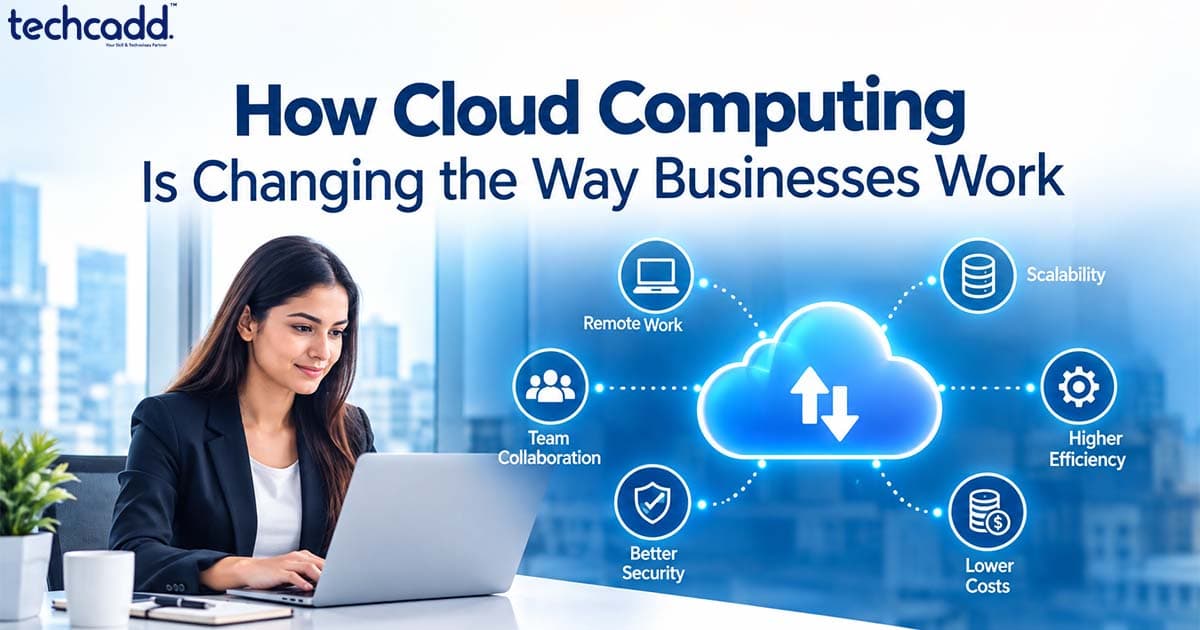
How Cloud Computing Is Changing the Way Businesses Work
Think about the last time you opened Gmail, watched something on Netflix, or sent a file through Google Drive. You didn't think twice about where that data was actually stored, right? That's the magic of cloud computing quietly working in the background — and it has completely changed how businesses function today, including many right here in Hoshiarpur.
A few years ago, if a shop owner or a small business in Hoshiarpur wanted to store customer records, manage billing, or run software for their operations, they needed a physical computer, a hard drive, maybe even a small server room. Everything was local. If the system crashed, data was gone. If you needed to access files from home, you simply couldn't — unless you carried a pen drive around like it was your lifeline.
Cloud computing broke that limitation completely.
So, What Exactly Is Cloud Computing?
In the simplest words — cloud computing means storing and accessing data, software, and computing power over the internet instead of on your own physical computer or server. Instead of installing software on every single system in your office, you just log in through the internet, and everything you need is right there.
You've probably already used cloud computing without realizing it. Google Docs, Zoom, Instagram, even your college's online result portal — all of these run on cloud servers owned by companies like Amazon (AWS), Google (Google Cloud), and Microsoft (Azure).
For businesses, this shift isn't just a "nice to have" anymore. It's become the backbone of how modern companies operate — from massive corporations to a small textile business in Hoshiarpur trying to manage its inventory more efficiently.
Why Businesses Are Making the Shift
Let's break down the real, practical reasons businesses — big and small — are moving to the cloud.
1. No More Expensive Hardware
Earlier, setting up an IT infrastructure meant huge upfront costs. Servers, storage devices, cooling systems, IT staff to maintain everything — it was a heavy investment, especially for small and medium businesses.
With cloud computing, a business only pays for what it uses. Need more storage this month because of a festive sale? Scale up. Business slows down in the off-season? Scale back down. No wasted money on hardware sitting idle.
This alone has made cloud adoption attractive for businesses in tier-2 cities like Hoshiarpur, where budgets are often tighter compared to metro cities, but the ambition to grow digitally is just as strong.
2. Access From Anywhere, Anytime
This is the one most people relate to instantly. Whether you're a business owner checking sales reports from your phone while travelling, or an employee working from home, cloud computing makes location almost irrelevant.
During and after the pandemic, this became a survival skill for businesses. Companies that had already shifted their operations to cloud-based tools adapted to remote work almost instantly. Those still dependent on physical systems struggled to keep up.
3. Better Security Than Most People Expect
A common doubt people have is — "Isn't it risky to store everything online?" It's a fair question, and honestly, a smart one to ask.
The truth is, major cloud providers invest massively in security — far more than what an individual business could afford on its own. Data encryption, regular backups, multi-layer authentication, and disaster recovery are built into most cloud services by default. Ironically, storing data locally on a single system is often riskier — one hardware failure, and everything could be lost permanently.
4. Real-Time Collaboration
Remember group projects in college where everyone had different versions of the same file, and combining them was a nightmare? Cloud tools like Google Workspace or Microsoft 365 solved this exact problem for businesses.
Multiple employees can now work on the same document, spreadsheet, or presentation simultaneously, from different locations, with changes updating in real time. For businesses with multiple branches — say, one office in Hoshiarpur and another in Jalandhar — this kind of seamless collaboration simply wasn't possible before cloud technology matured.
5. Faster Innovation and Deployment
For tech-based businesses and startups, cloud computing has cut down the time it takes to build and launch products. Instead of spending months setting up servers and infrastructure, developers can deploy applications within hours using cloud platforms.
This is a big reason why so many startups today are "cloud-native" — built on the cloud from day one, rather than migrating to it later.
A Simple Example to Understand the Impact
Let's say there's a small retail business in Hoshiarpur that sells clothes both offline and online. Earlier, managing inventory across both channels meant manually updating registers and Excel sheets — a process prone to errors and mismatched stock counts.
Now, with a cloud-based inventory management system, the moment a product is sold online, the stock automatically updates. The shop owner can check sales, inventory, and even customer trends from their phone, whether they're sitting in the store or attending a family function three cities away.
That's not a futuristic scenario — this is already happening, and it's becoming the standard, not the exception.
Is This Only for Big Companies?
This is one of the most common misconceptions. People often assume cloud computing is only relevant for large IT companies or tech giants. In reality, small businesses benefit from it just as much, sometimes even more, because it removes the need for a huge IT budget or dedicated technical staff.
A local coaching institute, a small manufacturing unit, a retail shop, or even a freelance consultant — all of them can use cloud tools to manage data, communicate with clients, handle payments, and store important documents securely.
This is exactly why understanding cloud computing isn't just useful for IT professionals anymore. It's becoming essential knowledge for anyone working in business, operations, marketing, or even finance.
Now that we've covered why businesses are shifting to the cloud, let's talk about something equally important — how this shift is actually changing the way people work on a day-to-day basis, and what it means for students and professionals who want to build a career around this technology.
The Changing Nature of Everyday Work
Cloud computing hasn't just changed the "back-end" of businesses — it has changed how employees experience their jobs.
A few years back, if you worked in accounts or finance, you'd probably have a fixed system loaded with Tally or Excel, and your work stayed tied to that one machine. Today, cloud-based accounting tools let finance teams access real-time data, generate reports instantly, and even collaborate with auditors sitting in a completely different city — all without emailing files back and forth.
Sales teams no longer wait for end-of-day reports compiled manually. Dashboards update live. Managers can see performance numbers the moment a sale happens, not the next morning.
Even something as simple as customer support has transformed. Cloud-based CRM (Customer Relationship Management) tools allow support teams to access a customer's entire history — past complaints, purchases, preferences — within seconds, no matter which branch or city the customer originally interacted with.
This shift means one thing clearly: businesses today expect employees to be comfortable working with cloud-based tools, not just traditional software.
Why This Matters for Students in Hoshiarpur
Here's something worth thinking about — if you're a student or a fresher trying to figure out where the job market is heading, cloud computing is one of those areas you simply can't ignore anymore.
It's natural to wonder, "Is this only for computer science students?" Not really. Cloud computing today touches almost every field:
Marketing professionals use cloud-based analytics tools to track campaigns.
Finance professionals use cloud accounting software.
HR teams manage employee data through cloud-based HR platforms.
Even retail and operations roles now involve cloud-based inventory or supply chain systems.
So whether you're aiming for a technical role or a business-oriented one, having a working understanding of cloud computing gives you a real edge over other candidates who don't.
A lot of students in Hoshiarpur often ask, "But I don't come from a technical background, can I still learn this?" And honestly, that's one of the most encouraging things about cloud computing today — the entry-level concepts are far more beginner-friendly than most people assume. You don't need to be a coding expert to understand how cloud storage, cloud security, or cloud-based business tools work at a foundational level.
Common Doubts Students Have About Cloud Computing
Let's address a few real concerns students usually have, because these are the exact questions that come up in career counselling sessions.
"Is cloud computing difficult to learn?"
Not if you start with the fundamentals first. Concepts like cloud storage, deployment models (public, private, hybrid cloud), and popular platforms like AWS, Azure, and Google Cloud are logical once explained properly with real examples — not just theory.
"Do I need prior experience in programming?"
For basic understanding and business-use cases, not necessarily. However, if you want to move into more technical roles like cloud engineering or cloud architecture, some programming knowledge does help over time. The good part is, you can start learning cloud fundamentals first and build technical skills gradually.
"What jobs can I get after learning cloud computing?"
This is usually the most exciting part for students. Some common career paths include:
Cloud Support Associate
Cloud Administrator
IT Operations with cloud exposure
Digital Marketing roles using cloud-based analytics tools
Business roles that require cloud-based software management
You don't have to become a "cloud engineer" immediately. Many students start with roles that use cloud tools practically, and grow into more specialized positions as they gain experience.
"Will this actually help me get a job in Hoshiarpur or nearby cities?"
Yes — and this is important to understand. Even local businesses, especially those expanding online or managing multiple locations, are adopting cloud-based systems for billing, communication, marketing, and data management. Being someone who understands these tools instantly makes you more valuable, even in a local job market.
The Business Side: Why Companies Are Investing Heavily in Cloud Talent
From a business owner's perspective, cloud computing isn't just about saving costs anymore — it's about staying competitive.
Companies that fail to modernize risk falling behind those who can operate faster, respond to customers quicker, and make data-backed decisions in real time. This is why businesses are actively looking for employees who understand at least the basics of cloud tools, even if the role isn't purely technical.
This growing demand naturally creates opportunities — not just for engineers, but for anyone willing to upskill and stay relevant in a workplace that's becoming increasingly cloud-dependent.
A Mindset Shift, Not Just a Technology Shift
Perhaps the biggest change cloud computing has brought isn't technical at all — it's the mindset shift. Businesses have moved from "owning everything physically" to "accessing everything smartly." Employees have moved from "waiting for updates" to "working in real time." And students have moved from "just getting a degree" to "understanding practical, in-demand skills that businesses actually need."
This is exactly the gap that skill-based learning aims to fill — bridging the space between theoretical knowledge and real-world business expectations.
For students in Hoshiarpur, this means the opportunity isn't limited to moving to a metro city just to find relevant work. With the right cloud computing skills, remote and hybrid roles are increasingly accessible from anywhere, including your hometown.
How to Actually Start Learning Cloud Computing (Without Feeling Overwhelmed)
If you're a student reading this and thinking, "Okay, this sounds important, but where do I even begin?" — you're not alone. Most beginners feel exactly the same way when they first hear terms like AWS, Azure, virtual machines, or hybrid cloud.
Here's a simple way to approach it, step by step:
Step 1: Understand the Basics First
Before jumping into any specific platform, get comfortable with core concepts — what cloud computing actually is, the difference between public, private, and hybrid cloud, and common service models like SaaS, PaaS, and IaaS. These sound technical at first, but once explained with real examples (like comparing SaaS to using Netflix, or IaaS to renting land instead of buying it), they become much easier to grasp.
Step 2: Get Familiar With One Major Platform
You don't need to master AWS, Google Cloud, and Azure all at once. Pick one — AWS is a common starting point because of its wide industry usage — and get comfortable navigating its basic services like storage, computing, and databases.
Step 3: Work on Small, Practical Projects
Reading theory alone won't build confidence. Try hosting a simple website, setting up basic cloud storage, or working with a free-tier account to explore real dashboards. This hands-on exposure is what actually helps concepts stick.
Step 4: Understand How Businesses Use It
This is a step many beginners skip. Understanding how a business actually applies cloud computing — for billing systems, data storage, marketing analytics, or customer management — makes your knowledge practical, not just theoretical. Employers value candidates who understand the "why," not just the "how."
Step 5: Build Consistency, Not Perfection
You don't need to know everything before applying for jobs or internships. Cloud computing is a vast field, and even professionals keep learning new updates and services constantly. Focus on building a strong foundation and stay consistent.
Common Mistakes Beginners Make
A few patterns show up again and again with students starting out in this space:
Trying to learn everything at once — Cloud computing has multiple platforms and hundreds of services. Trying to learn all of them simultaneously usually leads to confusion rather than clarity.
Skipping the fundamentals — Jumping straight into advanced tools without understanding basic networking or cloud concepts often creates gaps that show up later.
Not practicing hands-on — Watching tutorials without actually trying things out on a platform limits real understanding.
Ignoring the business context — Purely technical learning without understanding how businesses actually use cloud tools makes it harder to explain your skills in interviews.
Being aware of these mistakes early can save a lot of time and frustration.
Why Learning This Skill Locally in Hoshiarpur Makes Sense
There's a common belief that to build a career in something as modern as cloud computing, you need to move to a bigger city. That's changing rapidly.
With structured, practical training available locally, students in Hoshiarpur no longer need to depend entirely on online tutorials or expensive courses in metro cities. Learning cloud computing fundamentals with proper guidance, real examples, and hands-on practice — right where you live — makes the learning process far more approachable.
At techcadd, the focus stays on making technical topics like cloud computing understandable for real students — not just textbook definitions, but practical knowledge you can actually explain and apply, whether that's in an interview, an internship, or your own business idea.
This matters because theoretical knowledge alone often isn't enough anymore. Employers, even local ones expanding digitally, want people who understand how these tools work in real business situations — not just definitions memorized for an exam.
Where This Is Heading
Cloud computing isn't a passing trend. As more businesses — from local retailers to large enterprises — continue moving their operations online, the demand for people who understand cloud fundamentals will only grow. This applies just as much to businesses in Hoshiarpur adapting to digital-first operations as it does to companies in major metro cities.
For students, this creates a genuine, long-term opportunity. Not just as cloud engineers, but as marketers, business analysts, support professionals, and operations staff who understand how modern, cloud-powered businesses function.
The businesses that adapt early tend to grow faster. The students who understand this shift early tend to have better career options. That pattern isn't likely to change anytime soon.
Final Thought
Cloud computing might sound like a purely technical topic on the surface, but at its core, it's about businesses working smarter — faster access to data, better collaboration, lower costs, and the flexibility to grow without physical limitations.
For students in Hoshiarpur figuring out where to invest their time and energy, understanding cloud computing isn't just an added skill anymore — it's quickly becoming a baseline expectation across multiple career paths.
Starting early, even with the basics, puts you in a much stronger position than waiting until it becomes unavoidable.


Comments
Nothing here yet. Be the first to say something.