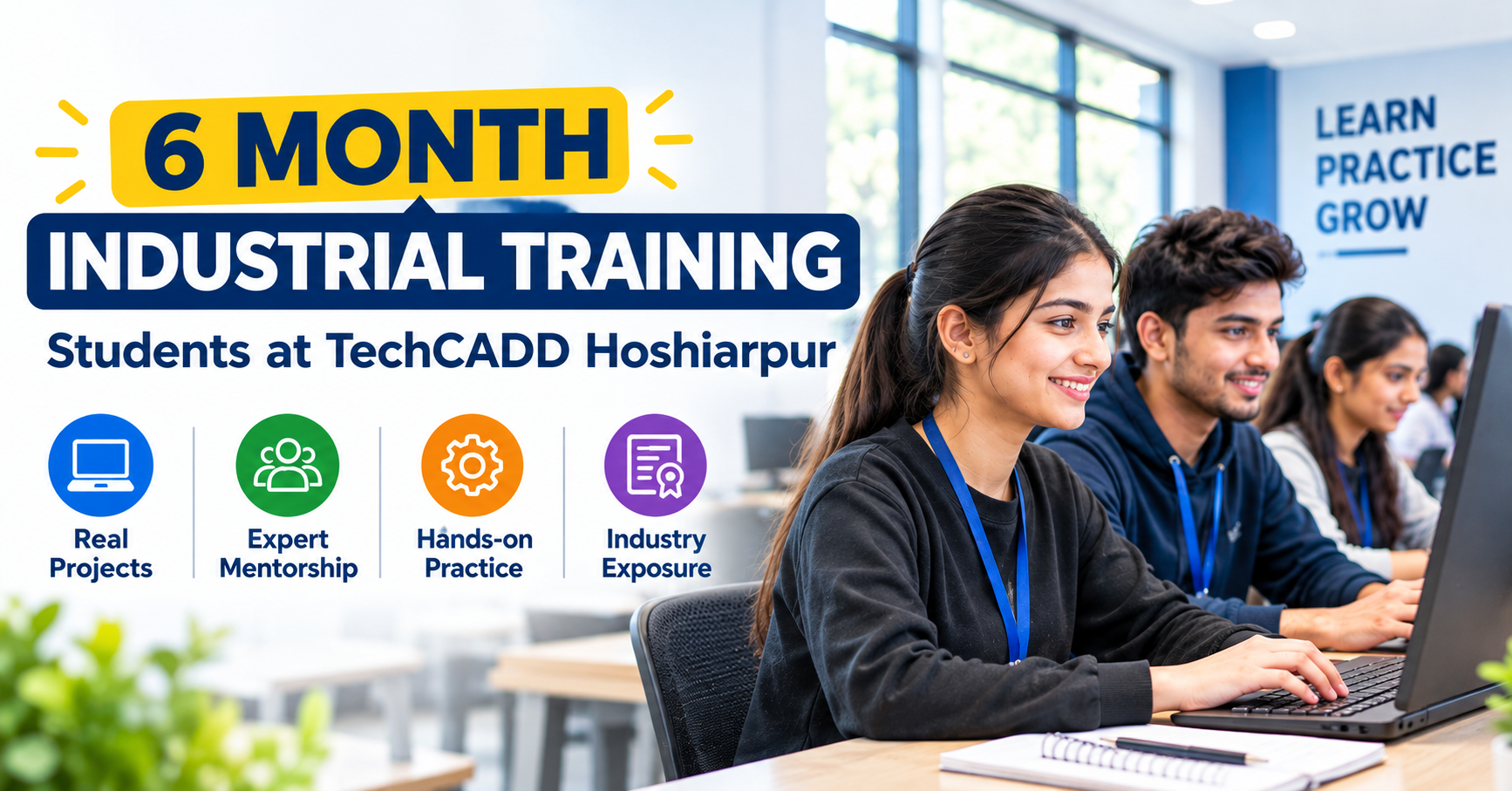
6 Month Technical Industrial Training in Hoshiarpur
Looking for a 6 month technical industrial training program in Hoshiarpur that prepares you for real jobs? At techcadd, our industrial training goes beyond theory. You work on practical, project-based tasks in in-demand technical fields, so you finish the program with real skills and not just a certificate.
Whether you are an engineering, diploma, BCA or graduate student who needs industrial training for your curriculum, or a job seeker who wants to become employable in six months, this program gives you a clear, structured path.
What Is Industrial Training, and Why Does It Matter?
Many college courses are strong on theory but light on practice. You study concepts for years, and then your first internship or job asks you to actually build something, and it feels like a different world.
Industrial training is meant to close that gap. Instead of only reading about web development, AutoCAD or data analysis, you use the same tools that professionals use, on tasks that look like real work. You make mistakes in a safe environment, get feedback, fix them, and slowly build the confidence that no textbook can give you.
For many students, industrial training is also a requirement. Engineering, diploma, BCA and MCA programs often ask students to complete a training period and submit a report or certificate. Doing it well gives you a double benefit: you meet the requirement and you come out with skills that employers can see.
Why Six Months Is the Right Duration
Students often ask whether a short course is enough. A few weeks can introduce you to a subject, but it rarely gives you time to practice properly. Six months strikes a more useful balance.
It’s long enough to learn the fundamentals, build a few real projects and revise what you’ve forgotten. It’s short enough to fit into a semester, a gap period or the stretch after your final exams. You’re not putting your life on hold for years, and you’re not rushing through topics either.
Think of it like learning to drive. A weekend crash course teaches you where the pedals are. Six months of regular practice teaches you to handle traffic. Employers notice that difference.
Who Can Join This Program?
This program is designed for a wide range of students and job seekers:
Engineering and diploma students who need industrial training as part of their curriculum
BCA and MCA students looking for hands-on exposure to real tools and projects
Graduates from any stream who want a technical skill to improve their job prospects
Final-year students who want to be job-ready before they finish college
Job seekers and career switchers in Hoshiarpur who want a focused path into a technical field
Do you need previous experience? For most courses, no. If you’re a complete beginner, the training starts from the basics and builds upward. If you already know a little, you can move faster and spend more time on projects. What matters most is that you show up regularly and practice.
Training Courses Available
Here’s an overview of the technical areas you can choose from. Pick the one that matches your degree, your interests and the kind of work you want to do.
Web Development
You learn how websites and web applications are built, from the front end that visitors see to the back end that makes things work. Typical topics include HTML, CSS, JavaScript and working with databases. This is a strong choice for BCA, MCA and computer science students, and for anyone who likes building things people can use.
Digital Marketing
This course covers how businesses get customers online: SEO, social media marketing, content, Google Ads and analytics. It suits students from any background, since marketing draws on communication and curiosity as much as technical skill. Local businesses in and around Hoshiarpur increasingly need people who understand this.
AutoCAD 2D and 3D
AutoCAD is used to create precise technical drawings in civil, mechanical and architectural work. You practice drawing plans, using layers and dimensions, and building 3D models. It’s a natural fit for civil, mechanical and diploma students, as well as interior design aspirants.
Python Programming
Python is known for being readable and beginner-friendly, and it’s used in everything from automation to data work. If you’re new to coding, it’s a gentle way to learn how programming logic works, and it opens the door to data analytics and AI later.
Data Analytics and Power BI
Here you learn to clean data, analyze it and turn it into clear reports and dashboards. Power BI lets you build visual summaries that managers can understand at a glance. If you enjoy finding patterns in numbers, this course is worth a serious look.
Artificial Intelligence and Machine Learning
This course introduces how machines learn from data, along with the tools and ideas behind modern AI. It works best when you have some comfort with Python or logical thinking, and it suits students who want to move toward data science and AI roles.
Graphic Designing
You learn the principles of layout, color and typography, and use design software to create posters, social media graphics, logos and more. It’s a good fit for creative students and for anyone who wants to work in marketing or branding.
MS Office, Advanced Excel and Tally Prime
These skills sit behind a huge number of office, accounts and administrative jobs. You learn to prepare documents, manage and analyze data, and handle business accounting with GST. They’re especially useful for commerce students and job seekers who want a quick, practical route into office work.
How the Six Months Typically Come Together
Every course has its own content, but a good six-month training usually follows a similar rhythm.
The early weeks focus on fundamentals. You get comfortable with the tools, learn the key terms and practice small exercises until the basics feel natural.
The middle months are about depth. You work on larger tasks, combine different skills and start building mini-projects. This is where many students notice the real jump in confidence.
The final stretch is about putting it all together. You complete a project, prepare your report or portfolio, and get ready for interviews. By the end, you have something concrete to show, not just a list of topics you’ve covered.
What Makes Practical Training Different
Anyone can say their training is practical. Here’s what that should actually mean for you:
You build things. Projects, assignments and exercises take up a large share of your time, not just lectures.
You get feedback. A trainer reviews your work, points out mistakes and explains how to improve.
You practice with real tools. The software you learn on is the software you’ll meet at work.
You learn to explain your work. Presenting a project or answering questions about it prepares you for interviews and viva exams.
You build a portfolio. Finished projects give you something to show employers and to include in your resume.
Common Mistakes Students Make During Industrial Training
A few patterns come up again and again. Knowing them early can save you a lot of wasted time.
Treating it only as a certificate. A certificate helps, but employers care about what you can actually do. Students who focus on skills end up with better results than those who focus only on paperwork.
Skipping practice outside class. Attending sessions is a start, but the real learning happens when you try things yourself, get stuck and work your way out.
Choosing a course because friends chose it. A course that suits someone else may not suit you. Think about your degree, your strengths and the work you’d enjoy.
Trying to learn too many things at once. Depth beats breadth. Becoming genuinely good at one area is more valuable than touching five lightly.
Waiting until the last month to build a project. Start early. Small projects along the way make the final one much easier.
How to Choose the Right Course
If you’re unsure, ask yourself a few honest questions.
What is your degree or background? A civil or mechanical student may lean toward AutoCAD, while a computer science student may prefer web development or Python.
What do you enjoy? If you like building and fixing, look at development or CAD. If you like communication and creativity, consider digital marketing or graphic design. If you like numbers, consider data analytics or Tally.
What kind of job do you want in the next year or two? Look at job listings for roles you like and note which skills appear most often.
Still not sure? Attending a demo class can help a lot. Seeing how a course is taught, and asking questions directly, often makes the decision clearer than any brochure.
What Can You Do After the Training?
The six months are a starting point, not the finish line. Depending on your course, doors that open include:
Internships and entry-level jobs in your chosen field
Freelance work for local businesses, such as building websites, running social media or preparing drawings
Stronger college projects and viva performance, since you’ve actually practiced the subject
A foundation for further learning, such as advanced courses, certifications or higher studies
A better resume, with real projects and tools listed instead of only subjects studied
Training doesn’t guarantee a job on its own. What it does is make you a stronger candidate who can show real work, and that’s what hiring managers respond to.
Tips to Get the Most Out of Your Six Months
Be regular. Consistency matters more than occasional bursts of effort.
Ask questions. If you don’t understand something, ask early. Everyone else probably has the same doubt.
Build your own small projects alongside the course, even simple ones.
Keep notes and a project folder. They’ll be useful for your report and interviews.
Revise weekly. A short revision session each week keeps earlier topics fresh.
Start your portfolio early. Don’t leave it for the last week.
Why Hoshiarpur Students Don’t Need to Look Far
A lot of students assume that good technical training means moving to a bigger city. That isn’t always necessary. With practical, well-structured training available locally, you can build strong skills without the cost and stress of relocating, and stay close to family while you learn.
Local businesses also need these skills. Shops, clinics, institutes and workshops around Hoshiarpur are moving online and modernizing their operations, and people who can build, design, analyze or manage are in demand. Starting your career close to home can be a smart move.
Ready to Start Your Six Months?
If you’re ready to turn your degree or your ambition into practical, job-ready skills, the next step is simple. Choose a course that fits you, visit techcadd in Hoshiarpur or reach out to us, and attend a free demo class. You’ll see how the training works, meet the trainers and get your questions answered before you commit.
Six months from now, you can be a student who studied a subject, or a student who can actually do the work. The difference is what you choose to start today.