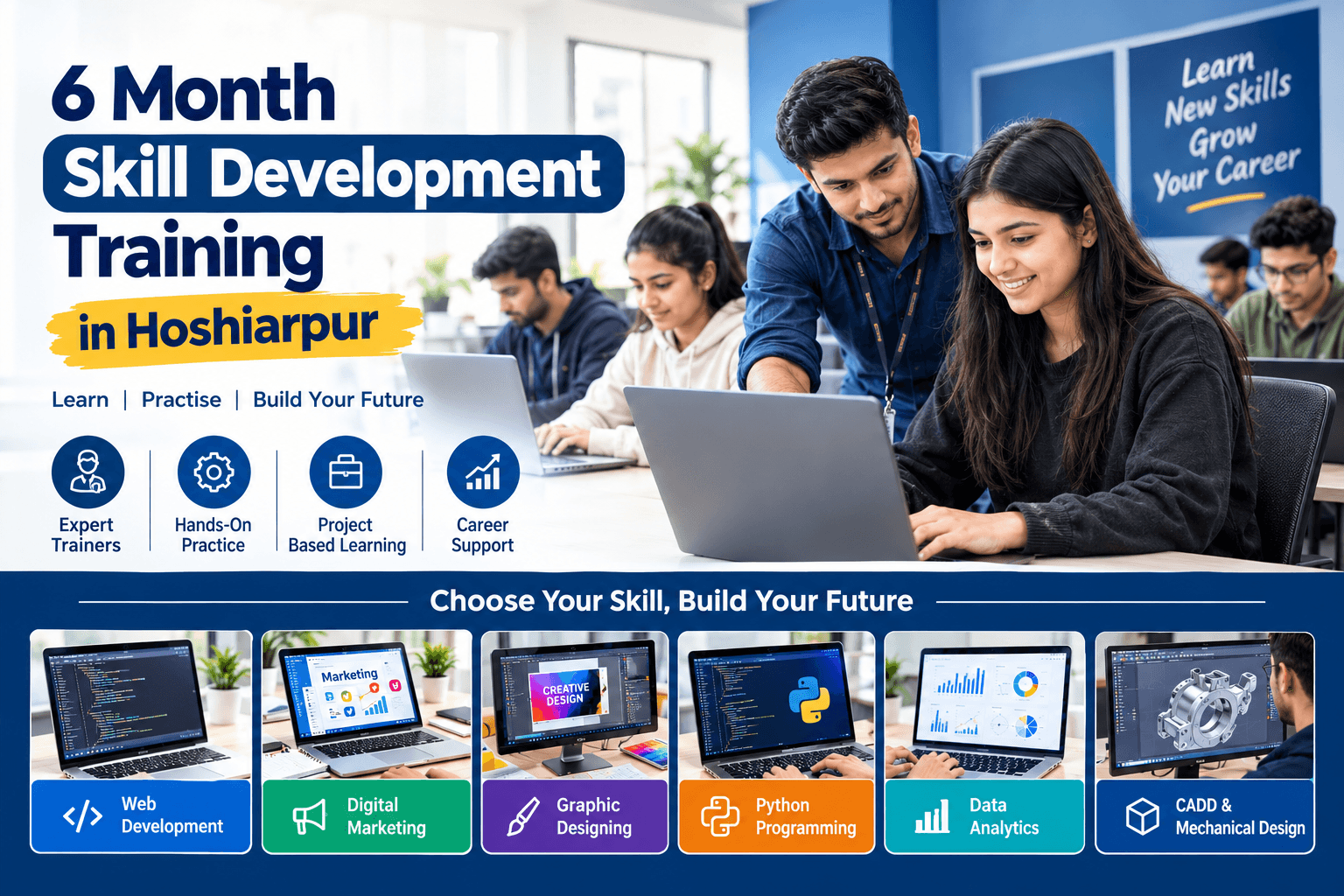
6 Month Professional Course in Hoshiarpur
6 Month Professional Course in Hoshiarpur
Choosing the right professional course can be an important step towards building your career. Today, employers value candidates who have relevant knowledge, practical skills, and the ability to complete tasks using industry-related tools. A professional course can help you develop these abilities and prepare for opportunities in your chosen field.
TechCadd Hoshiarpur provides learning opportunities for students, graduates, job seekers, and beginners who want to improve their computer and technical skills. A six-month professional course offers a structured way to learn important concepts, practise software tools, and work on practical assignments.
Our 6 month professional course in Hoshiarpur page introduces different learning paths for students interested in technology, design, online marketing, data analysis, and computer-aided design. Depending on the selected programme, students can develop technical knowledge, complete projects, and improve their confidence in applying what they learn.
A six-month learning period can give students time to understand the fundamentals, practise regularly, and gradually develop more advanced skills. Instead of focusing only on theory, learners can apply their knowledge to exercises and projects related to their chosen specialisation.
Whether you have recently completed school, are pursuing a degree, or want to improve your existing skills, choosing a suitable professional course can help you work towards your personal and career goals.
What Is a Professional Course?
A professional course is designed to develop knowledge and skills related to a particular occupation or industry. These courses often focus on practical applications, specialised software, industry-related techniques, and tasks that learners may encounter in professional environments.
For example, web development training teaches students how to create websites. Digital marketing training introduces methods for promoting businesses online. Graphic designing focuses on visual communication, while data analytics teaches learners how to organise and interpret information.
Professional courses can also include programming, office applications, and mechanical design software. The right choice depends on your interests, educational background, and preferred career direction.
Why Choose a Six-Month Course?
Six months can provide a useful timeframe for developing a foundation in a specialised subject and applying that knowledge through regular practice.
A structured programme may include:
Fundamental concepts and guided lessons.
Practical software training.
Assignments and skill-building exercises.
Projects related to the selected field.
Feedback and opportunities to improve.
Career preparation, depending on the programme.
The actual syllabus, course duration, and learning outcomes should be confirmed for the specific course you select.
Professional Courses Available
1. Web Development Course
Web development is suitable for learners interested in building websites and web applications. It involves creating website layouts, adding interactive features, and making websites work across different devices.
Depending on the syllabus, students may learn HTML, CSS, JavaScript, WordPress, responsive design, and introductory backend development.
Practical projects may include business websites, portfolio websites, landing pages, and other web-based applications. These projects help students apply their knowledge and create examples of their work.
2. Python Programming Course
Python is a popular programming language used in software development, automation, data analysis, and artificial intelligence applications.
A Python course may cover variables, data types, operators, conditional statements, loops, functions, lists, dictionaries, file handling, and object-oriented programming.
Students can practise writing programs, solving logical problems, and creating small applications. Consistent coding practice helps build a stronger programming foundation.
3. Digital Marketing Course
Digital marketing helps businesses reach audiences through search engines, social media, websites, email, and other digital channels.
Training may include search engine optimisation (SEO), social media marketing, keyword research, content planning, online advertising fundamentals, and website analytics.
Practical assignments may involve keyword research, website optimisation, content calendars, campaign planning, and performance reports. These activities help learners understand how businesses promote their products and services online.
4. Graphic Designing Course
Graphic designing is a professional skill for creating visual content that communicates ideas and information clearly.
Students may learn colour theory, typography, layout design, image editing, and design software such as Adobe Photoshop, Adobe Illustrator, or CorelDRAW, depending on the course.
Practical work may include social media creatives, posters, brochures, promotional banners, and advertisements. A portfolio of original designs can help demonstrate a student's abilities to prospective employers or clients.
5. Data Analytics Course
Data analytics focuses on organising, analysing, and presenting information to support decision-making.
Depending on the syllabus, students may learn Microsoft Excel, formulas, data cleaning, charts, PivotTables, Power BI, SQL, or introductory Python for data analysis.
Practical assignments can include preparing reports, analysing datasets, creating dashboards, and presenting findings through visualisations.
These skills can be useful in business reporting, administration, sales analysis, and other data-related activities.
6. CADD and Mechanical Design Course
Students interested in mechanical engineering, drafting, and product design can explore computer-aided design training.
Depending on the programme, topics may include AutoCAD, SOLIDWORKS, 2D drafting, 3D modelling, engineering drawings, and assemblies.
Practical exercises help learners understand design tools and develop digital models of mechanical components. Career options depend on the student's qualifications, technical knowledge, and experience.
7. Basic Computer and MS Office Course
Basic computer and office application skills are useful for students, job seekers, and professionals across many industries.
Training may cover computer fundamentals, Windows, file management, typing, internet usage, email, Microsoft Word, Excel, and PowerPoint.
These skills help learners prepare documents, maintain records, organise data, create presentations, and handle everyday computer-related tasks.
What Will You Learn in Six Months?
The learning plan varies according to the course. A general six-month structure may look like this:
Month 1: Introduction and Fundamentals
Learn the basic concepts of your selected subject and become familiar with relevant software, tools, and terminology.
Month 2: Core Skills
Develop a stronger understanding of essential features and techniques through guided exercises and regular practice.
Month 3: Practical Assignments
Apply the concepts you have learned to practical tasks. Improve your accuracy, learn to solve common problems, and build confidence using relevant tools.
Month 4: Project Development
Begin a project related to your chosen field, such as a website, programming application, design portfolio, data report, or CAD model.
Month 5: Advanced Practice
Refine your project, practise more complex techniques, and improve your ability to complete tasks independently.
Month 6: Project Completion and Career Preparation
Complete and review your project, organise suitable work samples, and prepare to explain your skills. Resume guidance or interview preparation may be available depending on the programme.
This is an illustrative learning structure, not a guaranteed syllabus for every course.
Benefits of Professional Training
Practical Skill Development
Professional training helps students apply concepts through exercises and projects. Regular practice can improve their understanding of relevant tools and techniques.
Improved Confidence
Learning step by step and completing assignments can help students become more comfortable with their chosen subject and develop confidence in their abilities.
Project Portfolio
Projects provide examples of what students can do. Depending on the field, a portfolio may include websites, graphic designs, programming applications, dashboards, or technical drawings.
Career Preparation
Professional skills can help learners prepare for entry-level job opportunities and further specialisation. Employers may also consider qualifications, communication, experience, and other role-specific requirements.
Opportunities for Continued Learning
A six-month course can provide a foundation for advanced training, certifications, specialised projects, or further study in a selected field.
Who Can Join a Six-Month Professional Course?
These courses may be suitable for:
College students who want to develop practical skills.
Diploma holders interested in technical training.
Graduates preparing for job opportunities.
Freshers looking to strengthen their resumes.
Beginners interested in learning computer applications.
Working professionals who want to update their skills.
Creative learners interested in design and digital media.
Students interested in programming, data, or mechanical design.
Eligibility requirements vary depending on the selected programme. Some technical courses may require basic computer knowledge or a relevant educational background.
Why Choose TechCadd Hoshiarpur?
Structured Learning Approach
A structured learning plan helps students progress from basic concepts to more advanced topics in an organised way.
Practical Training
Practical exercises help learners understand how software tools and technical concepts are used to complete tasks.
Multiple Specialisations
Students can explore different learning paths in technology, design, digital marketing, data analysis, and computer-aided design, subject to current course availability.
Project-Based Learning
Working on projects gives learners opportunities to apply concepts, solve problems, and build examples of their work.
Guidance and Feedback
Guidance during training can help students understand difficult topics, correct errors, and improve their work through regular practice.
Local Learning Option
Students searching for professional courses in Hoshiarpur can enquire about available programmes, course schedules, fees, eligibility, and practical training facilities at TechCadd Hoshiarpur.
Career Opportunities After a Professional Course
Career opportunities depend on the course completed, your qualifications, your practical skills, and employer requirements.
Web development learners may work towards junior web development or website support positions. Python students can continue building skills for programming and automation roles. Digital marketing learners may explore SEO and marketing assistant positions.
Graphic designing students can prepare for junior design roles or freelance projects by developing a portfolio. Data analytics learners may pursue opportunities involving spreadsheets, reporting, and dashboards. CADD students may work towards drafting and mechanical design roles, depending on their technical qualifications.
Students with basic computer and MS Office skills may consider computer operator, data entry, office assistant, or administrative support positions.
Completing a professional course does not guarantee employment. Continued practice, relevant projects, and preparation for job-specific requirements are important for career development.
How to Choose the Right Professional Course
Before enrolling, consider your interests, educational background, and career goals.
If you enjoy coding and building websites, web development or Python programming may be suitable options. If you enjoy visual creativity, consider graphic designing. If you are interested in promoting businesses online, explore digital marketing. If you prefer working with numbers and reports, data analytics may be worth considering. Students interested in engineering drawings can explore CADD.
Review the course syllabus carefully and ask which software tools, practical assignments, and projects are included. You should also confirm the duration, fees, class schedule, eligibility requirements, and certificate details.
Choosing a course that matches your interests can help you stay motivated and make better use of your learning time.
Start Your Professional Learning Journey in Hoshiarpur
Developing practical skills can help you prepare for new learning and career opportunities. Whether you want to work with websites, programming, digital marketing, graphic design, data analytics, or mechanical design, the right course can help you build a foundation in your chosen field.
TechCadd Hoshiarpur provides a local option for students and learners who want to explore professional computer and technical training.
Explore the available programmes, choose a course that fits your goals, and work towards improving your skills through consistent practice and project development.
Contact TechCadd Hoshiarpur to enquire about available six-month professional courses, course fees, eligibility, schedules, and enrolment details.
Frequently Asked Questions
1. What is a six-month professional course?
A six-month professional course is a structured learning programme that helps students develop specialised knowledge and practical skills in areas such as IT, programming, digital marketing, graphic design, data analytics, or CADD.
2. Which professional courses can I explore in Hoshiarpur?
Possible options include web development, Python programming, digital marketing, graphic designing, data analytics, CADD, and MS Office. Confirm current availability with TechCadd Hoshiarpur.
3. Who can join a six-month professional course?
Students, diploma holders, graduates, freshers, working professionals, and eligible beginners can explore courses that match their interests and educational backgrounds.
4. Can beginners join professional computer courses?
Yes, many courses begin with fundamental concepts. However, some advanced technical programmes may require previous computer knowledge or specific qualifications.
5. Does a professional course include practical projects?
Practical assignments and projects may be included, depending on the course syllabus. Ask about project work and hands-on training before enrolling.
6. Will I receive a certificate after completing the course?
Certificate availability and completion requirements depend on the selected programme. Confirm the certificate details with the institute before enrolment.
7. Can a six-month professional course help me find a job?
A professional course can help you develop relevant skills and prepare for job applications. Employment depends on your qualifications, abilities, project experience, and employer requirements.
8. How do I choose the best professional course for my career?
Compare your interests, career goals, course syllabus, software tools, practical projects, eligibility, and duration. Choose a programme that fits your learning needs and future plans.