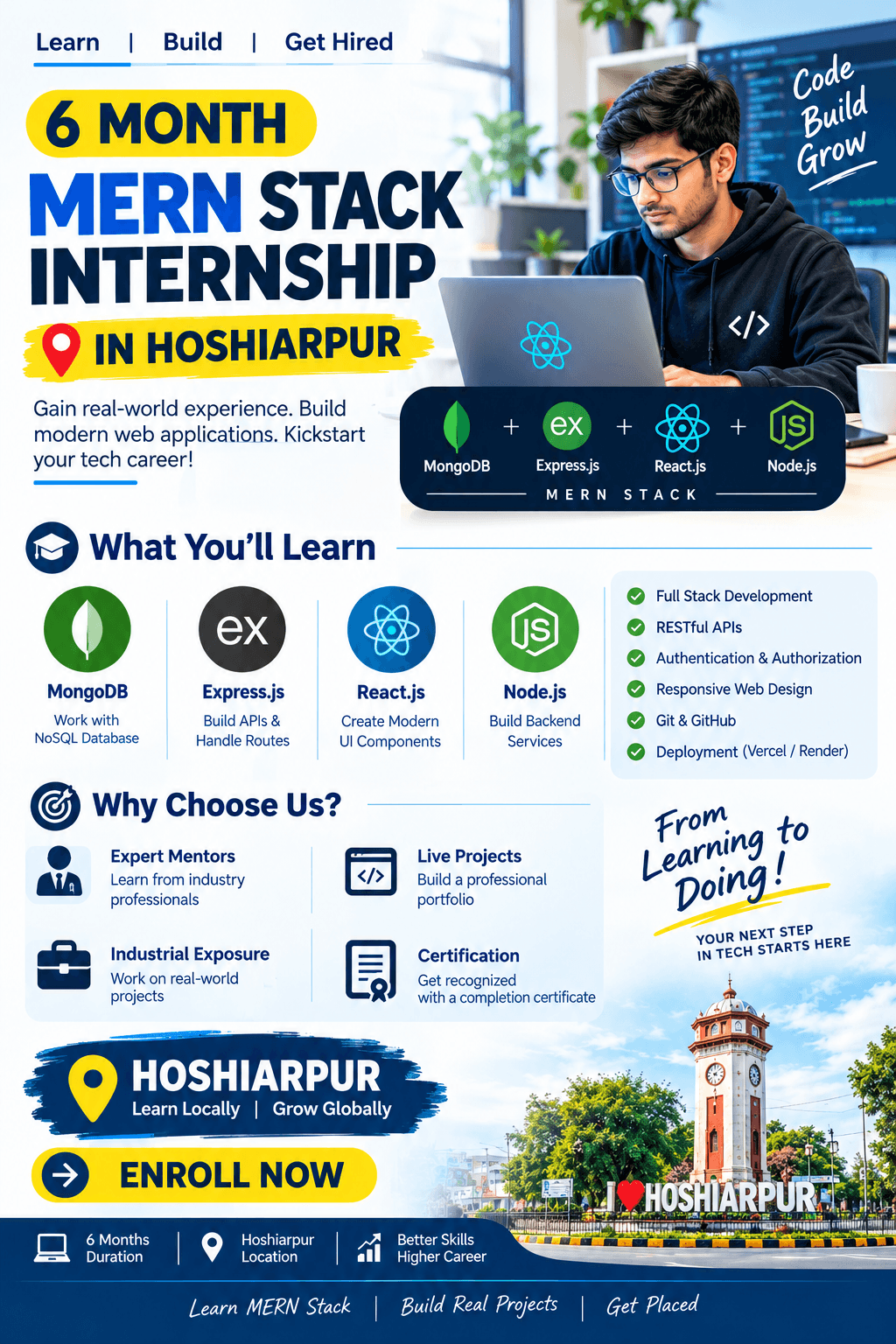
6 month MERN stack internship in Hoshiarpur
6 Month MERN Stack Internship in Hoshiarpur
Are you looking for a 6 month MERN Stack internship in Hoshiarpur to develop practical web development skills and understand how modern web applications are built? The MERN stack is a collection of four technologies commonly used to develop full-stack web applications: MongoDB, Express.js, React.js, and Node.js. Together with JavaScript, these technologies can help developers build interactive user interfaces, server-side functionality, and data-driven applications.
Techcadd Hoshiarpur is an option to enquire with if you want to explore full-stack development training and project-based learning. A structured six-month programme can provide time to learn web fundamentals, practise frontend and backend development, connect applications to databases, and build projects that demonstrate your skills.
Before enrolling, confirm the actual syllabus, software tools, practical hours, project support, and training format. An internship may include workplace exposure, while an industrial training programme may primarily involve instructor-led lessons and projects. If your college requires formal internship or industrial training documentation, check its requirements before joining.
What Is the MERN Stack?
MERN stands for MongoDB, Express.js, React.js, and Node.js. These technologies work together to support different parts of a web application.
MongoDB is a database technology used to store application information. Express.js is a framework for building server-side applications and API routes with Node.js. React.js is a JavaScript library used to create interactive user interfaces. Node.js allows JavaScript to run on the server side.
JavaScript connects many parts of the stack, allowing developers to work on both the frontend and backend. A typical application may let users interact with a React interface, send requests to an Express API, process those requests using Node.js, and read or update records stored in MongoDB.
Learning the MERN stack involves more than memorising tools. Developers also need to understand HTML, CSS, JavaScript, application structure, data flow, debugging, validation, and basic web security.
Why Choose a Six-Month MERN Stack Programme?
1. Learn Frontend Development
Understand how websites are structured and styled using HTML and CSS, then use JavaScript to add interactive behaviour. React can help you organise user interfaces into reusable components.
2. Develop JavaScript Skills
Practise variables, functions, arrays, objects, conditions, loops, modules, and asynchronous programming. JavaScript knowledge is essential for working effectively across the MERN stack.
3. Understand Backend Development
Learn how servers handle requests, process application logic, validate input, and return responses. Express.js and Node.js can be used to build the backend services that support a web application.
4. Work with Databases
Explore how MongoDB stores and organises application data. Practise basic database operations, including creating, reading, updating, and deleting records.
5. Connect Frontend and Backend
Learn how a frontend application communicates with a backend through APIs. Practise sending requests, handling responses, displaying data, and managing errors.
6. Build Full-Stack Projects
Combine frontend interfaces, server-side logic, and database operations in practical applications. Project work can help you understand how individual components function as a complete system.
What Will You Learn?
HTML, CSS, and Responsive Design
Start with webpage structure, styling, forms, navigation, layout techniques, and responsive design. Practise building interfaces that adapt to different screen sizes.
JavaScript Fundamentals
Learn variables, data types, operators, functions, arrays, objects, loops, conditions, and DOM concepts where relevant. Progress towards modern JavaScript features, modules, promises, and asynchronous operations.
React.js Frontend Development
Explore components, props, state, event handling, forms, and rendering data. Depending on the syllabus, you may also practise React hooks, routing, reusable UI patterns, and communicating with APIs.
Node.js and Express.js
Understand server-side JavaScript, routes, middleware, request handling, responses, and REST API development. Learn how to structure backend code and handle common errors.
MongoDB Database Fundamentals
Practise storing and retrieving records, designing simple document structures, and performing CRUD operations. Understand how database records support application features.
API Integration
Learn how the frontend and backend exchange data using HTTP requests and responses. Practise connecting React components to backend endpoints and displaying results.
Authentication and Application Security
If included in the syllabus, explore user registration, login workflows, password-handling practices, input validation, access control, and safe management of configuration secrets. Authentication should be implemented carefully rather than treated as a simple form submission.
Testing, Debugging, and Deployment
Practise identifying errors, checking application behaviour, and improving code. Depending on the course, learners may also explore version control, environment configuration, and deployment to a suitable hosting platform.
Illustrative Six-Month Learning Plan
This is a suggested structure for planning purposes, not a confirmed Techcadd timetable. The actual syllabus and sequence should be verified with the institute.
Month 1: Web Fundamentals and JavaScript
Learn HTML, CSS, responsive layouts, and JavaScript fundamentals. Build small webpages and practise interactive features.
Month 2: Advanced JavaScript and React Basics
Explore modern JavaScript concepts and begin building React components, forms, state-driven interfaces, and multi-page user experiences.
Month 3: React Application Development
Develop frontend features, practise routing where included, manage application data, and connect interfaces to sample APIs.
Month 4: Node.js and Express.js
Build server-side routes and REST APIs. Practise request handling, middleware, input validation, and error responses.
Month 5: MongoDB and Full-Stack Integration
Connect the backend to a database and link frontend interfaces with API endpoints. Develop the main features of a full-stack application.
Month 6: Final Project, Testing, and Revision
Complete a full-stack project, test key workflows, fix errors, document the application, and prepare to explain its structure and functionality.
Practical MERN Stack Projects
Projects provide opportunities to combine frontend, backend, and database skills. Suitable practice projects may include:
A task management application with create, update, and delete features.
A student record management system.
A product catalogue with search and filtering.
An appointment booking prototype.
A blog application with posts and categories.
A basic inventory management application.
A user login and registration workflow, if authentication is included in the syllabus.
A final full-stack application that connects a React interface, an Express API, Node.js, and MongoDB.
Project scope should match the learner's level and the confirmed course syllabus. Students should understand the code they submit and document the features, design decisions, and limitations of their work.
Who Can Join a MERN Stack Internship?
The programme may suit:
B.Tech and engineering students interested in software development.
BCA and MCA students looking to strengthen web development skills.
Computer science and IT students seeking project experience.
Eligible diploma students interested in web technologies.
Recent graduates and freshers building a development portfolio.
Beginners who want to learn full-stack development step by step.
Basic computer knowledge is helpful. Prior JavaScript experience may be useful, but beginners should confirm whether the programme starts with HTML, CSS, and programming fundamentals.
Career Opportunities After Training
MERN Stack training can provide a foundation for further learning and potential entry-level web development opportunities. Depending on practical ability, qualifications, portfolio quality, and employer requirements, learners may explore junior frontend development, junior web development, React development, Node.js development, or full-stack development pathways.
Employers may assess programming fundamentals, application architecture, debugging, database knowledge, API integration, and the ability to explain completed projects. A six-month course does not guarantee a job or make every learner ready for every developer role.
Continue practising after training, improve your code quality, learn version control, and build projects that demonstrate your own understanding.
How to Choose the Right MERN Stack Training Programme
Review the syllabus to ensure it covers the technologies and skills you want to learn. Ask how much time is allocated to React, Node.js, Express.js, MongoDB, JavaScript, APIs, and projects.
Confirm whether students receive practical coding time, trainer feedback, debugging support, and opportunities to build a complete application. Ask about the total duration, schedule, fees, software requirements, assessments, and certificate policy.
If your college requires an internship, verify whether the programme includes workplace experience or mainly classroom training and project work. Confirm that the institute can provide the documentation your college requires before enrolling.
Frequently Asked Questions
1. What is the MERN stack?
MERN stands for MongoDB, Express.js, React.js, and Node.js. These technologies can be used together to build full-stack web applications.
2. Do I need coding experience before joining?
Not always. Beginners can start with HTML, CSS, and JavaScript if these topics are included. Confirm the course's entry requirements.
3. What will I learn during six months?
Potential topics include frontend development, JavaScript, React, Node.js, Express, MongoDB, REST APIs, debugging, and full-stack projects. The actual syllabus may differ.
4. Will I build a full-stack project?
Ask whether the programme includes a final project that connects the frontend, backend, and database, and whether guided feedback is provided.
5. Is this an internship or industrial training?
The format depends on the programme. Confirm whether it includes workplace exposure or is an instructor-led training course with practical projects.
6. Will I receive a certificate?
Certificate availability and completion requirements depend on the institute's policy. Verify the issuing organisation and whether the certificate meets your college requirements.
7. Can I get a job after completing the programme?
The programme may help you develop relevant skills, but employment is not guaranteed. Practical ability, portfolio quality, qualifications, and interview performance also matter.
Start Your Full-Stack Development Journey
If you are searching for a 6 month MERN Stack internship in Hoshiarpur, enquire with Techcadd Hoshiarpur about the current programme, syllabus, project work, training schedule, fees, and certification requirements.
Choose a learning path that matches your goals, practise coding consistently, and build applications that demonstrate your understanding of frontend, backend, and database development. A solid foundation in the MERN stack can help you plan your next steps in web development.
6 Month MERN Stack Internship in Hoshiarpur
Learn MongoDB, Express.js, React.js, Node.js, JavaScript, API development, and full-stack web application development through practical training in Hoshiarpur.