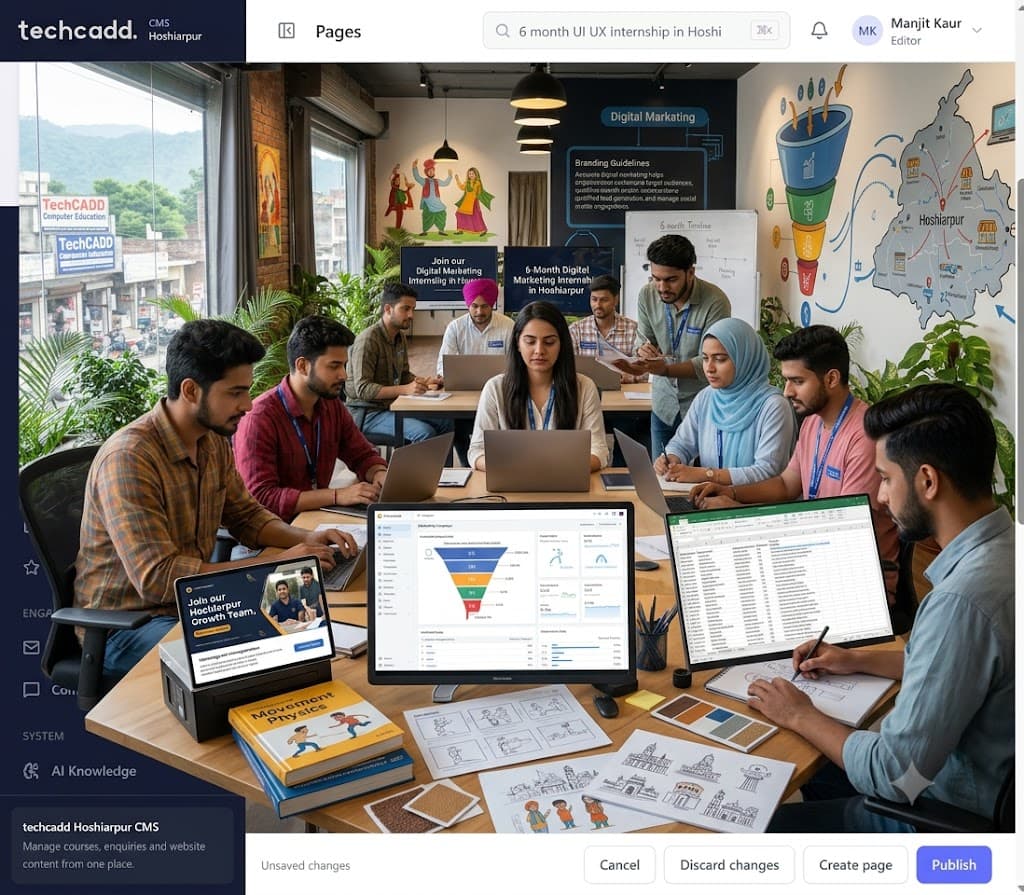
6-Month Digital Marketing Industrial Training in Hoshiarpur
Accurate digital marketing industrial training helps organizations understand target audiences, optimize search engine visibility, drive qualified lead generation, manage social media engagement, and measure return on ad spend (ROAS). Marketing software and analytics tools support this work by organizing keyword research, campaign schedules, audience segments, landing page performance data, and conversion funnels. However, reliable results depend on the marketer's foundational strategic knowledge, analytical depth, and attention to consumer behavior trends.
Learning Digital Marketing and Growth Strategy in Hoshiarpur involves connecting marketing fundamentals with practical analytics tools and multi-channel campaign methodologies. Students need to understand consumer search intent, select suitable promotion channels, test conversion paths, and review performance analytics metrics.
Learners can contact Techcadd Hoshiarpur to discuss their academic background, career goals, and available 6-month training options. A structured approach helps beginners develop confidence through realistic project portfolios rather than relying entirely on memorized tool shortcuts.
What Is Digital Marketing and Growth Strategy?
Digital marketing encompasses search engine optimization (SEO), pay-per-click advertising (PPC), social media marketing, content strategy, and email automation to build brand awareness and acquire customers online. Depending on the project requirements, scope, and target audience, users can work with keyword planners, ad managers, analytics dashboards, and campaign landing pages.
Learning the campaign process begins with understanding how user pain points and search behavior are represented in analytics insights. A traffic drop, low conversion rate, or target keyword gap needs appropriate campaign testing and audience classification.
A 6-Month Digital Marketing Course in Hoshiarpur can introduce:
Setting up professional ad manager and analytics workspaces.
Conducting audience research and buyer persona creation.
Designing SEO metadata, keyword maps, and content calendars.
Creating paid ad campaigns and high-converting landing pages.
Maintaining scalable email marketing workflows and lead funnels.
Reviewing bounce rates, conversion metrics, and ROI reports.
Managing organized campaign reporting and client handoffs.
Software makes data collection easier to process, but it does not replace marketing judgment and consumer empathy.
What Does Digital Campaign Management Involve?
Campaign management involves organizing the data and processes needed to support end-to-end digital promotion. It connects market research, ad creative, budget allocations, stakeholder feedback, and preparation for performance reporting.
Students should understand that boosting a random social media post is only one part of the process. The user's online journey, ad platform compliance guidelines, and conversion tracking setup also need attention.
Digital Marketing Training in Hoshiarpur can introduce:
Reviewing campaign performance metrics and audience feedback.
Maintaining keyword tracking and content record sheets.
Checking ad creative consistency across different device placements.
Recording documented campaign iterations and A/B test results.
Comparing cost-per-click (CPC) and conversion rates across channels.
Preparing client review schedules and milestone updates.
Tracking unresolved traffic friction points and drop-off funnels.
The aim is a clear, traceable workflow in which marketing decisions can be connected with user research and business growth goals.
Why Learn SEO and Paid Advertising Together?
Organic search visibility (SEO) and paid acquisition channels depend on the same underlying audience search intent and conversion constraints. Studying them together helps learners understand how landing page quality affects ad quality scores, organic rankings, and overall customer acquisition cost (CAC).
For example, a digital campaign exercise can involve reading product requirements, identifying target keywords, structuring landing pages, launching targeted ad sets, and preparing analytics performance reports.
A 6-Month Digital Marketing Course in Hoshiarpur can help develop:
Practical digital strategy understanding.
Accurate campaign budgeting and targeting habits.
Familiarity with marketing documentation and brand style guides.
Confidence in presenting marketing proposals and campaign audits.
Better discrepancy-identification and data critique skills.
Clearer communication with clients, designers, and stakeholders.
Learning becomes more useful when students follow complete campaign workflows instead of practicing isolated tactics without checking their overall conversion impact.
Who Can Learn Digital Marketing?
Digital marketing learning can suit students and professionals with different starting points. Creative or analytical knowledge may help, but beginners can start with marketing foundations before moving into advanced programmatic ad exercises.
Potential learners include:
Business and commerce students.
Graduates exploring e-commerce and brand management work.
Sales professionals looking to improve online lead generation skills.
Graphic designers wanting to transition into social media marketing.
Entrepreneurs promoting their own startup ventures.
Professionals refreshing practical portfolio skills.
Before selecting Digital Marketing Classes in Hoshiarpur, discuss prerequisites, tool access, live project assignments, and the expected starting level. Learners should understand whether the training begins with core marketing theories or assumes previous software experience. This makes it easier to identify a suitable learning path and prepare effectively.
Build Strong Marketing Foundations
Software operations make more sense when learners understand the marketing funnel, consumer psychology, unique selling propositions (USPs), brand positioning, and the purpose of data-driven decision-making.
Students should learn how messaging affects audience attention and why the campaign must reflect the customer's buying journey accurately.
A Basic Digital Marketing Course in Hoshiarpur can introduce:
The AIDA (Attention, Interest, Desire, Action) marketing funnel.
Keyword research and search intent analysis.
On-page and technical SEO fundamentals.
Social media algorithmic distribution basics.
Email marketing segmentation strategies.
Basic analytics evaluation and KPI tracking.
Use straightforward examples first. Understanding the underlying user intent helps students recognize an ineffective campaign angle even when the platform allows the ad spend and impressions appear high.
Setting Up a Digital Campaign
Initial account setup influences later campaign optimization, so beginners should approach it carefully. Use a fictional business brief with clearly defined target metrics for training.
Record the target audience demographics, relevant brand guidelines, campaign budget constraints, and key performance indicators (KPIs). Review tracking pixel installations before launching live ad sets.
Useful setup habits include:
Following consistent naming conventions for campaigns, ad sets, and UTM parameters.
Recording marketing assumptions and target audience hypotheses.
Checking mobile responsiveness of target landing pages.
Separating test ad groups from final budget-allocated campaigns.
Confirming which geographic and demographic filters the exercise requires.
Saving a version history backup of ad copy and creative assets before major overhauls.
Students exploring Practical Digital Training in Hoshiarpur should understand why a specific targeting parameter is needed rather than copying it from another brand without examining suitability.
Creating Content Calendars and SEO Strategies
Content planning organizes audience outreach into meaningful publishing schedules. Keyword maps help maintain consistency across search engine results pages and blog networks.
Incorrect keyword targeting can affect organic traffic acquisition, making this an important area for practical review. Students should understand the purpose of each content piece and how it relates to the user journey.
Practice activities include:
Creating keyword maps and search volume spreadsheets.
Setting up monthly content distribution calendars.
Reviewing meta title and meta description constraints (such as 60-character titles and 160-character descriptions).
Checking content elements against supplied business briefs.
Avoiding keyword stuffing and duplicate content penalties.
Correcting documented SEO audit mistakes.
A clear naming approach makes campaign files easier to understand for clients and team members. Similar tracking tags should not be used casually when they could cause data attribution errors during reporting.
Designing Social Media and Paid Ad Creatives
Visual design and ad copywriting connect brand identity with consumer engagement. Learners need to read the complete creative brief and identify audience expectations before selecting color themes or drafting ad hooks.
Social Media Marketing Training in Hoshiarpur can include:
Designing responsive social media posts and banner ads (such as 1200x630px sharing graphics).
Preparing sample carousel and video ad variations.
Distinguishing primary value propositions from secondary call-to-actions.
Checking contrast ratios and readability for ad text overlays.
Reviewing hook variations for short-form video content.
Inspecting landing page continuity with ad messaging.
After campaign creation, compare the creative assets with the brand guidelines and target audience profile. Then review the complete conversion path. This multi-stage check helps identify messaging disconnects that may not be obvious from a single ad creative alone.
Funnel Optimization, Analytics, and Tracking
Traffic acquisition and conversion tracking are different deliverables. Similarly, driving clicks to a website does not necessarily mean visitors will complete a purchase or lead form.
Students should understand how user behavior on landing pages affects conversion rates and how to set up conversion tracking.
Useful exercises include:
Setting up Google Analytics goals and event tracking.
Analyzing user drop-off points in conversion funnels.
Reviewing heatmaps and session recordings.
Checking form submission tracking accuracy.
Identifying broken links and slow-loading page elements.
Preparing a conversion rate optimization (CRO) audit log.
Accurate tracking supports reliable campaign optimization and budget allocation. Avoid ignoring high bounce rates simply to make campaign reports look successful. Gaps need landing page revisions and, where necessary, copywriting adjustments.
Email Marketing, Automation, and Lead Nurturing
Email systems connect subscriber lists, automated sequences, segmentation tags, and open-rate analytics. It requires consistent naming conventions and careful handling of contact data.
An Email Marketing and Automation Course in Hoshiarpur can introduce:
Creating sample welcome sequences and promotional broadcast emails.
Defining appropriate audience segmentation rules.
Organizing lead magnet delivery funnels.
Connecting landing page forms with CRM software.
Reviewing email deliverability and spam score guidelines.
Comparing open rates, click-through rates (CTR), and unsubscribe metrics.
Start with a small subscriber segment so students can trace open and click rates easily. Check whether the subject lines and email copy have both been represented appropriately. Campaign sequences may look complete while individual tracking links contain broken destinations, so review detail as well as global strategy.
Understanding Market Research and Consumer Psychology
Marketing strategy and audience research setup should reflect the business goals and competitive landscape. Learners need to understand the purpose of market data collected and the consequences of ignoring competitor analysis.
Digital Strategy Training in Hoshiarpur can introduce the use of competitor audits, consumer surveys, social listening, and keyword gap analysis within a controlled project dataset.
Students should practice:
Reading the supplied business briefs.
Checking relevant competitor market share details.
Reviewing customer review insights and pain points.
Comparing campaign performance with initial market hypotheses.
Identifying core target audience conversion barriers.
Documenting recommendations for brand growth.
Market trends and consumer preferences can change. Training should develop the habit of consulting current industry benchmarks and digital advertising policies instead of relying only on remembered examples.
Campaign Review and Performance Evaluation
Marketing evaluation requires accurate data interpretation and a clear connection between traffic drops and underlying campaign flaws. Learners should check CTR, cost-per-acquisition (CPA), conversion rates, and SEO ranking reports.
A Digital Audit Course in Hoshiarpur can use sample campaign data containing deliberate targeting and budgeting mistakes.
Useful checks include:
Correct audience targeting and negative keyword implementation.
Consistent branding across all ad placements and landing pages.
Appropriate ad spend pacing throughout the month.
Clear call-to-action buttons on conversion pages.
Agreement between business revenue goals and digital marketing execution.
Accurate references to analytics tracking metrics.
Read through performance reports before finalizing client presentations. Missing data discrepancies should be investigated through structured audits rather than supplied through assumptions. A high-impression campaign still needs careful conversion validation.
Campaign Iterations, Revisions, and A/B Testing
Digital campaigns must adapt based on real-time performance data. Ad sets can burn through budget without converting, audience fatigue may set in, or an SEO audit may require a documented content update.
Students should understand how a campaign iteration relates to original strategy data and how it affects overall return on investment.
Practical activities include:
Identifying the original performance bottleneck or low-converting ad copy.
Recording the strategic rationale for budget reallocations or creative changes.
Checking ad platform policy compliance.
Maintaining version control references for ad variations and landing page tests.
Reviewing the impact on existing keyword rankings and ad quality scores.
Listing matters requiring further split testing.
Do not delete or overwrite previous campaign data merely to hide poor initial results. A traceable iteration process makes portfolio presentation easier and helps explain why the strategy evolved.
Portfolio Review and Case Study Preparation
Portfolios help students showcase their digital marketing skills to potential employers. Beginners should learn to move between high-level campaign growth metrics and the detailed audience research behind them.
Useful practice deliverables include audience persona sheets, keyword research reports, content calendars, ad creative mockups, and analytics performance dashboards. The available portfolio artifacts depend on the project scope and tools used.
Learners should ask:
Does the case study explain the business problem and growth strategy clearly?
Are all analytical insights connected to marketing decisions?
Can campaign choices be traced back to audience data?
Are multi-channel attribution models reflected appropriately?
Do unresolved performance questions remain?
What needs further refinement before publishing?
Portfolio presentation should produce clear, understandable storytelling. Add clear notes about marketing challenges and budget constraints instead of presenting an untested strategy as a guaranteed success.
Collaborative Tools for Supporting Work
Collaborative marketing tools are useful for shared content calendars, ad account management, analytics dashboards, and client reporting. They should support a clear workflow rather than become an unstructured collection of random marketing spreadsheets.
Important beginner skills include:
Consistent campaign, ad set, and UTM parameter naming.
File packaging and asset sharing for design teams.
Calendar synchronization across marketing channels.
Organizing digital asset folders and brand kits effectively.
Using version control for landing page copy and ad variants.
Checking export compatibility for analytics and financial reports.
Separating exploration drafts from live production campaigns.
After launching marketing assets, review live pages and tracking pixels to confirm that data flows correctly into analytics platforms. A neat marketing plan may still contain broken conversion tags or unlinked tracking parameters. Document the strategy background, target audience, and business goals so stakeholders can understand the solution.
Practical Projects and Professional Habits
A complete 6-month digital marketing project helps learners connect market research, SEO planning, social media creation, paid ad management, email automation, analytics evaluation, and portfolio presentation.
Useful assignments include organizing marketing briefs, conducting keyword research, planning content calendars, managing simulated ad budgets, analyzing conversion metrics, and writing a comprehensive case study.
Keep training files organized and separate from live client projects. Protect sensitive business data and follow agreed platform safety guidelines.
Professional habits also include meeting campaign milestone deadlines, incorporating critique constructively, preserving performance backups, and explaining marketing decisions clearly. These behaviors make tool knowledge more valuable within a growth team. Progress should be demonstrated through well-researched, data-driven marketing work rather than the number of posts published.
Explore Learning Options with Techcadd
When discussing a Techcadd Digital Marketing Course in Hoshiarpur, explain your current professional background and the career roles you want to target with confidence.
Ask about digital marketing fundamentals, software versions and platforms (such as Google Ads, Meta Ads Manager, Google Analytics, and SEO tools), practical project datasets, mentor feedback, and portfolio reviews. Confirm course duration, batch timings, equipment requirements, fees, and any certification details directly with Techcadd.
A suitable learning plan should help students explain marketing rationales, master funnel optimization, execute targeted campaigns, and recognize performance issues needing further attention. Clear expectations make it easier to assess progress through completed project portfolios and choose relevant career next steps.
Conclusion
Learning Digital Marketing and Growth Strategy in Hoshiarpur can provide a foundation in SEO, paid advertising, social media marketing, email automation, analytics evaluation, and campaign management. Reliable work combines platform proficiency with consumer empathy, structured research, and thoughtful iteration.
Contact Techcadd Hoshiarpur to discuss relevant 6-month training options. Practice complete campaign workflows, investigate analytics feedback carefully, and develop the confidence to support routine digital marketing responsibilities while recognizing when additional guidance is required.